Salmonella is the disease you cannot see coming. A flock can look healthy, grow well, lay well and pass every visual check you make, and still be quietly carrying the bacteria that end up on a customer's plate. That is what makes non-typhoidal Salmonella different from the diseases that kill birds in front of you: its biggest danger is not to the chickens at all, but to the people who eat the eggs and meat. For a Ghanaian farm selling to markets, chop bars, hotels and neighbours, a Salmonella problem is a food-safety problem, a reputation problem and — increasingly — a market-access problem. This guide explains what the bacteria are, how they get into a flock, what they do, and exactly how to keep them out under local conditions.
Written by the Agro Prime Ghana poultry team and reviewed against current references (MSD Veterinary Manual and the World Health Organization). Last updated September 2026.
Key takeaways
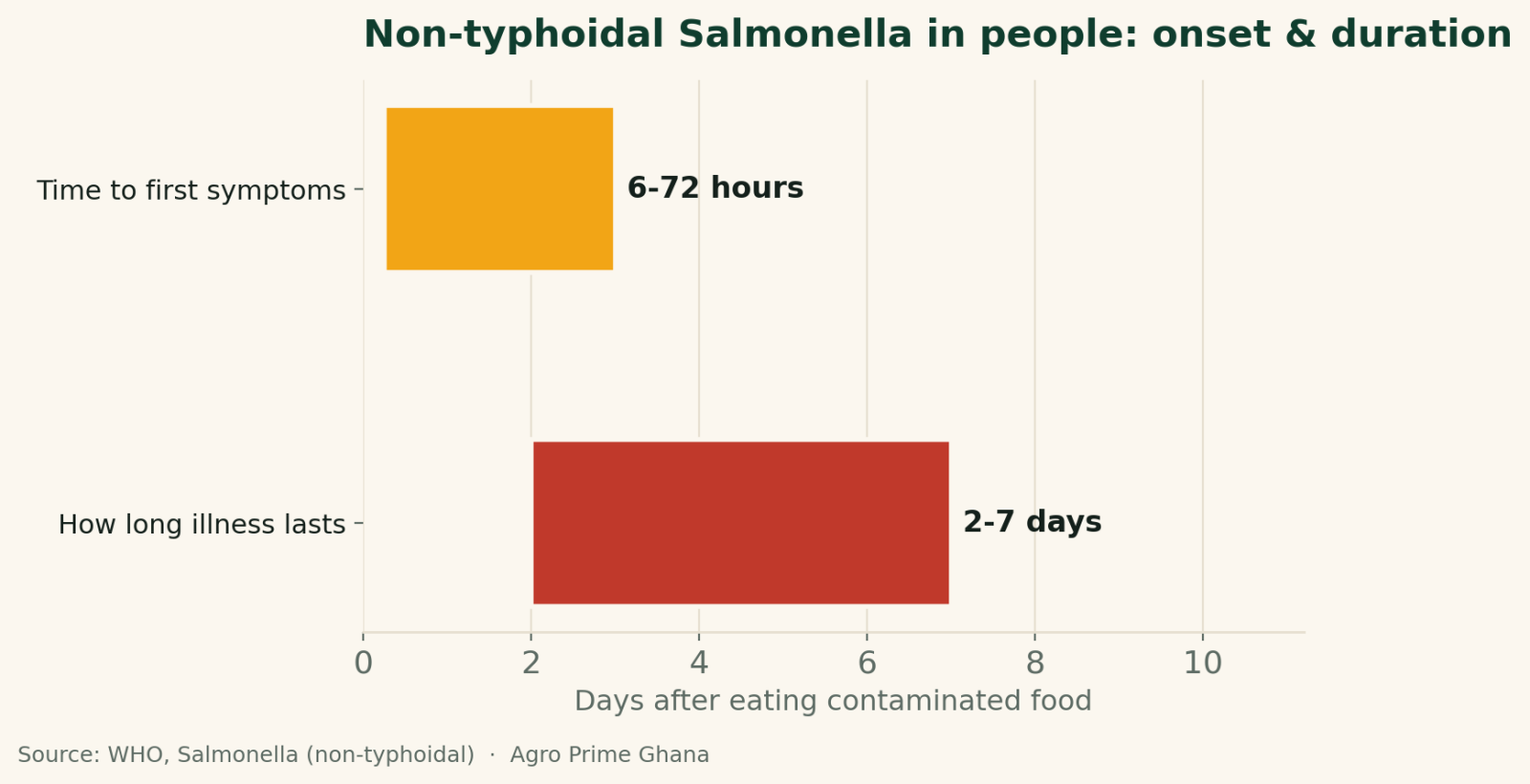
Non-typhoidal Salmonella (the "paratyphoid" group, chiefly Salmonella Enteritidis and Salmonella Typhimurium) is mainly a food-safety threat: adult birds usually carry it with no signs at all, while shedding it into eggs, meat and the environment. It kills young chicks — deaths are mostly in the first weeks after hatch — but the real cost is human illness. Globally, unsafe food causes about 550 million illnesses a year, and Salmonella is one of the four leading causes of diarrhoeal disease. It spreads into the egg from infected breeders and through droppings, feed, rodents, flies and dirty equipment. There is no reliable "cure" — antibiotics do not clear a carrier flock — so control is entirely about biosecurity, rodent control, clean chicks and feed, hygiene, and (for layers/breeders) vaccination. In people, illness starts 6–72 hours after eating contaminated food and lasts 2–7 days.
What non-typhoidal Salmonella actually is
Salmonella is a large family of bacteria, and it helps to separate two groups. One is host-adapted and causes serious disease in the birds themselves — Salmonella Pullorum (pullorum disease) and Salmonella Gallinarum (fowl typhoid). The other, much larger group is the non-typhoidal or paratyphoid salmonellae: according to the MSD Veterinary Manual there are more than 2,500 of these non–host-adapted serovars, and they can infect almost any animal. The two that matter most for poultry and public health are Salmonella Enteritidis and Salmonella Typhimurium, with others such as Kentucky and Heidelberg also showing up — the bacteria that make headlines when eggs or chicken are linked to food poisoning. The MSD Veterinary Manual is blunt about why we care: paratyphoid Salmonella "has public health importance because of contaminated poultry product consumption." In short, this is a disease of poultry that becomes a disease of people.
Why it is a food-safety issue, not just a bird disease
The hardest thing to accept about non-typhoidal Salmonella is that a carrier flock looks completely normal. The MSD Veterinary Manual notes that death in young birds "is most often limited to the first few weeks after hatch," while adult birds typically remain asymptomatic carriers — they grow, lay and behave like healthy chickens while shedding bacteria in their droppings and, for S. Enteritidis, into their eggs. That is the trap: no bloody dropping, no swollen head, no flock crash to warn you. The problem surfaces somewhere else — in a family that ate undercooked eggs, or a hotel tracing a food-poisoning complaint back to its egg supplier. The World Health Organization lists Salmonella among the four key global causes of diarrhoeal disease, and identifies eggs, poultry meat and other animal products as the main routes by which it reaches people; unsafe food overall causes around 550 million illnesses a year, including some 220 million in children under five. This reframes the whole issue: you are not just protecting your birds, but the safety of the food you sell — and your name on it.
How people get sick — and why cooking matters
When a person swallows enough Salmonella, illness follows fairly predictably. The WHO describes an "acute onset of fever, abdominal pain, diarrhoea, nausea and sometimes vomiting," with symptoms starting 6 to 72 hours after eating contaminated food (most often 12–36 hours) and lasting 2 to 7 days. For most healthy adults it is a miserable few days; for infants, the elderly and people already ill, it can be dangerous. The reassuring part is that Salmonella is killed by thorough cooking, which is why the WHO's "Five keys to safer food" — keep clean, separate raw and cooked, cook thoroughly, keep food at safe temperatures, use safe water — are the last line of defence. But no farm should rely on the customer's kitchen to fix a problem it created. Runny fried eggs and lightly cooked egg sauce are everyday realities in Ghanaian kitchens; the safest egg and bird is the one that never carried a heavy dose of Salmonella in the first place.
How Salmonella gets into a flock
Non-typhoidal Salmonella has two main ways into your birds, and both need closing. The first is vertical — from parent to chick. The MSD Veterinary Manual explains that faecal contamination of the eggshell is the main route from breeders to progeny, but that S. Enteritidis is also passed transovarially, getting inside the egg before the shell is even laid down. A chick can therefore hatch already infected — which is why the source of your day-old chicks matters so much: a hatchery with a Salmonella problem posts it to you in the box. The second route is horizontal — picked up from the environment after hatch. The culprits are familiar: infected birds shedding in droppings, contaminated feed, and above all rodents, wild birds and flies, which the MSD Veterinary Manual lists directly as sources. Contaminated water, dirty crates, shared egg trays, boots and vehicle tyres all carry the bacteria from place to place. Because carriers show no signs, Salmonella moves silently along every one of these paths.
Field note: the chicks and the feed store are where it starts
On the farm, the two questions we keep returning to with Salmonella are "where did these chicks come from?" and "what is living in the feed store?" Clean chicks from a reputable hatchery and a rodent-proof, well-managed feed store close off the two biggest doors at once. We treat the feed store the way we treat the brooder — swept, sealed, no spilled feed left overnight, no gaps a rat can use, and no bags sitting on a damp floor. It is unglamorous work, but every rat you keep out of the feed is a batch of chicks you keep clean.
What it does to your birds
Although the public-health angle dominates, non-typhoidal Salmonella does cause real disease in young stock. The MSD Veterinary Manual describes the hallmarks in young birds as lethargy, poor growth, weakness, diarrhoea and dehydration, with deaths concentrated in the first few weeks of life; in layers, S. Enteritidis can cause reduced feed intake and a dip in egg production. But the signs are not specific — they describe a dozen problems, from a chilled brooder to coccidiosis to simple bad management. That is precisely why Salmonella cannot be diagnosed by eye. The MSD Veterinary Manual is clear that diagnosis depends on isolating, identifying and serotyping the bacteria by laboratory culture, and that blood (serological) testing "is not highly reliable" for these infections. If you suspect Salmonella, the answer comes from a laboratory, not from looking at the birds.
| Where Salmonella lives / travels | Why it matters | What to do |
|---|---|---|
| Infected breeders & hatchery | Passes into or onto the egg; chicks hatch already infected | Buy from reputable hatcheries; ask about their Salmonella monitoring |
| Rodents (rats, mice) | Carry and shed Salmonella; contaminate feed and litter | Rodent-proof stores, baiting, remove harbourage and spilled feed |
| Feed & feed ingredients | Contaminated raw materials seed the flock | Clean sources; heat-treated/pelleted feed; dry, sealed storage |
| Wild birds & flies | Move bacteria between farms and into houses | Screen houses; fly control; keep feed and water covered |
| People, boots, crates, vehicles | Carry droppings between houses and farms | Footdips, dedicated boots, clean/disinfect equipment and crates |
| Contaminated eggshells | Faecal contamination reaches the consumer | Clean nests, collect often, keep eggs cool, dispose of floor/dirty eggs |
Control on the farm: biosecurity first
There is no antibiotic that clears Salmonella from a flock. The MSD Veterinary Manual states plainly that treatment with antimicrobials "is not recommended" — several drugs may reduce mortality in a sick batch, but they "cannot eliminate flock infection," and using them risks driving antibiotic resistance in bacteria that then infect people. Control, therefore, is prevention, built on the same biosecurity that protects against every other disease. Start with the chicks: source them from a reputable hatchery that takes Salmonella seriously, and inspect what arrives — our guides to choosing healthy day-old chicks and poultry biosecurity cover this in detail. Then close the horizontal doors: control rodents relentlessly, screen houses against wild birds, run fly control, and keep the feed store dry, sealed and free of spilled grain. Use footdips and dedicated boots between houses, keep visitors and shared equipment to a minimum, and clean, disinfect and rest houses between batches. If you mix feed on farm, buy sound, dry ingredients and store them well, as covered in our guide to making poultry feed. None of this is exotic — it is ordinary hygiene done consistently, which is exactly what Salmonella exploits when it is done carelessly.
Vaccination, competitive exclusion and testing
For breeders and commercial layers — birds that live a long time and whose eggs reach the public — extra tools are worth knowing about. The MSD Veterinary Manual lists vaccination (killed or live Salmonella vaccines, particularly against S. Enteritidis) as part of control programmes; vaccinated hens shed far less, lowering the chance of contaminated eggs. It also mentions competitive exclusion products — beneficial gut bacteria given to day-old chicks so "good" microbes colonise the gut first and crowd out Salmonella before it takes hold. In many countries, layer and breeder operations run routine monitoring, culturing droppings, dust or eggs to catch a problem early. Not all of this fits a small Ghanaian farm today, but the direction is clear: as buyers, hotels and export markets ask harder food-safety questions, farms that can show a clean, monitored, vaccinated status will have the advantage. Discuss vaccination and testing with your veterinarian, since the right programme depends on your flock type and market.
Field note: eggs are food from the moment they are laid
The simplest food-safety habit is to treat every egg as food, not just a product to stack. That means clean nest boxes with fresh litter so eggs are not laid in droppings, collecting often rather than leaving eggs in the house all day, handling them with clean hands, and keeping them cool rather than in a hot store. Cracked, dirty and floor-laid eggs are the highest-risk of all and should never go to a customer as table eggs. Cool, clean, promptly-collected eggs are not just better to sell — they carry a much lower Salmonella risk to the person who eats them.
The economics: why prevention pays
It is tempting to see Salmonella control as a cost with no visible return — you spend to prevent a disease your birds may never visibly show. But weigh it against what a real incident costs: a single traced food-poisoning outbreak can end a supply relationship with a hotel, school or wholesaler overnight, and word travels fast in a local market. Even without a public incident, the first-week chick deaths and poor early growth Salmonella causes quietly erode a batch's profit. Set against that, the cost of good biosecurity is small — and it is the same spending that protects against Newcastle, coccidiosis, fowl typhoid and much else. You are not buying Salmonella insurance alone; you are buying a healthier, more sellable flock, of which clean, safe eggs and meat are simply part.
The bottom line on Salmonella
Non-typhoidal Salmonella is the quietest disease on the farm and, in many ways, the most consequential. It rarely announces itself in the birds — adults carry it without a sign, chicks die of things that look like other problems — yet it travels from your flock into eggs and meat, and from there into the people who trust your food. There is no cure to fall back on, so everything rests on prevention: clean chicks, ruthless rodent and pest control, sound clean feed, honest hygiene, cool clean eggs, and, for long-lived layers and breeders, vaccination and monitoring. Treat food safety as part of the job rather than someone else's problem, and Salmonella stays where it belongs — out of your flock, and off your customers' plates.
Frequently asked questions
What is non-typhoidal Salmonella in poultry?
How do I know if my flock has Salmonella?
Can I treat Salmonella with antibiotics?
How does Salmonella get into eggs?
Is Salmonella dangerous to my family and customers?
How do rodents spread Salmonella on a poultry farm?
Should I vaccinate my layers against Salmonella?
How can a small farm reduce Salmonella risk cheaply?
Sources & further reading
- MSD Veterinary Manual — Paratyphoid Infections in Poultry (serovars, vertical/transovarial and horizontal transmission, signs in young birds, diagnosis by culture, control and why antibiotics are not recommended).
- MSD Veterinary Manual — Overview of Salmonelloses in Poultry (non–host-adapted serovars and public-health importance).
- World Health Organization — Salmonella (non-typhoidal) fact sheet (human symptoms, incubation, food sources, global burden, Five keys to safer food).
- Agro Prime Ghana guides: poultry biosecurity, choosing healthy day-old chicks, and how to make poultry feed.
About Agro Prime Ghana
Agro Prime Ghana Limited runs a poultry hatchery and mixed agribusiness in Kasoa, supplying day-old chicks and supporting poultry keepers across the country. These guides combine hands-on hatchery and farm experience with current veterinary and public-health references. This article is general educational information, not a substitute for professional veterinary or food-safety advice — if you suspect Salmonella in your flock or a food-safety problem in your products, consult a veterinarian and have samples tested. Need chicks, feed advice or farm support? Book a visit or message us on WhatsApp (+233 24 915 1503).