
Reserving day-old chicks in advance means placing your order — usually with a deposit — weeks before your planned start date, so the hatchery can set the right number of eggs and guarantee your chicks on the day you need them. In Ghana it is not a nicety but a practical necessity, because a chick takes about 21 days from egg to hatch: a hatchery cannot conjure a thousand day-old chicks on demand, and the popular breeds sell out fastest exactly when everyone wants them — before the festive season and the major planting-and-rearing peaks. Book ahead and you lock in your date, your breed and often a better price; leave it to the last minute and you risk empty brooders, a scramble for whatever is available, or paying more on the open market. This guide explains why pre-ordering works, how lead times and deposits are set, and how to plan a reservation that keeps your operation running on schedule.
Written by the Agro Prime Ghana hatchery team and reviewed against current industry references (Aviagen hatchery guidelines and USDA/FAO Ghana poultry data). Last updated September 2026.
Key takeaways
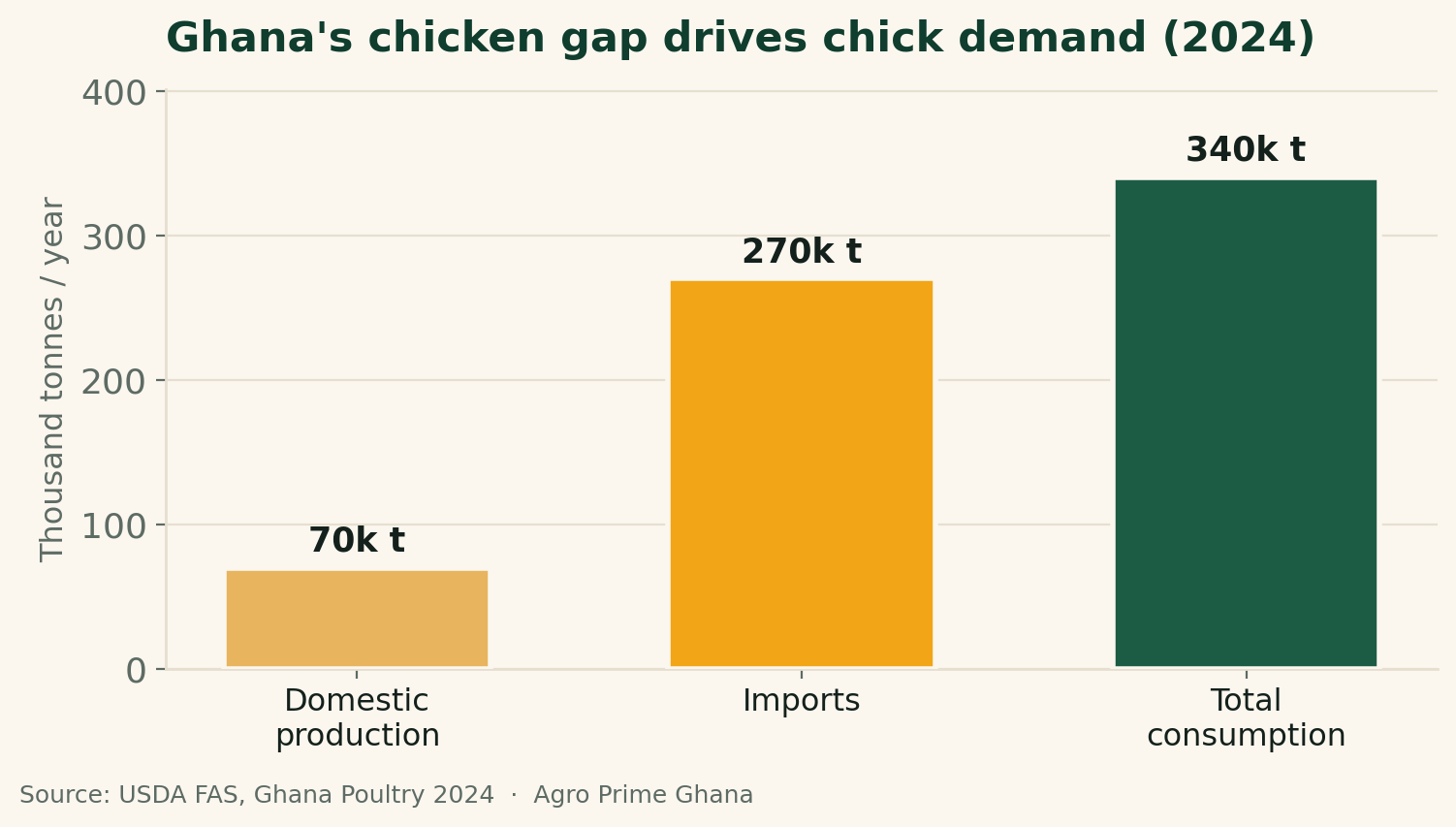
Reserving chicks means ordering ahead, usually with a deposit, so the hatchery can plan its egg sets around your date. It matters because incubation takes about 21 days, so chicks cannot be produced instantly, and because demand in Ghana far outstrips local supply — domestic chicken production was around 70,000 tonnes in 2024 against consumption of roughly 340,000 tonnes, with broiler self-sufficiency under 5%. Booking ahead secures your breed, quantity and hatch date, protects you from festive-season stockouts, and lets the hatchery grade and vaccinate for your flock rather than selling you leftovers. Sensible lead times are roughly 2–6 weeks for ordinary orders and longer before Christmas and Easter. Deposits are normal and reasonable; treat them as a commitment on both sides, and confirm exactly what your reservation covers.
What reserving chicks in advance actually means
Reserving — or pre-ordering — day-old chicks means committing to a specific breed, quantity and hatch date ahead of time, rather than turning up and buying whatever happens to be available. In practice you contact the hatchery, agree the breed (broiler, layer, or a dual-purpose bird such as a local improved type), the number of chicks, and the week you want them, and you usually secure the booking with a deposit. The hatchery then works backwards from your date: because it takes roughly 21 days to incubate and hatch a chick, your order tells them how many fertile eggs to set, and when. Your reservation effectively buys you a place in a specific hatch.
This is fundamentally different from spot-buying. A hatchery is not a shop with a warehouse of chicks on a shelf; it is a production line running on a three-week biological cycle. Every box of chicks dispatched on a given day was planned three weeks earlier when the eggs went into the setter. If you order today for delivery next week, you are relying on someone else having already set those eggs — and hoping they have not all been spoken for. Reserving in advance removes that dependence on luck and puts your batch into the plan. For a wider view of the market you are buying into, see our guide to where to buy day-old chicks in Ghana.
Why booking ahead matters so much in Ghana
Ghana's poultry market is defined by a large, persistent gap between how many birds the country needs and how many it produces — which is exactly why chick supply tightens so easily. Domestic chicken-meat production was estimated at about 70,000 metric tonnes in 2024, while consumption ran near 340,000 tonnes, according to the USDA Foreign Agricultural Service; broiler self-sufficiency sits below 5%, with the shortfall covered by imported chicken. That demand pressure runs all the way back down the chain to day-old chicks: when many farmers decide to rear at the same time, hatchery capacity for the popular breeds is quickly booked out.
The pressure is sharpest around the festive season. Demand for live and dressed birds rises steeply in the run-up to Christmas, and to a lesser extent Easter, which pulls broiler production forward: because a broiler needs roughly six to eight weeks to reach market weight, the chicks for the Christmas market must go into brooders in October and early November — so the hatchery orders that fill those weeks are placed even earlier. A farmer who waits until December to look for chicks has missed the market entirely. The same logic applies to layers, where a pullet takes months to reach point of lay, so egg producers must plan chick intake far ahead to have hens laying when they need eggs. Booking ahead is simply how you align a slow biological process with a market that peaks on the calendar. Our guide to selling live birds for the festive season works through that timing in detail.
Lead times: how far ahead should you reserve?
The right lead time depends on the breed, the quantity and the season, but the table below gives realistic planning ranges for Ghana. Treat them as a guide and always confirm with your hatchery, since capacity varies.
| Situation | Suggested lead time before placement | Why |
|---|---|---|
| Ordinary order, common breed, off-peak | ~2–4 weeks | Covers at least one full 21-day hatch cycle plus grading and dispatch |
| Large order or specific breed/sex | ~4–6 weeks | Lets the hatchery set enough eggs and hold your quantity |
| Broilers for the Christmas market | Book by Sept–Oct for Oct–Nov placement | Birds need ~6–8 weeks to finish; peak demand books out capacity |
| Layers / point-of-lay planning | Months ahead | Pullets take ~18–20 weeks to reach point of lay |
How deposits and reservations work
A deposit is the normal, reasonable way a chick reservation is secured, and it protects both sides. For you, it locks in your breed, quantity and hatch date so the hatchery cannot simply sell your chicks to a walk-in buyer. For the hatchery, it confirms that the eggs it is about to set — at real cost, three weeks before any money comes in at dispatch — are backed by a genuine order, not a casual enquiry that may evaporate. That mutual commitment is what makes advance planning possible: a hatchery can only reserve capacity for buyers who have reserved it in return.
There is no single national rule for deposit size or terms, so the sensible approach is to ask clearly and get the arrangement in writing, even a simple WhatsApp message. Confirm: the exact breed and sex, the number of chicks, the agreed hatch or delivery week, the total price and how much of it the deposit represents, what happens if a hatch under-performs (reputable hatcheries will offer the next hatch, an adjusted quantity or a refund of the deposit rather than a substandard bird), and whether the deposit is refundable if you cancel. A trustworthy hatchery will be comfortable spelling all of this out. Vague terms, pressure to pay in full for a distant date, or reluctance to put anything in writing are all reasons to be cautious.
Reserve your batch with us — and we'll plan the hatch around your date
At Agro Prime Ghana we hatch broiler and layer chicks in Kasoa on a rolling schedule, and reserving ahead is the surest way to get the breed and quantity you want on the week you need them. Tell us your placement date, breed and numbers, secure the batch with a deposit, and we will set the eggs and grade and vaccinate the chicks for your order — not sell you whatever is left over. Planning for Christmas broilers or a new layer flock? The earlier we talk, the better we can line it up. Message us on WhatsApp (+233 24 915 1503) or book a visit to reserve your chicks and lock in your date.
What reserving protects you from
The value of a reservation shows up most clearly in what it prevents. The first and biggest risk it removes is the stockout: arriving to buy chicks and finding the breed you want is sold out for weeks, which leaves brooders empty, staff idle and your production schedule — and cash flow — stalled. The second is being pushed into a substitute you did not plan for: taking a different breed or an unsexed batch simply because it is what is available, then discovering it does not suit your market or your feeding plan. The third is price exposure: chick prices tend to firm up when demand is highest and supply is tightest, so the last-minute buyer often pays more, while a reservation typically fixes your price when you book. And the fourth, more subtle, is quality: when you order ahead, a good hatchery can grade and vaccinate specifically for your batch, whereas a rushed spot-purchase is more likely to be leftovers. Reserving turns chick supply from something you hope goes your way into something you have arranged.
Field note: the farmers who never run out are the ones who plan a batch ahead
Across the keepers we supply, there is a clear pattern. The ones whose brooders are never empty are not lucky — they are always thinking one batch ahead. Before their current flock is even halfway to market, they have already told us the breed, number and week for the next intake, and secured it. The keepers who struggle are usually the ones who only start looking for chicks when the present birds are sold, then find the breed they wanted is booked out and lose a fortnight of empty housing. A reservation is really just a habit of planning the next cycle while the current one is running — and that habit is what keeps a poultry business steady instead of stop-start.
How to plan a reservation around your production cycle
A good reservation starts from your market date and works backwards, not from when you happen to feel ready to buy chicks. Decide first when you want to sell — a festive live-bird market, a steady egg supply to a contract, a batch to fill a particular gap — then subtract the growing time to find your placement date, and add the hatchery lead time on top of that to find your booking date. For broilers, count back roughly six to eight weeks from your sale date to your placement date; for layers, remember pullets reach point of lay at around 18–20 weeks, so the chicks must go in well over four months before you need eggs.
Then plan the practical side around that placement date: your brooder must be cleaned, disinfected and warmed and your feed and water arranged before the chicks arrive, exactly as covered in our brooding guide. Keepers running continuously often reserve staggered batches — booking the next intake before the current birds are sold — so housing never sits empty and income is steady rather than lumpy. If you are still deciding what to rear, our comparison of broiler versus layer profitability and our poultry business plan guide can help you fix the breed and numbers before you book. The discipline is simple: know your market date, count backwards, reserve early, and prepare the brooder in good time.
The bottom line on reserving chicks
Reserving day-old chicks in advance is how a poultry keeper turns an unpredictable supply into a dependable schedule. Because a chick takes about three weeks to hatch and Ghana's demand routinely outruns local supply, the popular breeds book out fastest exactly when you most want them — before Christmas, before Easter, whenever many farmers rear at once. A reservation, secured with a reasonable deposit and clear terms, locks in your breed, quantity, date and price, lets the hatchery grade and vaccinate for your batch, and shields you from stockouts, forced substitutes and last-minute price rises. Plan from your market date backwards, book early, keep a batch always in the pipeline, and prepare the brooder before the chicks land. Do that, and empty housing and missed markets stop being risks you carry — they become problems other, less-organised keepers have.
Frequently asked questions
Why do I need to reserve day-old chicks in advance?
How far ahead should I book my chicks?
Do I have to pay a deposit to reserve chicks?
What happens if the hatch under-performs and there aren't enough chicks?
When should I reserve broilers for the Christmas market?
Can I reserve a specific breed and sex, like layer pullets or broiler cockerels?
Is reserving chicks more expensive than buying on the spot?
How do I plan a reservation around my farm's cycle?
Sources & further reading
- USDA Foreign Agricultural Service — Ghana poultry sector reports (domestic production ~70,000 t, consumption ~340,000 t, broiler self-sufficiency under 5%).
- Aviagen — Transporting chicks with diligence and care (day-old chick biology and the yolk-reserve window behind delivery timing).
- Agro Prime Ghana guides: where to buy day-old chicks, selling live birds for the festive season, broiler vs. layer profit, poultry business plan, and how to brood day-old chicks.
About Agro Prime Ghana
Agro Prime Ghana Limited runs a poultry hatchery and mixed agribusiness in Kasoa, hatching day-old chicks on a rolling schedule and supporting poultry keepers across the country. We supply healthy day-old chicks (broilers and layers), point-of-lay pullets, quality feed and hands-on farm support, and we plan hatches around reserved orders so you get the breed and quantity you need on the day you need them. This article is general educational information, not a substitute for professional veterinary or agronomic advice. Ready to start or expand? Book a visit or message us on WhatsApp (+233 24 915 1503) to reserve chicks, feed or advice.