Most poultry keepers treat manure as a problem to get rid of — a smell, a fly nuisance, a heap behind the house that neighbours complain about. That is a mistake, because sitting in that heap is one of the richest fertilisers a Ghanaian farmer can lay hands on, and a second income stream if you handle it well. Raw poultry droppings are too "hot" and too risky to use straight — they can scorch crops, carry disease and stink out a compound. But composted properly, that same manure becomes a stable, safe, nutrient-dense soil food that maize, vegetable and tree-crop growers will pay for. This guide explains how to turn poultry manure into quality compost under Ghanaian conditions: the method, the numbers that make it work, the safety, and the real value of what you are producing.
Written by the Agro Prime Ghana agronomy team and reviewed against current references (University of Nebraska–Lincoln and NC State Extension composting and poultry-litter guidance). Last updated September 2026.
Key takeaways
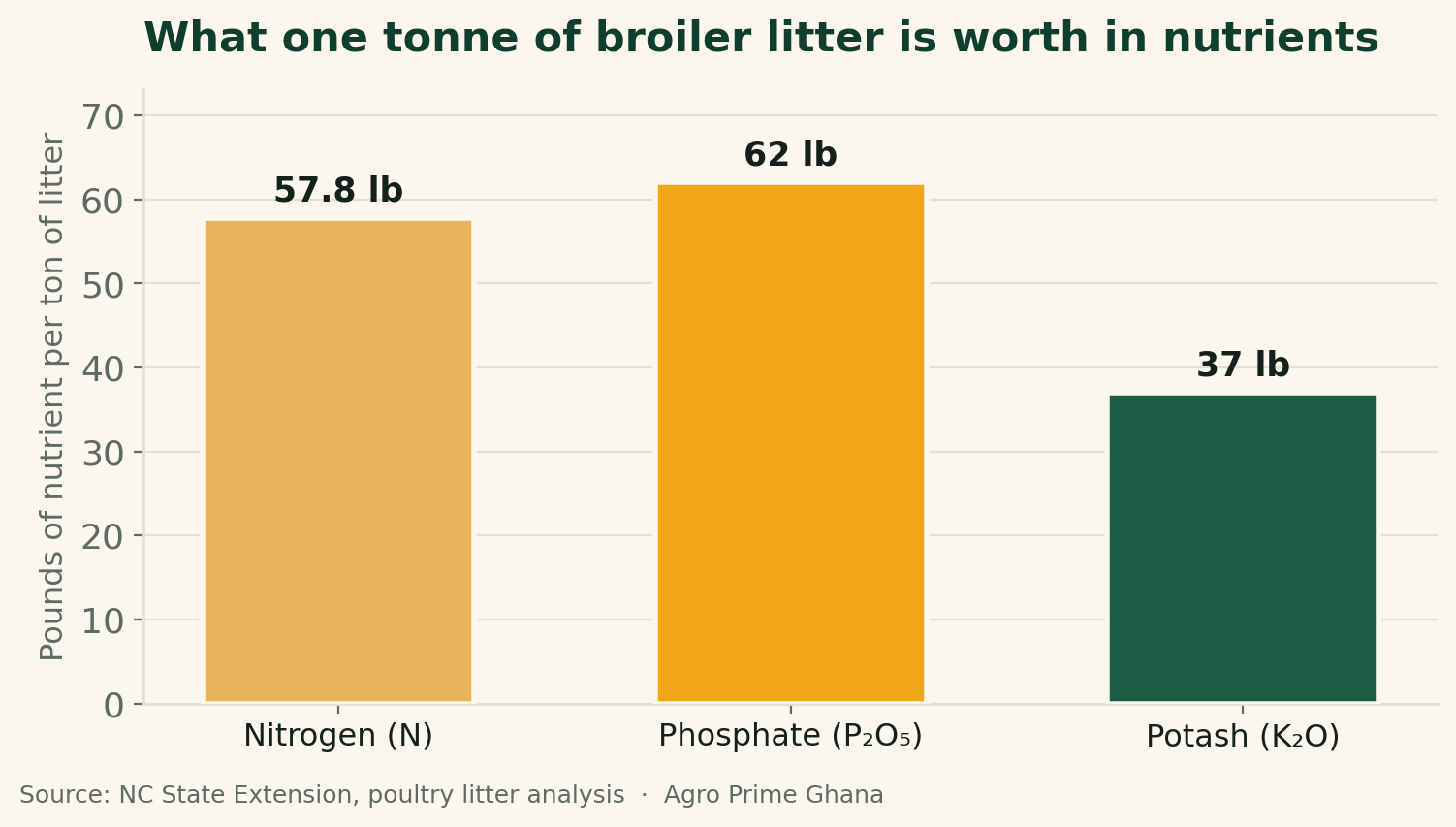
Poultry manure is high in nitrogen and phosphorus — broiler litter analyses run around 57 lb nitrogen, 62 lb phosphate and 37 lb potash per tonne — which makes it valuable but too strong and too risky to apply raw. Composting fixes both problems. The recipe is about ratios and heat: blend the manure with dry "brown" carbon material to reach a carbon-to-nitrogen ratio near 25–30:1, keep it moist like a wrung-out sponge (50–60% moisture), and let it heat. A working pile reaches 40–65°C; holding it above about 55°C for at least three days kills the pathogens and worm eggs, and above roughly 63°C destroys weed seeds. Turn it when it overheats or cools, and in Ghana's warm climate it finishes in roughly 2–3 months, when it is dark, crumbly, earthy-smelling and its C:N has dropped below 20. The result is a safe, storable fertiliser you can use or sell.
Why raw manure is wasted money — and a hazard
Fresh poultry droppings are deceptively concentrated. The nitrogen in them is largely in unstable forms that either burn plant roots if applied too heavily or escape into the air as ammonia — that sharp smell over a manure heap is literally your fertiliser value evaporating. NC State Extension figures for broiler litter come to roughly 57.8 lb of total nitrogen, 62 lb of phosphate (P₂O₅) and 37 lb of potash (K₂O) per tonne, at a moisture content under 30%. That is genuinely rich material — but only if you keep the nutrients in it and make it safe to use. Raw manure carries three problems that composting solves at once: it is chemically too hot, scorching seedlings and young roots; it is biologically risky, potentially carrying Salmonella, E. coli and parasite eggs you do not want on food crops or spreading back to your birds; and it is unstable and unpleasant — wet, smelly, fly-breeding and impossible to store or sell in that state. Composting turns a liability into an asset.
What composting actually does
Composting is controlled biological decomposition. You are not just letting manure rot — you are feeding a population of microbes the right diet, moisture and air so they work fast, get hot, and transform the raw material into stable humus. Those microbes need two things in balance: carbon for energy and nitrogen for protein. Poultry manure is very high in nitrogen and low in carbon — University of Nebraska–Lincoln Extension puts fresh chicken manure at a carbon-to-nitrogen ratio of only about 4:1 to 18:1, and broiler litter around 6:1 to 24:1 — far too nitrogen-rich to compost on its own, so left alone it just goes slimy, smelly and loses its nitrogen. The fix is to mix in dry, carbon-rich "brown" material to bring the blend to the sweet spot of about 25:1 to 30:1, the ratio Extension identifies as ideal for rapid composting. Get that balance right and the microbes multiply explosively, the pile heats up, and within days you have a thermophilic (heat-loving) process running at 40–65°C that cooks out pathogens and drives the material toward finished, stable compost with a C:N below 20.
The ingredients: greens, browns, water and air
Everything in good compost comes down to four inputs, and Ghanaian farms have all of them to hand. The "green" (nitrogen) component is your poultry manure and litter — the engine of the pile. The "brown" (carbon) component is dry plant material to balance it: dry maize stalks and cobs, rice straw or husks, groundnut haulms, dry grass, sawdust, dry leaves. If your birds are on deep litter, the wood shavings already mixed with the droppings supply some of this carbon, which is why litter composts more easily than pure droppings from a cage or slatted house. Water keeps the microbes alive — the target is a pile as damp as a wrung-out sponge, around 50–60% moisture, meaning you can squeeze a handful and feel it moist but get only a drop or two out. And air keeps the process aerobic and sweet-smelling rather than anaerobic and foul; you supply it by turning the pile and not letting it get waterlogged or compacted. The whole craft of composting is keeping these four in balance as the pile works.
| Parameter | Target for good compost | Why it matters |
|---|---|---|
| C:N ratio of the mix | About 25–30:1 | Balances microbe energy and protein; too much N is lost as smelly ammonia |
| Fresh chicken manure C:N | Only ~4–18:1 (too rich alone) | Why you must add dry "brown" carbon material |
| Moisture | 50–60% (wrung-out sponge) | Too dry stalls; too wet goes anaerobic and stinks |
| Working temperature | 40–65°C | Sign the pile is active and cooking out pathogens |
| Pathogen kill | ≥55°C for at least 3 days | Destroys Salmonella, E. coli and parasite eggs |
| Weed-seed kill | ~63°C in the pile | Stops the compost seeding weeds into your fields |
| Finished C:N | Below 20 | Stable, safe, won't rob soil nitrogen from crops |
Building the pile, step by step
The method is simple and needs no machinery. Choose a spot on well-drained ground, in partial shade, away from wells and living quarters and downwind of the house. Build a pile at least about a cubic metre in size (a metre or more each way); smaller than that and it struggles to hold the heat it needs. Layer as you build: start with a coarse "brown" base of stalks or husks for drainage and air, then alternate layers of manure/litter with dry carbon material, watering each layer to damp — not soaking — as you go. Aim by eye for roughly two to three parts "brown" to one part manure by volume; litter that already contains shavings needs less added carbon than raw droppings. Mix roughly rather than leaving neat stripes, cover the heap with a thin layer of soil, dry grass or a tarpaulin to hold moisture and shed heavy rain, and let it work. Within a day or two a well-built pile will be hot in the centre — you should feel real warmth pushing a stick into the core, and see faint steam on a cool morning. That heat is the process working exactly as it should.
Field note: reading the pile with your senses
You do not need a laboratory to run good compost — your hands and nose tell you most of what you need. We check three things. Heat: push a stick into the core, leave it a minute, and pull it out; it should come out hot to the touch in a healthy young pile. Smell: a working pile smells earthy and warm — sharp ammonia means too much manure and not enough dry carbon; sour and rotten means too wet and airless, and needs turning. Squeeze: a handful should feel like a wrung-out sponge — dusty and it needs watering, dripping and it needs dry material and turning. Those three checks, done every few days, keep a pile on track far better than any fixed schedule.
Turning, temperature and time
Turning is what keeps composting fast, even and safe. Each turn folds the cooler outer material into the hot core, re-supplies oxygen, evens out moisture, and re-fires the heat when the pile cools. The practical trigger is temperature: turn when the pile climbs too hot (Extension guidance flags turning as material approaches roughly 63°C / 145°F, both to protect the microbes and because that is the temperature that kills weed seeds) and again when it cools after a heat cycle — usually every one to two weeks in the active phase. Crucially, make sure the whole pile — not just the middle — has spent time in the hot zone, because that is what sanitises it: holding material above about 55°C (131°F) for at least three days is the standard for destroying pathogens and parasite eggs, and turning is how you move the outer material through that hot core. After several heat-and-turn cycles the pile stops reheating strongly; that is your signal it has moved from active composting into curing. In Ghana's warm climate the process is quick — Extension puts composting at roughly two to six months depending on temperature and management, and a well-run poultry pile here typically finishes toward the shorter end, around two to three months. Let it cure a few final weeks and it is done.
How to know when it is finished
Finished compost announces itself. It is dark brown to nearly black, crumbly and loose rather than slimy, and it no longer heats up after turning. The original ingredients are no longer recognisable — you should not see whole droppings or intact stalks. Most tellingly, it smells earthy and pleasant, with no trace of ammonia or rot. Chemically, its carbon-to-nitrogen ratio has fallen below about 20, which is why finished compost is "stable": applied to soil, it releases nutrients gently instead of burning crops or robbing the soil of nitrogen. A quick check if you are unsure is to seal a moist handful in a bag for a day or two and smell it — finished compost still smells earthy, while unfinished material turns sour or ammoniacal. Do not rush this stage: immature compost can tie up soil nitrogen and set plants back, undoing the whole point of the exercise.
The value: what your compost is really worth
This is where manure stops being waste and starts being business. Composted poultry manure is a genuine fertiliser, for two reasons. First, the nutrients: those broiler-litter figures of around 57 lb nitrogen, 62 lb phosphate and 37 lb potash per tonne translate into a balanced fertiliser once composted and stabilised — strong on the phosphorus that Ghanaian soils so often lack, and carrying calcium, magnesium and micronutrients that bagged N-P-K does not. Second, and just as important, is what mineral fertiliser cannot give: organic matter. Compost feeds the soil itself, improving structure, water-holding and biology — which matters enormously on the tired, low-organic-matter soils common across much of the country. For a poultry farmer this creates two clear wins: use it yourself on maize, vegetables or tree crops and cut your fertiliser bill, or sell it — bagged, stable, odour-free compost is a product vegetable growers, nurseries and tree-crop farmers actively want, turning a disposal cost into a revenue line. Either way, the manure that neighbours complained about becomes part of what makes the enterprise pay. For the litter-management side of the same coin, see our guide to poultry litter management.
Field note: compost is a second harvest from the same birds
We think of the manure heap the way we think of eggs or meat — as output the birds produce that we would be foolish to waste. The mindset shift is treating it as a product from day one: siting the composting area properly, capturing the litter cleanly at clean-out, and running the pile deliberately rather than letting it fester. Farmers who do this find the compost quietly pays for itself twice — by replacing bought fertiliser on their own plots, and by selling on to crop growers nearby. The birds already made the fertiliser; composting is simply the small extra step that lets you collect it.
Safety: protecting your crops, your customers and your flock
Composting done properly is a food-safety and biosecurity tool, not just a fertiliser process — but only if you respect the heat and the hygiene. The temperature targets matter because of disease: raw poultry manure can carry Salmonella, E. coli and parasite eggs, and the World Health Organization notes that produce contaminated by animal faeces is a recognised route for foodborne illness — which is exactly why treated (composted) rather than raw waste should go onto food crops. Reaching and holding the hot phase — above about 55°C for at least three days, spread across the whole pile by turning — is what sanitises the material. Beyond heat, apply common sense: site piles away from wells, streams and drinking water; keep the composting area away from your poultry houses so you are not cycling pathogens back to your birds; wash hands and tools after handling raw manure; and let compost fully mature before putting it on anything eaten raw. These habits sit naturally alongside the biosecurity you already practise for the flock — see our poultry biosecurity guide.
The bottom line on composting poultry manure
Poultry manure is not waste — it is a rich, phosphorus-heavy fertiliser trapped in an unstable, risky raw form, and composting is the cheap, low-tech step that unlocks it. The whole method comes down to balance and heat: blend the nitrogen-rich manure with dry carbon material to reach a C:N around 25–30:1, keep it as moist as a wrung-out sponge, build the pile big enough to heat, and turn it so the entire mass passes through a hot phase above about 55°C for at least three days. Do that and in a couple of Ghanaian months you have a dark, crumbly, earthy-smelling, disease-free fertiliser that improves your soil in ways no bag of N-P-K can, cuts your input bill, and can even be sold on. The birds hand you this second harvest every day; composting is simply the discipline of not throwing it away.
Frequently asked questions
Can I put fresh poultry manure straight onto my crops?
Why do I need to add dry material like straw or husks to the manure?
How hot should the compost pile get, and why does it matter?
How long does poultry manure take to compost in Ghana?
How do I know when the compost is ready to use?
Is composted poultry manure safe on vegetables?
What nutrients does poultry compost provide?
Can I sell composted poultry manure?
Sources & further reading
- University of Nebraska–Lincoln Extension — Composting Manure and Other Organic Materials (C:N ratios, moisture, temperatures for pathogen and weed-seed kill, composting duration).
- NC State Extension — Poultry Litter as a Fertilizer Source (nitrogen, phosphate and potash content of broiler litter; moisture; nutrient value).
- World Health Organization — Salmonella (non-typhoidal) fact sheet (manure contamination of produce; use treated faecal waste).
- Agro Prime Ghana guides: poultry litter management and poultry biosecurity.
About Agro Prime Ghana
Agro Prime Ghana Limited runs a poultry hatchery and mixed agribusiness in Kasoa, supplying day-old chicks and supporting poultry and crop farmers across the country. These guides combine hands-on hatchery, farm and soil experience with current agronomic references. This article is general educational information, not a substitute for professional agronomic advice tailored to your soils and crops. Need chicks, farm support or advice on turning your manure into fertiliser? Book a visit or message us on WhatsApp (+233 24 915 1503).