If you are choosing between point-of-lay pullets and day-old chicks in Ghana, the real question is how long you can wait for eggs and who carries the cost of rearing the birds. Day-old chicks cost less to buy but need roughly 20 weeks of feed, housing and care before the first egg. Point-of-lay (POL) pullets cost more per bird because someone has already reared them to around 16 to 18 weeks, and they usually start laying within a few weeks of arriving on your farm. Agro Prime Ghana runs a working hatchery in Kasoa and supplies both, so this guide sets out the trade-offs plainly, so you can choose the option that fits your farm.
The choice usually comes down to three things: cash flow now, whether a laying house is ready, and how much rearing experience you have on the farm. A buyer with money tied up for only a few weeks and a clean house waiting will often choose pullets. A buyer who wants to control every stage of the bird's life, and who can wait, will often choose chicks. Neither choice is wrong. The table below sets out each factor.
From the Agro Prime Ghana team — a working hatchery in Kasoa supplying day-old chicks, point-of-lay pullets and feed across Ghana. Last updated October 2026.
Quick answer
Choose point-of-lay pullets if you want eggs within a few weeks and already have a laying house ready. Choose day-old chicks if you want the lowest upfront cost, can rear birds for about 20 weeks, and want to manage them from the first day. Agro Prime Ghana sells both from its Kasoa hatchery. To order, message WhatsApp (+233 24 915 1503) with the number of birds, the breed you need and your town. We will confirm what is available and how delivery works. We do not publish prices in this article, because they change with breed, age, season and order size.
What you are really buying
A day-old chick is a bird one day out of the egg. You pay the hatchery for the bird, and then you carry the whole rearing period yourself: brooding, feeding, vaccination, housing, labour and the losses that come with raising young birds. Everything that happens to the flock in its first 16 to 20 weeks happens on your farm, under your management.
A point-of-lay pullet has already been through that period with someone else. Pullets are normally moved into the layer house at around 16 weeks. The Hendrix Genetics transfer guide gives 16 weeks as the ideal transfer age, says all hens should be housed by 119 days (about 17 weeks), and recommends the move about four weeks before egg production starts, and no later than two weeks before. So a pullet bought at point of lay is close to laying, but the exact timing depends on the breed and how the seller reared her. This is why we ask every buyer for the bird's age on the day of sale, not an estimate.
Time to first egg: the number that decides most farms
For most buyers the deciding factor is the wait. If you buy a day-old chick, you should expect the first eggs at about 20 weeks of age. If you buy a pullet at 16 weeks and she is housed on time, the wait is roughly four weeks. The gap is about sixteen weeks of feed, labour and housing that you either pay for yourself or avoid.
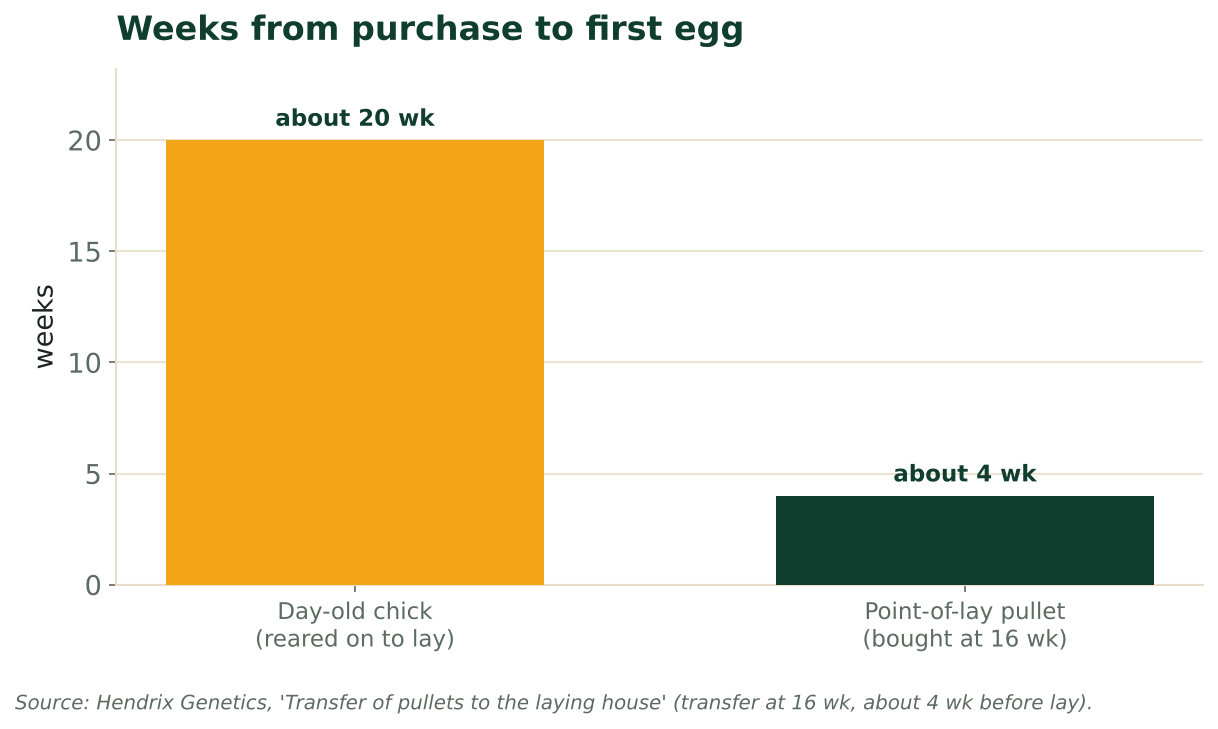
The chart is a simple calculation from the transfer timing in the Hendrix guide: a pullet transferred at 16 weeks and laying about four weeks later reaches first egg near 20 weeks. The chick bar is the same bird reared from hatch to first egg. Your actual timing depends on breed, weather, house conditions and how well the birds are fed through the grower stage.
Cost: the price tag is not the whole cost
Day-old chicks are cheaper at the point of purchase. Point-of-lay pullets are more expensive per bird, because the seller has already paid for 16 or more weeks of feed, housing, labour and vaccination. To compare fairly, you need the total cost to the first egg, not the price on the day of purchase.
Feed is the largest part of that rearing cost. A Ghanaian Times report on high feed costs, published in January 2026, quotes a poultry producer's estimate that feed makes up about 65 to 70 percent of total production cost. The wording in that report is imperfect, so treat the figure as a quoted estimate rather than a survey result. The point stands: when you buy chicks, you are taking on the feed bill for the whole rearing period. When you buy pullets, the seller carries most of it, and the price reflects that.
We did not find a dated, reliable published source for current chick or pullet prices in Kasoa, so we are not quoting one here. Prices depend on breed, age on the day, the time of year and the size of your order. Message us for a current quote and we will explain what is included.
Ready to compare for your farm?
Send us your target number of birds, the date you want them, and your town on WhatsApp (+233 24 915 1503). We will reply with what we can supply and a quote for both options so you can compare like with like. You can also book a visit to see the hatchery before you decide.
Risk on each side
Day-old chicks carry rearing risk from the first day. Brooder temperature, water, feed access and early hygiene all decide how well the flock starts. Losses in the first weeks are the most common complaint from new rearers. The advantage is control: you know how every bird was handled from the start. Our guide on how to brood day-old chicks covers the setup that protects that early period.
Point-of-lay pullets carry a different risk. The Hendrix guide notes that transfer stress can cause a weight drop of 10 to 15 percent through moisture loss, so the move itself needs care: clean transport, water and feed available on arrival, and a house that is ready before the birds land. You also depend on the seller's rearing record. Ask where the pullets were reared, what vaccinations the batch received, and when they were moved. A seller who can answer these questions quickly is usually a seller who knows the flock.
Decision table: which option fits your farm
| Factor | Day-old chicks | Point-of-lay pullets |
|---|---|---|
| Age on arrival | 1 day old | Around 16 to 18 weeks (ask for the exact age) |
| Time to first egg | About 20 weeks from hatch | A few weeks after arrival, depending on age at purchase |
| Upfront cost | Lower per bird | Higher per bird; message us for a quote |
| Feed and care before eggs | You pay for the whole rearing period | Most rearing is already done; you still need layer feed |
| Rearing risk | Yours, from day one | Shared; depends on the seller's rearing record |
| Housing needed | Brooder first, then a laying house | A laying house ready before arrival |
| Best for | Farmers who can wait, want to learn rearing, or want to control every stage | Farmers who need eggs sooner and have a clean house ready |
| Ask us before you pay | Breed, vaccination plan, brooding support | Exact age, transfer date, breed, vaccination record |
How to order from Agro Prime Ghana
- Message us on WhatsApp. Send +233 24 915 1503 with the product you want (day-old chicks or point-of-lay pullets), the number of birds, the breed if you know it, your town and the date you need them.
- We confirm what we can supply. We check what is available in the batch you need, and we tell you the age of the birds on the day they would leave the hatchery.
- We send a quote. The quote covers the birds and any delivery or transport we arrange. Ask for anything you do not understand before you pay.
- Prepare the house. Have brooding or laying housing, feeders, drinkers and feed ready before the birds arrive. For pullets, aim to have the house ready at least two weeks before the birds come.
If you would rather see the birds first, book a visit to the Kasoa hatchery.
Delivery and transport
Agro Prime Ghana arranges transport of day-old chicks and point-of-lay pullets from our Kasoa hatchery to customers across Ghana. Delivery cost and timing depend on your town and the order, so we confirm them when you message us, before you pay. For pullets, the journey matters more: stress and moisture loss during transport are why we recommend a ready house and prompt arrival. Tell us your town early so we can plan the route.
Bottom line
Pullets buy you time. Chicks buy you lower upfront cost and full control, at the price of about 20 weeks of rearing. Work out how many weeks you can afford to wait, how much feed and housing you can fund in that period, and whether you have the rearing experience to handle the first weeks. If you need eggs soon and have a clean house ready, pullets are usually the better fit. If you can wait and want to manage the flock from the start, chicks are the right choice. Either way, ask the seller for the age, breed and vaccination record before you pay.
Get a quote on both options
Message WhatsApp (+233 24 915 1503) with your number of birds, breed and town, and we will reply with a quote and the age of the birds on the day. Prefer to visit first? Book a visit to the Kasoa hatchery.
Frequently asked questions
Which is cheaper, point-of-lay pullets or day-old chicks?
How long after buying pullets will they lay?
How long do day-old chicks take to start laying?
Are your birds vaccinated?
Can I buy a small number of pullets?
Do you deliver pullets outside Kasoa?
What happens if some birds die in transit?
What should I have ready before pullets arrive?
Sources
- Hendrix Genetics, “Transfer of pullets to the laying house”: layinghens.hendrix-genetics.com
- Ghanaian Times, report on high feed costs and local poultry prices, January 2026: ghanaiantimes.com.gh
Order from Agro Prime Ghana
Agro Prime Ghana Limited runs a poultry hatchery in Kasoa and supplies healthy day-old chicks (broilers & layers), point-of-lay pullets, quality feed and hands-on advice to farmers across Ghana, with delivery arranged to your area. Message us on WhatsApp (+233 24 915 1503) for a current quote and to order, or book a visit. You can also see our partner and investment options if you are planning a larger operation.