Pineapple is one of Ghana's great agricultural success stories and one of its clearest export opportunities. Sweet, sought-after at home and abroad, and grown well in the country's southern belt, pineapple has earned Ghana real standing in fresh-fruit and juice markets — especially with the prized MD2 and sugarloaf varieties. But pineapple is also a serious, patient, standards-driven crop: it takes over a year to fruit, demands the right planting material and careful management, and — for the export prize — must meet strict quality and certification standards. This guide covers how to grow pineapple successfully in Ghana and how to reach its most rewarding markets.
Key takeaways
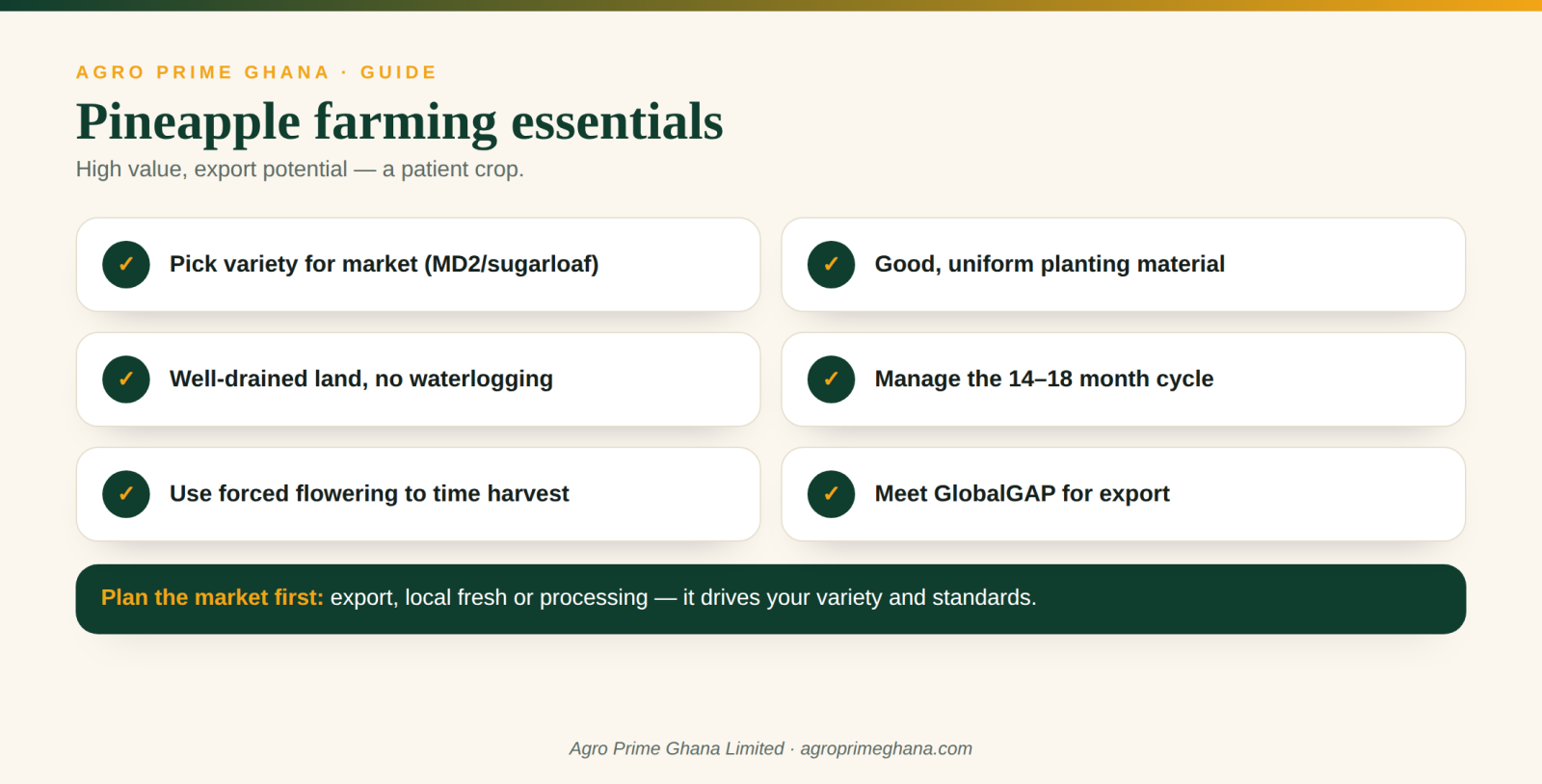
Pineapple is a high-value crop with strong local and export demand, led by MD2 and sugarloaf varieties. It is a long, patient crop (well over a year to harvest), grown from suckers/planting material, and often has its flowering deliberately triggered to time the harvest. The big prize is export and processing (juice, dried fruit), which requires meeting quality and certification standards like GlobalGAP. Choose the right variety for your market, secure good planting material, manage the long cycle well, and plan your market — especially if aiming for export.
Why pineapple is a standout opportunity
Pineapple combines several strengths that make it one of Ghana's most attractive commercial crops. It has strong demand at home and abroad: Ghanaians love fresh pineapple and its juice, and the fruit is a genuine export earner, with Ghana holding a real reputation in regional and international fresh-pineapple and juice markets. It is high-value, particularly the sweet premium varieties that fetch good prices. And it supports a value chain beyond fresh fruit — processing into juice, concentrate and dried pineapple adds value and absorbs fruit that does not make the fresh-export grade. Ghana's southern coastal and forest-transition belt suits pineapple well, and the crop has a track record of lifting farmers and earning foreign exchange. The flip side is that pineapple is a demanding, long-cycle crop, and its best markets — export especially — come with real standards. It is a crop for the committed, patient farmer who will grow to a quality specification, and it rewards that commitment well.
Varieties: MD2, sugarloaf and smooth cayenne
Variety choice is strategic in pineapple because different varieties serve different markets. The globally dominant fresh-export variety is MD2 ("Golden") — very sweet, attractive, with good shelf life and travel qualities — and it is the benchmark for international fresh markets. Sugarloaf is a soft, exceptionally sweet variety much loved in local and regional West African markets. Smooth cayenne is a classic variety well-suited to juice and processing. Choose your variety to match your target market: MD2 if you are aiming at fresh export and its standards; sugarloaf for the strong local and regional fresh demand; a processing-suited variety if you are supplying juice makers. This decision shapes everything downstream — your planting material, management, standards and buyers — so decide your market and matching variety before you plant.
Planting material and establishing the crop
Pineapple is grown not from seed but from vegetative planting material — suckers, slips or crowns taken from existing plants — so securing enough good, healthy, uniform planting material of your chosen variety is a key early step and can itself be a constraint when scaling up. Plant healthy material of even size (uniform planting gives a more uniform harvest) on well-prepared, well-drained land at the recommended density, keeping the field clean. Pineapple tolerates relatively poor soils but needs good drainage and dislikes waterlogging. Because pineapple sits in the ground a long time, good land preparation, spacing and weed control at establishment pay off across the whole long cycle. Sourcing quality planting material and establishing a clean, uniform, well-drained field sets up everything that follows.
The long cycle and forced flowering
A defining feature of pineapple is its long growing cycle: the crop takes well over a year — commonly around 14 to 18 months or more depending on variety and management — from planting to harvest. This demands patience and steady management (weeding, feeding, crop care) across many months before any income arrives, and it means good planning and enough working capital to carry the crop. A distinctive practice in commercial pineapple is forced (induced) flowering: growers deliberately trigger the plants to flower at a chosen time (using recognised flower-induction methods) so that the crop flowers and then fruits together and matures on a planned schedule. This is powerful because it lets you produce uniform fruit and, crucially, time your harvest to hit a target market window — a specific export shipment, a price period, or a processor's schedule. Managing the long cycle well and using flower induction to time and synchronise the harvest are central skills in commercial pineapple growing, turning a long, patient crop into a planned, marketable one.
The export prize and quality standards
Here is where pineapple's biggest reward and biggest demand meet: export and processing markets, and the standards they require. Fresh export — especially MD2 to international markets — is the high-value prize, but it comes with strict requirements: buyers demand consistent fruit size, sweetness, appearance and quality, and typically require certification such as GlobalGAP and adherence to food-safety and traceability standards. Meeting these standards — through good agricultural practices, record-keeping, proper handling and certification — is the gateway to export prices and reliable international buyers, and it is a real discipline that separates export-capable farms from those selling only locally. For farmers not aiming at fresh export, the processing route (juice, concentrate, dried pineapple) is a strong market that absorbs large volumes and fruit outside fresh-export grade, and generally has less stringent appearance requirements. The strategic point is to decide early which market you are for — certified fresh export, local and regional fresh, or processing — because that decision drives your variety, your standards, your management and your buyer relationships. Planning the market, and meeting its standards, is as important as growing the fruit.
Harvest, handling and the economics
Pineapple must be harvested at the right maturity for its market — fruit for distant export is picked at a stage that will arrive in prime condition, while fruit for local sale or processing is picked riper — and handled carefully, as bruised or damaged fruit is downgraded or rejected, especially for export. Good post-harvest handling, grading and cool, careful transport protect the value built up over the long growing cycle. On economics, pineapple is a longer-term, higher-investment crop: costs include planting material, land preparation, fertiliser and crop care across many months, flower induction, harvesting and handling, and — for export — certification and compliance. Because income only comes after a year or more, it requires patience and working capital. Against that, pineapple's high value, strong local, regional and export demand, and processing outlets can make it very rewarding, and its multiple markets give flexibility. The key economic disciplines are planning for the long cash-flow gap, matching variety and standards to a chosen market, and building the quality and (for export) certification that unlock the best prices. Grown to standard for the right market, pineapple is one of Ghana's premier commercial crops.
Common mistakes to avoid
- Not planning the market first, growing a variety that does not match export, local or processing demand.
- Underestimating the long cycle, running short of capital before the year-plus crop pays.
- Poor or uneven planting material, giving an uneven, hard-to-market harvest.
- Ignoring export standards (like GlobalGAP) while hoping to sell into export markets.
- Waterlogged or poorly drained land, which pineapple dislikes.
- Rough handling at harvest, bruising fruit and losing export or fresh grade.
Frequently asked questions
Is pineapple farming profitable in Ghana?
Which pineapple variety should I grow?
How long does pineapple take to harvest?
What is forced flowering in pineapple?
What do I need to export pineapple?
Where does pineapple grow best in Ghana?
Can I make money from pineapple without exporting?
How do I get pineapple planting material?
The bottom line on pineapple farming
Pineapple is one of Ghana's premier commercial crops and one of its clearest paths from farming into export and value chains. It offers strong demand at home, across the region and internationally, high value in its premium sweet varieties, and multiple markets from fresh fruit to juice and dried product. But it is a serious, patient, standards-driven crop. Success starts with a strategic decision — which market you are growing for — and the matching variety, whether MD2 for certified fresh export, sugarloaf for local and regional fresh demand, or a processing type for juice. From there it demands good, healthy planting material, careful management of a long cycle well over a year, the skilful use of forced flowering to time and synchronise the harvest, and — for the export prize — meeting quality and certification standards like GlobalGAP. Manage the long cash-flow gap, grow to your market's specification, and handle the fruit with care, and pineapple rewards the committed farmer as few crops can, turning Ghana's natural suitability for this fruit into real income and export earnings.
Grow toward high-value and export markets
Agro Prime Ghana Limited runs a hatchery and agribusiness in Kasoa. High-value, export-capable crops like pineapple can transform farm income for the committed grower. Talk to us about building a resilient, ambitious farm: book a visit or message WhatsApp (+233 24 915 1503).