Adding oil or fat to poultry feed is the most concentrated way to raise a ration's energy: fats and oils carry roughly 8,000–9,200 kcal of metabolisable energy per kilogram — about 2.25 times more than starch or carbohydrate — so a small amount lifts energy density sharply. In Ghana, where locally available palm oil, palm kernel oil and vegetable oils are common, a modest fat addition helps broilers hit their energy targets, cuts feed dust, improves pellet quality and even eases heat stress. But there are limits: too much fat wrecks pellet durability and mixing, young chicks digest saturated fats poorly, and fat that turns rancid destroys vitamins and can harm birds. This guide explains how much fat to add, which types to use, and how to keep it fresh under Ghanaian conditions.
Written by the Agro Prime Ghana poultry team and reviewed against current industry references (poultry nutrition feed-energy tables and peer-reviewed reviews on dietary fats). Last updated September 2026.
Key takeaways
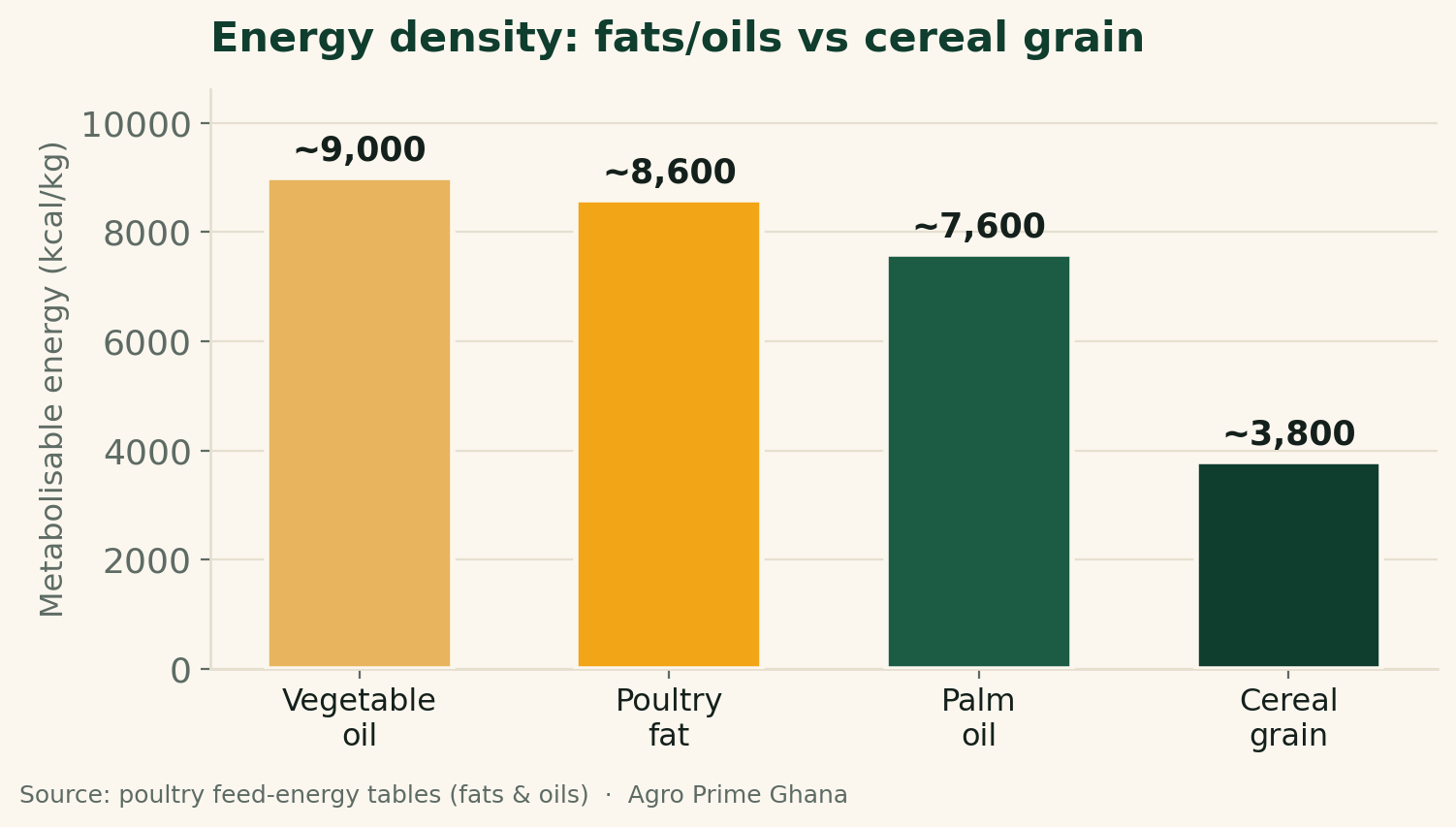
Added fats and oils are pure energy for poultry — about 8,000–9,200 kcal/kg for vegetable oils, versus roughly 3,500–4,000 for cereals — so they raise energy density fast and let you formulate high-energy broiler diets. Practical inclusion is about 3–4% mixed into the feed, plus up to 2–3% sprayed onto pellets (so up to ~6–7% total), with a minimum of ~1% for essential linoleic acid and palatability. Mixing unsaturated and saturated fats gives an "extra-caloric" boost of about 5% above the expected energy. Young chicks digest saturated fats poorly, so favour unsaturated oils early. The big management risk is rancidity — always use fresh fat protected with an antioxidant, and never feed oxidised oil.
Why add fat to poultry feed at all
Fat is added to poultry feed for one main reason: energy. Growth, egg production and body maintenance are all driven by dietary energy, and fats are by far the most energy-dense feed ingredient available. Weight for weight, fat supplies roughly 2.25 times the metabolisable energy of carbohydrate, so adding a few percent of oil lifts the energy of a ration in a way that grains alone cannot match without bulking the feed. This matters most for broilers, which are bred for fast growth and need energy-dense diets to reach market weight efficiently — a well-fatted finisher ration supports better daily gain and feed conversion. Beyond raw energy, fat brings practical bonuses: it reduces dust in mash feeds (better for birds' respiratory health and less feed waste), improves palatability, carries fat-soluble vitamins, supplies the essential fatty acid linoleic acid, and acts as a lubricant that improves pellet quality and mill throughput. For where fat sits among all the components of a ration, see our guide to poultry feed ingredients in Ghana.
How much energy fat really provides
The energy value of fat is high but varies by source and by the age of the bird eating it. Published feed-energy tables put the metabolisable energy of common fats in the range of 7,000 to 9,200 kcal/kg: vegetable oils are highest at about 8,800–9,200 kcal/kg, fish oil and poultry fat around 8,600–9,000, and more saturated fats like tallow and palm oil lower at roughly 7,200–8,000 kcal/kg. There is also a clever bonus. When you blend an unsaturated oil with a saturated fat, the mixture is digested better than either alone — the unsaturated fatty acids help the bird absorb the saturated ones. This "extra-caloric" or synergistic effect means, for example, that a 50:50 mix of unsaturated and saturated fat can deliver about 5% more energy than the calculated average. The catch is age: young birds under about three weeks digest saturated fats poorly, and the digestibility of palmitic acid (a major saturated fatty acid) rises from around 50% to 85% between 14 and 56 days of age. So the same fat is worth more energy to an older bird than to a young chick.
Which fat or oil should you use in Ghana?
The best fat depends on availability, price, the birds' age and how the feed is presented (mash or pellet). In Ghana, vegetable oils, palm oil and palm kernel oil are the realistic options for most farmers, and each has a place. The table below compares the common choices on energy and practical behaviour, based on poultry feed-energy data.
| Fat / oil | ME (approx. kcal/kg) | Fatty-acid character | Practical notes |
|---|---|---|---|
| Vegetable oil (e.g. soy) | 8,800–9,200 | Highly unsaturated (high linoleic) | Best for young chicks; well digested; supplies linoleic acid |
| Fish oil | 8,600–9,000 | Unsaturated, omega-3 rich | High energy but can taint egg/meat flavour if overused |
| Poultry fat | 8,200–9,000 | Moderately unsaturated | Good all-round energy source |
| Palm oil | 7,200–8,000 | More saturated | Widely available locally; better for older birds; blend with an unsaturated oil |
| Tallow (beef fat) | 7,400–8,000 | Saturated | Poorly used by young birds; blend for synergy |
A sound approach for Ghanaian conditions is to use a well-digested unsaturated oil for young broilers and to blend a more saturated, cheaper local fat like palm oil with an unsaturated oil for older birds — capturing the synergy bonus while keeping cost down. How you set energy targets across the growth stages is covered in our broiler feeding guide.
How much fat to add — the inclusion limits
There is a lower limit and an upper limit, and both matter. On the low side, poultry diets generally need a minimum of about 1% added fat to supply enough linoleic acid and to keep the feed palatable and dust-free. On the high side, the constraint is physical, not nutritional: about 3–4% is the most fat you can mix into the feed before it interferes with mixing and, in pelleted feed, with pellet durability. To go higher, mills spray an extra 2–3% of fat onto the hot pellet as it leaves the die — hot pellets absorb the fat well — bringing the practical total to roughly 6–7%. The reason for the ceiling is that fat mixed into the mash before pelleting acts as a lubricant that weakens the pellet, producing crumbly pellets and fines; adding the extra fat after the pellet is formed avoids that. For home mixers making mash, this means staying nearer the 3–4% range and mixing the oil in thoroughly and evenly so it does not clump or leave dry pockets. Pushing fat too high in a home mix gives you a greasy, poorly mixing, quick-to-spoil feed.
Field note: mix oil in slowly and evenly
The commonest home-mixing error we see with oil is dumping it in all at once, which leaves greasy lumps in one part of the batch and dry feed in another — so some birds get an energy-dense mouthful and others get almost none. We add oil gradually while the mixer or turning is running, so it coats the mash evenly, and we keep the total modest (around 3–4%) in mash feeds. If the feed looks patchy, smells off, or clumps in the store, the oil is either too much, poorly mixed, or going rancid. Even, moderate, fresh — that is the rule.
Rancidity: the hidden way fat goes wrong
Fat's greatest weakness is that it oxidises and turns rancid, and in Ghana's heat this happens faster than many farmers expect. Rancid fat is not a minor cosmetic issue: oxidation destroys fat-soluble vitamins (A, D, E and K) in the feed, reduces palatability so birds eat less, and at worse levels the oxidation products can harm gut health and performance. Feed-quality guidance flags rancid odour developing in animal fats at around 20 milliequivalents of peroxide per kilogram, and quality fats should test below 20 meq/kg after the standard accelerated (AOM) stability test. The defences are simple and non-negotiable: always treat fats and oils with an antioxidant — ideally added at the point of manufacture — buy oil fresh and in quantities you will use quickly, store it cool, dark and sealed away from air and light, and never use oil that smells rancid, sharp or "off." The same discipline extends to the finished feed: high-fat feed does not keep as long as low-fat feed, so mix fatty rations in smaller, fresher batches rather than storing them for weeks in a hot store.
Field note: trust your nose on the oil drum
Before oil goes into any mix we smell it. Fresh vegetable or palm oil smells clean and mild; oil that has started to turn has a sharp, paint-like or "old-cooking-oil" edge, and that is the signal to stop — birds fed rancid oil eat less and lose the vitamins the feed was supposed to carry. We are wary of cheap oil sold from drums that have sat open in the sun, and we buy oil in amounts we will use quickly rather than holding a big drum through the heat. In our climate, fat spoils faster than most farmers expect, so fresh and sealed beats cheap and old every time.
Fat and heat stress — a Ghana advantage
There is a specific reason fat is useful in a hot country like Ghana. When a bird digests and metabolises feed, it produces body heat — the "heat increment" of feeding — and different nutrients differ in how much heat they generate. Fat produces less metabolic heat per unit of energy than carbohydrate or protein, so a diet that gets more of its energy from fat imposes less of a heat load on the bird. During the hot season, or in poorly ventilated houses, birds cut their feed intake to avoid overheating, which starves them of energy just when they need it. Using a fat-supplemented, energy-dense diet lets a bird meet its energy needs from less feed and with less metabolic heat — a genuine help in managing heat stress. It is not a cure on its own; ventilation, cool water and stocking density still come first, as we set out in our guide to heat stress in poultry. But it is a real, practical reason to pay attention to dietary fat in our climate.
Balance energy density with the whole ration — we can help
Adding fat only pays off when the rest of the ration is balanced to it — energy, protein, amino acids and calcium all have to move together, or you simply waste the extra energy. Agro Prime Ghana helps farmers formulate energy-dense broiler and layer rations that use local fats and oils sensibly, and we supply strong day-old broilers and layers, point-of-lay pullets and quality feed so your inputs are sound from the start. If you are trying to lift feed energy for faster growth or to beat the heat, let us look at your ration first. Message us on WhatsApp (+233 24 915 1503) or book a visit for chicks, feed and formulation help.
Getting the whole ration to match the energy
Raising energy with fat only works if you raise everything else to match. Poultry eat largely to meet their energy needs, so when you make a ration more energy-dense, birds eat less of it — which means every kilogram must carry proportionally more protein, amino acids, vitamins and minerals, or the birds fall short despite eating "enough" energy. This is the single most common formulation mistake with fat: adding oil for growth while leaving protein and lysine at the old levels, so the birds get fat energy but not the building blocks to use it. The fix is to formulate the whole diet around the new energy level, keeping the energy-to-protein ratio correct for the bird class. If you mix your own feed, our guides to making poultry feed and feed formulation with the Pearson square show how to keep the ration in balance as you change its energy. And because fat is a cost-effective way to buy energy when oil prices are reasonable, it also features in our thinking on reducing poultry feed cost.
The bottom line on oil and fat in poultry feed
Fat and oil are the most concentrated energy you can put in a poultry ration — around 8,000–9,200 kcal/kg for good vegetable oils, more than double the energy of grain — and used well they support faster broiler growth, better feed conversion, less dust, firmer pellets and easier feeding through the heat. The rules are clear: add at least about 1% for essential fatty acids and palatability, keep total added fat to roughly 3–4% in mash (up to 6–7% when the extra is sprayed onto pellets), favour well-digested unsaturated oils for young chicks and blend cheaper local fats like palm oil for older birds to capture the synergy bonus, and above all keep the fat fresh and antioxidant-protected so it never goes rancid. Then raise the rest of the ration to match the higher energy. Do that, and dietary fat becomes one of the most reliable tools for growing birds well and cost-effectively in Ghana.
Frequently asked questions
Why is fat added to poultry feed?
How much oil can I add to poultry feed?
How much energy does fat provide compared to grain?
Which oil is best for chicks and broilers in Ghana?
What is rancidity and why does it matter?
Does adding fat help with heat stress?
Can too much fat spoil my pellets?
If I add fat, do I need to change the rest of the feed?
Sources & further reading
- Poultry nutrition feed-energy tables (fats & oils) — metabolisable energy values, inclusion limits, synergy/extra-caloric effect, age-related fat digestibility, and rancidity/antioxidant guidance. See the fats-and-oils summary at Poultry Nutrition (Karel's Nutrition).
- Peer-reviewed review — Fats in poultry nutrition: digestive physiology and factors influencing their utilisation (Animal Feed Science and Technology) on fat digestion, age effects and utilisation.
- Agro Prime Ghana guides: poultry feed ingredients, broiler feeding guide, how to make poultry feed, feed formulation (Pearson square), heat stress in poultry, and reducing poultry feed cost.
About Agro Prime Ghana
Agro Prime Ghana Limited runs a poultry hatchery and mixed agribusiness in Kasoa, supplying day-old chicks and supporting poultry keepers across the country. These guides combine hands-on hatchery and farm experience with current industry and nutrition references. This article is general educational information, not a substitute for professional nutritional advice — if you are reformulating a ration's energy, balance the whole diet and verify fat quality. We supply healthy day-old chicks (broilers & layers), point-of-lay pullets, quality feed and hands-on farm support. Ready to start or expand? Book a visit or message us on WhatsApp (+233 24 915 1503) to order chicks, feed or advice.