If you are searching for Kuroiler chicks for sale in Ghana, you are looking for a dual-purpose bird: a flock meant to give you both meat and eggs from the same birds. Agro Prime Ghana is a working poultry hatchery in Kasoa, and we arrange transport of day-old chicks, point-of-lay pullets and feed to farmers across Ghana. Before you plan a Kuroiler flock, ask us which strains we have available now, because availability can vary. You can get that answer, a current quote and delivery details on WhatsApp. The Kuroiler is best understood as a backyard and semi-free-range bird with a strong laying record, rather than a specialist broiler or brown layer, so the rest of this page explains what the performance data does and does not show.
From the Agro Prime Ghana team — a working hatchery in Kasoa supplying day-old chicks, point-of-lay pullets and feed across Ghana. Last updated October 2026.
Quick answer
The Kuroiler is a dual-purpose chicken for meat and eggs, suited to backyard and semi-free-range flocks. In a Nigerian on-farm trial of six improved dual-purpose breeds, Kuroiler males reached about 1,391 g at 18 weeks, and hens laid on about 45.7% of days over the laying period, third-highest of the six. Its weak point was hen survival: about 70% through laying, the lowest in that trial. In a 2024 Ghana study, introduced dual-purpose birds averaged 2 kg at 18 weeks under farmer management. Agro Prime Ghana can advise on Kuroiler flocks. To order or ask which strains we have, message WhatsApp (+233 24 915 1503).
What a Kuroiler is and who it suits
The Kuroiler is an improved dual-purpose hybrid that has spread through parts of Asia and East Africa and is now sold to farmers in West Africa too. It is built to produce a reasonable amount of meat from the males and a steady supply of eggs from the females, and it is most often kept in compounds, backyards and open runs where the birds can forage. That makes it a poor fit for a tightly managed, fully housed broiler operation, and a good fit for a household or small-market flock that wants a mix of products.
The practical question is not whether the Kuroiler is a good bird in general. It is whether its particular blend of growth and laying suits your setup. The data below helps you answer that question with numbers rather than reputation.
Growth and laying: what the trial data shows
The most detailed comparison we can cite is the African Chicken Genetic Gains trial in Nigeria. About 2,100 smallholder farmers in five agroecological zones each kept around 30 birds in backyard, free-range conditions between 2016 and 2018. Six improved dual-purpose breeds were compared, and the results were published in Archives of Animal Breeding in 2020. Kuroiler males averaged about 1,391 g at 18 weeks. The paper reports that the three heaviest breeds, Noiler, Sasso and Kuroiler, did not differ significantly from each other, so the Kuroiler sits in the leading group on weight.
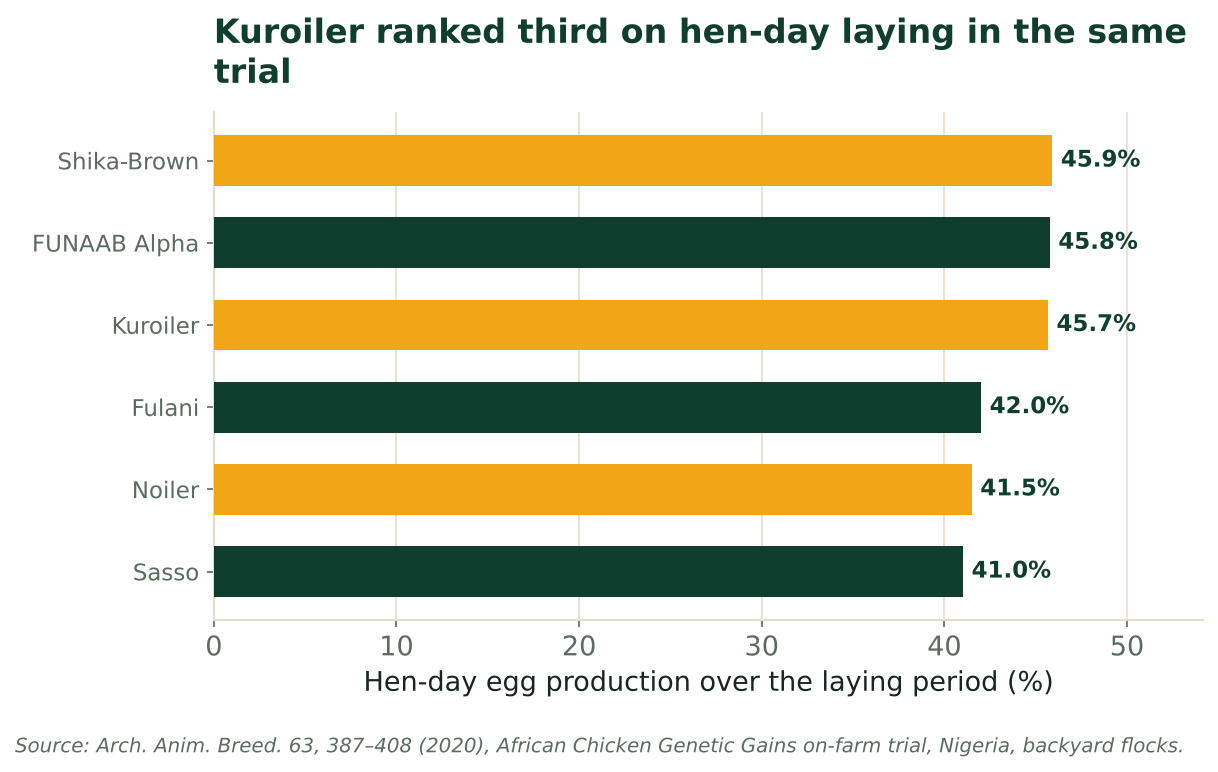
On laying, the Kuroiler is a strong performer. Over the laying period, Kuroiler hens produced eggs on about 45.7% of hen-days, third of the six breeds behind Shika-Brown and FUNAAB Alpha. In practice that means a typical hen in this trial laid on roughly 45 days out of every 100. That is a useful figure, but it was recorded in backyard conditions, so do not expect your own flock to match it without good feed, shelter and disease control. The same trial also shows the Kuroiler's weak point. Its estimated survival through the laying period was about 70%, the lowest of the six breeds. If you buy Kuroiler hens, plan for losses and keep replacement birds in mind.
A Ghana study on introduced dual-purpose birds
A second study is closer to home. Published in Genetic Resources in November 2024, it followed poultry farmers in five of Ghana's 16 regions who raised introduced, tropically adapted dual-purpose birds under their own management systems. Two genotypes were included, Kuroiler and Hubbard, and the authors compared the introduced birds with local Ghanaian chickens under semi-intensive management. The introduced birds averaged about 2 kg at 18 weeks, while local chickens took around 30 weeks to reach about 1.6 kg. The authors report that this growth advantage was significant. Egg production was described as comparable to local chickens. The abstract does not give exact egg counts or mortality figures, and it does not separate Kuroiler from Hubbard in its headline weights, so read it as evidence that improved dual-purpose birds grow faster than local birds in Ghanaian farms rather than as a Kuroiler-only benchmark.
Ghana's Chicken4U project is also scaling up dual-purpose chicks for rural households, which shows the same type of bird is reaching family-scale producers in Ghana.
Kuroiler against the alternatives
The table sets the Kuroiler beside the other dual-purpose and broiler options buyers ask us about. The dual-purpose numbers come from the Nigerian backyard trial. The broiler row comes from a controlled Cobb performance study, so it is a reference for a specialist meat bird, not a like-for-like comparison.
| Option | Growth (males) | Main use | Egg and survival data from the trial | Best for |
|---|---|---|---|---|
| Kuroiler | About 1,391 g at 18 weeks | Meat and eggs | Hen-day laying about 45.7% (third of six); laying survival about 70% (lowest); growing survival about 77% | Backyard and semi-free-range flocks where egg output matters most |
| Noiler | About 1,461 g at 18 weeks | Meat and eggs | Hen-day laying about 41.5%; laying survival about 82% (best of six) | Flocks that want the best hen survival, with a lower egg rate |
| Sasso | About 1,399 g at 18 weeks | Meat, coloured and free-range | Hen-day laying about 41.0%; laying survival about 73% | Free-range meat flocks with a longer cycle |
| Cobb 500 (broiler) | About 3,503 g at 42 days (males, controlled objective) | Fast meat only | Not in the trial; needs tight feed, heat and housing control | Shortest meat cycle, housed and managed closely |
If your priority is the highest egg output among the dual-purpose options, the Kuroiler is a strong candidate. If your priority is keeping the hens alive through a long laying period, the Noiler's trial record is better. Our best chicken breeds for Ghana guide explains how to weigh these trade-offs against your market.
How to order Kuroiler chicks from Agro Prime
- Message us on WhatsApp at +233 24 915 1503. Say you are asking about Kuroiler chicks and tell us your town.
- Ask which strains we have available now. We confirm the stock that is ready rather than promising a strain in advance.
- Say what you want the flock to do. Tell us whether you are raising for meat, for eggs, or both, and whether point-of-lay pullets would suit your plan better than day-old chicks.
- Agree the date, transport and price. We give you a written quote and confirm the delivery arrangement before you pay.
- Brood the chicks properly from the start. Our guide to brooding day-old chicks sets out the heat, water and feed routine for the first weeks.
Delivery and what to prepare before the birds arrive
We supply farmers across Ghana and arrange transport. Delivery cost and timing depend on your location, the size of the order and the route, so we do not state either on this page. When you message us, we confirm the expected arrival and the cost for your town, and we agree how the birds will be handled on the journey.
Before the chicks arrive, have the brooder built, clean and warm, with fresh water and starter feed ready. A dry, draught-free space with room to spread out is more important than an expensive house. Keep a record of arrival numbers, weights and any early losses, and tell us promptly if anything looks wrong on arrival.
Feeding a dual-purpose flock
A Kuroiler flock is fed differently depending on what you want from it. Birds raised for meat need a growing ration that supports steady weight gain, and hens raised for eggs need a layer ration with enough calcium for strong shells. Many smallholders mix the two, so plan feed for each group. Our layer feeding guide covers the laying ration in detail, and the principles of clean feed, clean water and steady protein apply to every bird in the house.
Want help choosing before you buy?
Message us on WhatsApp (+233 24 915 1503) with your space, your market and how many birds you have in mind. We will tell you honestly whether a Kuroiler, a Noiler, a broiler or a brown layer suits your plan. You can also book a visit to the Kasoa hatchery and talk it through with us in person.
Pricing: why we quote per order
We do not publish a Kuroiler price on this page. The cost depends on the strain and quantity we can supply at the time, the season, whether you want pullets or feed as well, and your delivery location. A market figure from a few months ago would not reliably reflect what we can offer you today. When you message us, we give you a current quote for the birds and quantity you need, along with the delivery cost, before you commit.
Budget the whole cycle rather than the chick price alone. Include feed through the growing and laying stages, brooding equipment, vaccines, housing and transport. For a dual-purpose flock, the return comes from both meat and eggs, so judge the numbers over the full life of the birds.
Bottom line on Kuroiler chicks in Ghana
The Kuroiler is a practical choice for a family or small-market flock that wants meat and eggs from the same birds. The Nigerian trial shows solid male weights and one of the best laying rates in the group, with the weakness being hen survival through the laying period. The Ghana study points the same way: improved dual-purpose birds outgrew local chickens on Ghanaian farms. Choose it for the mix, and plan carefully for hen losses. Ask us which strains we have available now, and if you are weighing a larger poultry project, see our partner page for the investment side of working with us.
Frequently asked questions
Do you have Kuroiler chicks available right now?
How much do Kuroiler chicks cost?
Is there a minimum order?
Can you deliver Kuroiler chicks to my town?
Are the chicks vaccinated?
Kuroiler or broiler: which should I buy?
How far ahead should I order?
What if some chicks die in transit?
Sources
- African Chicken Genetic Gains on-farm trial (Nigeria), six improved dual-purpose breeds, Archives of Animal Breeding 63, 387–408 (2020): aab.copernicus.org/articles/63/387/2020
- "Genetics solutions for improved chicken production in Ghana," Genetic Resources 5(10), 107–116 (November 2024): genresj.org
- Food & Agribusiness, "Ghana's Chicken4U Project scales up dual-purpose chicks for rural households" (April 2026): foodagribusiness.world
- Cobb 500 Broiler Performance Nutrition Supplement (2022), used for the broiler reference row: cobbgenetics.com
Order from Agro Prime Ghana
Agro Prime Ghana Limited runs a poultry hatchery in Kasoa and supplies healthy day-old chicks (broilers & layers), point-of-lay pullets, quality feed and hands-on advice to farmers across Ghana, with delivery arranged to your area. Message us on WhatsApp (+233 24 915 1503) to ask which strains we have available now and for a current quote, or book a visit.