Chickens can safely eat many household food scraps — cooked rice and banku, vegetable peelings, kenkey ends, fruit trimmings, cooked beans and stew leftovers — and feeding them is a sensible way to cut waste and stretch your feed budget, provided scraps stay a supplement of no more than about 10% of the diet and never replace balanced feed. A handful of foods, though, are genuinely dangerous: mouldy food, raw dried beans, avocado, green potatoes, very salty foods, large amounts of onion, and chocolate or caffeine should never be given. In a Ghanaian compound where nothing edible is thrown away lightly, the temptation is to let the fowls "finish the food" — and mostly that is fine. The danger is treating scraps as the diet rather than a top-up, or tipping a spoiled, mouldy pot into the run because it was "only going to waste." This guide sets out what is safe, what is harmful, how much is too much, and how the rules differ for backyard hens versus a commercial flock.
Written by the Agro Prime Ghana poultry team and reviewed against current extension and food-safety references (UF/IFAS Extension, FAO and poultry-nutrition guidance). Last updated September 2026.
Key takeaways
Kitchen scraps are a useful supplement, not a diet: keep them to roughly 10% of what your birds eat, with the other 90% a balanced feed or a well-managed scavenging base. Safe scraps include cooked rice, banku and kenkey ends, cooked beans, vegetable peelings, most fruit, and cooked meat scraps in moderation. Never feed: mouldy or rotten food (aflatoxin and other toxins), raw or dried beans (contain phytohaemagglutinin), avocado (persin), green or sprouted potato peels (solanine), very salty leftovers, large amounts of onion (can cause anaemia), and chocolate, coffee or alcohol. Scraps are mostly starchy and watery — energy-rich but low in protein, calcium and the balanced amino acids laying and growing birds need — so leaning on them alone stunts growth and cuts egg production. Chop scraps small, feed fresh, remove leftovers before they spoil, and never let the feed trough go empty in the name of "using up" food.
Are kitchen scraps safe for chickens?
Most ordinary household food scraps are safe and beneficial for chickens, which are natural omnivores. The birds in a typical Ghanaian compound already scavenge exactly this kind of food, and feeding them your peelings, leftover rice, kenkey and banku ends and vegetable trimmings simply channels waste that would otherwise rot into eggs and meat. The FAO, in its work on family poultry, treats household food waste as a core part of the "scavengeable feed resource base" that keeps village flocks alive, and notes that the more nutritious that feed, the more eggs the hens lay. So scraps are not just tolerated — for backyard birds they are a genuine feed resource. But two things must be true for scraps to be safe: the food must be fit to eat (fresh, not mouldy or rotten), and it must not be one of the specific foods toxic to poultry. Get those right and everyday Ghanaian leftovers are a welcome, waste-cutting addition to the diet; get them wrong — especially by feeding spoiled food — and scraps become a fast route to a poisoned flock.
Which foods are harmful or toxic to poultry?
A short, specific list of foods does real harm and should never reach your birds. Drawing on University of Florida (UF/IFAS) Extension guidance, the ones to watch in a Ghanaian kitchen are: mouldy or rotten food, which can carry aflatoxin and other mycotoxins that damage the liver and suppress immunity (never tip a spoiled pot of stew, mouldy bread or caked, musty grain into the run); raw or dried beans, which contain phytohaemagglutinin — beans must be fully cooked first; avocado skin and stone, which contain persin and cause breathing and heart problems; green or sprouted potato peels, which contain solanine; very salty foods such as leftover salted fish, stock cubes and heavily seasoned stew, causing dehydration and kidney damage; large amounts of onion, which can damage red blood cells and cause anaemia; and chocolate, coffee, caffeine and alcohol, toxic to the heart and nervous system. Fruit pits and apple seeds also release cyanide compounds and should not be fed in quantity. None of this means fretting over every scrap — it means keeping a firm mental "never" list and, above all, never feeding mouldy or spoiled food.
Why scraps must stay a top-up, not the diet
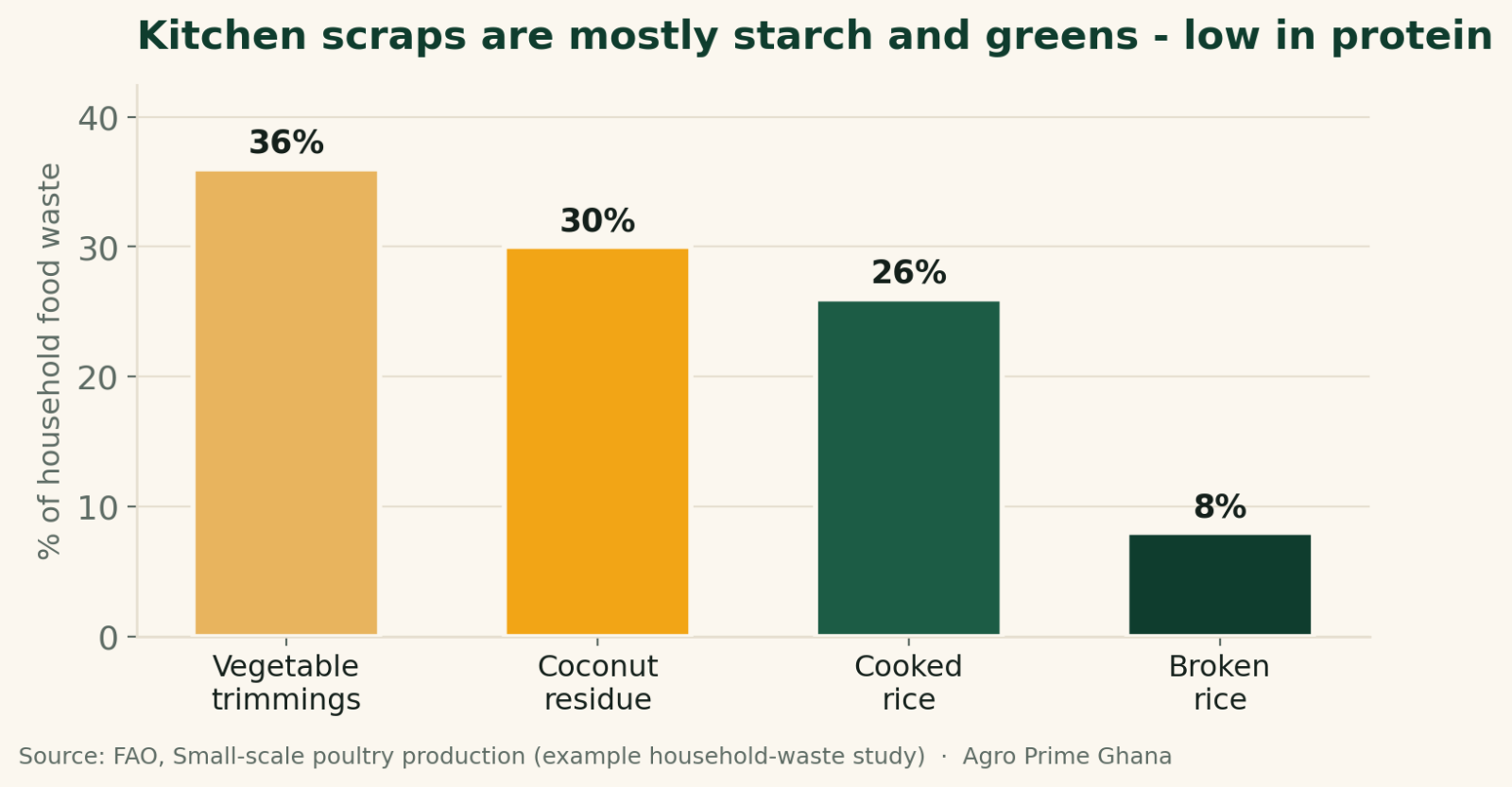
Even when every scrap is safe, kitchen waste cannot be the main diet of a productive flock, because of what scraps are nutritionally. A Ghanaian kitchen mostly discards cooked rice, banku, kenkey and yam ends, coconut and cassava residue, and vegetable trimmings — and FAO's example survey of household waste fed to family poultry found it dominated by starchy cooked grains and vegetable trimmings, energy-rich but watery and low in protein. That is the problem in a sentence: scraps give a bird calories and bulk, but they are short on the protein, balanced amino acids, calcium and vitamins that growing chicks and laying hens need most. A layer building an eggshell every day needs steady calcium and quality protein that peelings and leftover rice do not contain; a growing bird needs concentrated amino acids to build muscle. Fill a bird up on scraps and it eats less balanced feed and grows or lays below its potential. This is why the widely used 90/10 rule exists: as poultry-nutrition guidance puts it, treats and scraps should be no more than about 10% of the diet, with complete balanced feed the other 90%. Scraps stretch the feed bill at the margin; they cannot carry the flock.
| Safe in moderation (a top-up) | Never feed |
|---|---|
| Cooked rice, banku, kenkey, yam and plantain ends | Mouldy, caked or rotten food of any kind |
| Vegetable peelings and trimmings, cooked leafy greens | Raw or dried (uncooked) beans |
| Fully cooked beans and legumes | Avocado skin and stone |
| Most fruit and fruit peels (in moderation) | Green or sprouted potato peels |
| Cooked meat and fish scraps (small amounts) | Very salty foods, salted fish, stock-cube leftovers |
| Bread, cooked pasta, porridge ends (small amounts) | Large amounts of onion; chocolate, coffee, alcohol |
Backyard flocks versus commercial birds
The right role for scraps depends heavily on which kind of flock you keep, and this is where a lot of confusion lives. For a backyard or free-range flock of a few local hens that also scavenge insects, greens and seeds, kitchen scraps are a natural and valuable part of the diet — they top up what the birds forage, cut waste, and cost nothing. These hardy, slow-growing birds are not pushed for high output, so scavenging plus scraps, ideally with a little grain and a calcium source, works well; FAO's family-poultry guidance is built around making the most of exactly this feed base. For a commercial or semi-intensive flock — broilers finishing on a schedule, or layers expected to hit 90%-plus production — the calculus is different. These improved birds have high, precise nutrient demands that only balanced formulated feed can meet, and every gram of scraps displaces feed and pulls performance down. Scraps also raise biosecurity questions on a commercial unit: outside food waste attracts flies, rodents and disease, and pooled waste spoils fast in the heat. So: for backyard birds, scraps are a real feed resource; for commercial birds, keep them minimal, clean and incidental, and let a proper ration do the work. Our guides to backyard poultry keeping and layer feeding cover each case in more depth.
Field note: sort the scraps bowl, not the run
The habit that keeps scrap-feeding safe on our own compound is to do the sorting in the kitchen, not at the fowl run. A separate bowl takes only the good scraps — cooled rice, peelings, vegetable trimmings, fresh cooked bean and stew leftovers — while salted fish bones, mouldy bread, onion-heavy waste and anything soured goes straight to compost. By the time the bowl reaches the birds, every decision is already made, and nobody is standing over the run wondering whether that day-old pot is "probably fine." It rarely is, in this heat. Sorting once, at source, beats trusting your judgement with hungry birds looking up at you.
Field note: the mouldy pot is the one that kills
If we could make Ghanaian keepers remember only one rule about scraps, it would be this: never feed food that has gone off. The instinct to avoid waste is strong, and a pot of stew or a bowl of rice that has soured in the heat, or bread and grain that have grown mould, feels like a shame to throw away — so it goes to the fowls. That is exactly the food that does the most harm. Mould on food produces toxins, including aflatoxin, that damage the liver, wreck feed conversion and quietly suppress the immune system so vaccines fail and disease breaks through. The birds may show nothing dramatic at first, just poor thrift and mysterious illness. Spoiled food is not "free feed" — it is a poison you are paying to add. When in doubt, throw it on the compost, not into the run.
How to feed scraps safely and cleanly
Feeding scraps well is mostly a few simple habits. Chop scraps small so birds eat them without gorging and no single bird monopolises a big lump. Feed fresh and in the right amount — only what the flock clears in 15–20 minutes, ideally later in the day after their balanced feed, so scraps top up rather than replace the ration. Remove leftovers before they spoil in the heat and grow mould. Cook what needs cooking: beans and legumes must be fully cooked, and cooked leftovers are generally safer and more digestible than raw. Keep the scraps bowl separate from the "never" foods so toxic items do not slip through, and always keep clean water available since scraps can be dry or salty. For farmers trimming feed cost more systematically across the whole ration, our guide to reducing poultry feed cost puts scraps in the wider picture.
Turn kitchen waste into eggs — on top of the right feed and birds
Using safe kitchen scraps is smart, thrifty poultry keeping — but scraps only turn into eggs and meat when they sit on top of good birds and a balanced base feed. Agro Prime Ghana supplies strong day-old chicks and point-of-lay pullets that make the most of what you feed them, plus quality layer and grower feed to form the reliable 90% of the diet that scraps top up. Starting a backyard flock or scaling toward commercial? Message us on WhatsApp (+233 24 915 1503) or book a visit and we will help you set up a feeding plan that uses your kitchen waste sensibly without shortchanging the birds.
Scraps, calcium and grit — filling the gaps
Because scraps are short on exactly the minerals laying birds need, keepers who rely on them should fill two gaps. The first is calcium: no amount of rice, peelings or greens supplies the calcium a hen needs to lay a sound shell daily, so scrap-fed layers need a separate calcium source — crushed oyster shell, limestone or well-prepared eggshell — offered free-choice. The second is grit: birds have no teeth and grind food in the gizzard using small hard stones, so scavenging and scrap-fed birds need insoluble grit to digest fibrous scraps. Both are covered in our guide to grit and oyster shell. The wider point: scraps do not remove the need for balanced nutrition — they shift the burden onto you to supply the missing pieces elsewhere. A backyard flock on scraps plus scavenging, a little grain, a calcium source and grit can do genuinely well; the same flock on scraps alone lays thin-shelled eggs, grows slowly and stays prone to disease.
The bottom line on feeding kitchen scraps
Feeding household food scraps to poultry is a sound, waste-cutting Ghanaian tradition — within limits. Most everyday leftovers are safe and useful: cooked rice, banku and kenkey ends, vegetable trimmings, cooked beans, fruit and cooked meat scraps all channel kitchen waste into eggs and meat. A firm "never" list — mouldy or rotten food above all, plus raw beans, avocado, green potato, very salty food, lots of onion, chocolate and caffeine — keeps it safe. But scraps are energy-rich and nutrient-poor, so they must stay a top-up of around 10% of the diet, with balanced feed or well-managed scavenging carrying the rest, and laying birds still need a separate calcium source and grit. Backyard flocks can lean on scraps as a real feed resource; commercial flocks should keep them minimal and clean. Feed scraps fresh, small and in moderation, compost the spoiled ones, and they become what they should be — a free bonus on top of a properly fed flock, not a shortcut around feeding it well.
Frequently asked questions
Can chickens eat kitchen scraps and food waste?
What kitchen foods are toxic to chickens?
How much of a chicken's diet can be kitchen scraps?
Can I feed chickens mouldy or spoiled food?
Can chickens eat beans?
Are kitchen scraps enough to feed laying hens?
Is it safe to feed scraps to commercial poultry?
Do scrap-fed chickens still need grit and calcium?
Sources & further reading
- University of Florida (UF/IFAS) Extension — 10 Foods You Should Never Feed Chickens (toxic foods and the reasons they harm poultry).
- FAO — Small-scale poultry production (household waste in the scavengeable feed resource base and the need for supplementation).
- Purina Animal Nutrition — What to feed chickens: treats to feed and avoid (the 90/10 rule for treats and scraps).
- Agro Prime Ghana guides: backyard poultry keeping, layer feeding, reducing poultry feed cost, and grit and oyster shell.
About Agro Prime Ghana
Agro Prime Ghana Limited runs a poultry hatchery and mixed agribusiness in Kasoa, supplying day-old chicks and supporting poultry keepers nationwide. These guides combine hands-on hatchery and farm experience with current extension and food-safety references. This article is general educational information, not a substitute for professional nutritional or veterinary advice. We supply healthy day-old chicks (broilers & layers), point-of-lay pullets, quality feed and hands-on farm support across Ghana. Building a flock and want a feeding plan that uses your kitchen waste wisely? Book a visit or message us on WhatsApp (+233 24 915 1503) to order chicks, feed or advice.