You raised the chicks well. They were vaccinated on schedule, the brooder was warm, and at three weeks they looked strong. Then, almost overnight, a batch of birds around four weeks old goes quiet, huddles, passes watery whitish droppings, and some start pecking at each other's vents. A few die within two or three days; others recover, but the flock never quite thrives again, and later a disease you vaccinated against still breaks through. That pattern — a sharp, short crisis in young birds followed by a flock that stops responding to its vaccines — is the signature of infectious bursal disease, the illness most Ghanaian keepers know as Gumboro. This guide explains what it is, why it does its worst damage unseen, and how to keep it out of your flock.
Written by the Agro Prime Ghana poultry team and reviewed against current veterinary references (MSD Veterinary Manual and The Poultry Site). Last updated September 2026.
Key takeaways
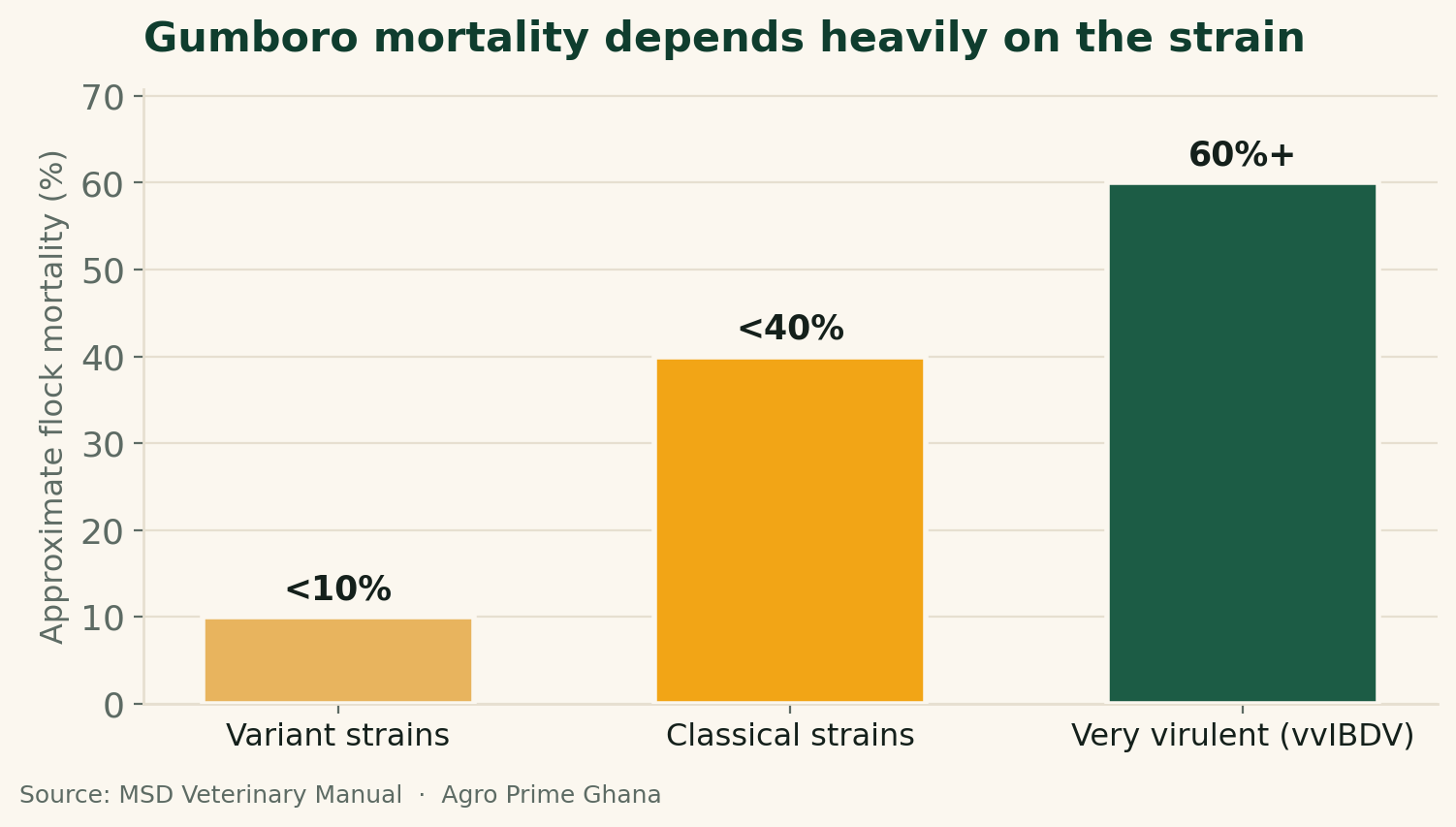
Infectious bursal disease (IBD, or Gumboro) is caused by a tough double-stranded RNA virus that attacks one organ: the bursa of Fabricius, the young bird's immune-training gland. Chickens are most susceptible to visible disease at 3–6 weeks old, with signs appearing just 2–4 days after infection. Classical strains kill under 40% of a flock, but very virulent strains can kill 60% or more, while morbidity often reaches 100%. The quieter danger is immunosuppression: even mild or early infection damages the bursa, so vaccines "take" poorly and diseases like Newcastle and coccidiosis break through. There is no treatment. The virus is extremely stable, resists most disinfectants, and survives for months in a house — so control rests on breeder vaccination for maternal immunity, well-timed chick vaccination, and hard biosecurity.
What Gumboro actually is
Infectious bursal disease is a viral disease of young chickens caused by infectious bursal disease virus (IBDV), a double-stranded RNA virus in the family Birnaviridae. According to the MSD Veterinary Manual, it comes in two serotypes, but only serotype 1 causes disease in chickens. What makes IBDV distinctive is its single-minded target: almost every other poultry virus attacks the gut, airways or nervous system, but this one goes for the immune system itself. Its target is the bursa of Fabricius — a small gland just above the vent, unique to birds, whose job is to manufacture and train the B-lymphocytes that later produce antibodies. In a chick that bursa is at its largest and most active during the first weeks of life — exactly when the virus strikes.
The damage is fast and specific. MSD notes that after an incubation of just 3–4 days, the virus multiplies in the bursa, swelling it and then shrinking it; atrophy of the bursa occurs about 7–10 days after infection. The organ responsible for building the bird's future immunity is gutted in a little over a week, at the one age it can least afford it. That is why Gumboro is really two diseases in one — a dramatic acute illness you can see, and a silent collapse of the immune system you cannot.
Why it hits so hard in Ghana
Gumboro is one of the most common and economically important viral diseases of chickens worldwide, and Ghanaian conditions give it several openings. The first is age: most of what we raise — broilers, cockerels and growing pullets — passes through the vulnerable window at the wrong time. MSD states that chickens are most susceptible to clinical disease at 3–6 weeks of age; below three weeks infection is usually subclinical, showing no obvious illness while still immunosuppressing the bird. The second opening is the virus's toughness: The Poultry Site notes IBDV is highly resistant to most disinfectants and environmental conditions, persisting for months in contaminated premises, so a house that has had Gumboro keeps re-challenging every new batch unless it is cleaned hard.
The third opening costs the most and is least understood: immunosuppression. When the bursa is destroyed, the flock's response to other vaccines weakens, so a well-run farm that suddenly sees "vaccine failure" against Newcastle disease, or unusually severe coccidiosis and colibacillosis, may be looking at the shadow of an early, unnoticed Gumboro infection — a disease that quietly cancels the value of your whole vaccination programme, in ways that never show up as a dead bird.
The two faces of the disease
How Gumboro looks depends on the strain and the age at infection, but the key thing to grasp is that it harms a flock in two distinct ways — one you can see, one you cannot — set out below.
| Form | When & how it shows | What it costs you |
|---|---|---|
| Clinical (acute) disease | Birds 3–6 weeks old; sudden prostration, watery diarrhoea, huddling, vent pecking; deaths over 5–7 days | Direct mortality (up to 60%+ with very virulent strains), lost growth, cost of the batch |
| Subclinical immunosuppression | Often before 3 weeks; no obvious illness, but the bursa is damaged | Poor vaccine response, vaccine "failures", secondary infections (Newcastle, coccidiosis, colibacillosis), lifelong underperformance |
How to recognise Gumboro early
The clinical form is dramatic and fast, which is both a warning and a clue. Watch for a cluster of signs appearing together in birds around three to six weeks old, over a day or two: severe prostration and depression, unsteady birds, watery, whitish diarrhoea, soiled and pasted vent feathers, ruffled feathers around the head and neck, and — especially suggestive — vent pecking at one another's inflamed cloacas. Affected birds sit hunched, stop eating and look cold even in a warm brooder. In a severe outbreak, deaths climb steeply for two or three days, peak, and fall away as suddenly as they came — a "spiking" mortality curve that is itself characteristic of Gumboro.
That confirmation is not in the live bird — it is the bursa itself, and because the lesion is so specific, a post-mortem beats guessing. If you are seeing sudden deaths in three-to-five-week-old birds, do not treat blindly — get a bird opened up.
Field note: the mortality curve tells you a lot
When young birds start dying, one of the first things we look at is the shape of the losses over days, not just the total. A disease that kills a few more birds each morning for a week behaves differently from Gumboro, which comes as a sharp spike — very few deaths, a sudden jump for two or three days, then a fall — in birds old enough (three weeks and up) to have lost maternal protection. Vent pecking and soiled, wet vents in that age group push our suspicion further. That pattern is our cue to get a bird post-mortemed quickly rather than losing days to the wrong treatment.
How the virus spreads and survives
Gumboro spreads by the faecal–oral route, and its power lies in how durable it is. MSD notes that IBDV is shed in the faeces and transferred from house to house by fomites — boots, feed scoops, crates, clothing and hands. Because it is very stable in the environment and difficult to eradicate from premises, and resists most ordinary disinfectants, a farm that has had one outbreak carries a reservoir that challenges every batch that follows. This is why Gumboro rewards serious biosecurity and punishes casual hygiene.
Prevention: vaccination and maternal immunity
Because there is no cure, control is built almost entirely on immunity, and the strategy works on two generations at once. The foundation is maternal antibody. MSD describes the standard approach: breeder flocks get live attenuated vaccines during rearing and then inactivated (killed) vaccines before lay, raising high antibody levels the hens pass into the egg yolk, so chicks hatch already protected through their first, most vulnerable weeks, when they are too young to vaccinate effectively themselves. This is a strong reason to source chicks from a hatchery whose breeders are properly vaccinated — part of what you are really buying when you choose healthy day-old chicks rather than the cheapest ones available.
The second layer is vaccinating the chicks themselves, usually with a live vaccine in the drinking water, and timing is the whole game. The Poultry Site stresses that live vaccine must be matched to the level of maternal antibodies: too early, while maternal antibody is high, and those antibodies neutralise the vaccine; too late, and birds meet field virus before the vaccine protects them. This is why many farms give it as two doses across the vulnerable window — commonly a first dose early in the second week and a booster a week or so later — so that as maternal antibody fades, vaccine immunity rises to replace it. The exact age depends on the vaccine and the chicks' antibody status, so set the programme with your supplier or vet.
Field note: why we don't rush the Gumboro vaccine
The most common Gumboro mistake we see is vaccinating too early, or on a fixed date copied from a friend's farm, then being surprised when the flock breaks anyway. If the chicks came in with good maternal antibody, an early dose is cancelled out by those antibodies and does almost nothing. We set the programme with the chick supplier and protect the vaccine along the way: keep it cold, mix it in clean non-chlorinated water, add a stabiliser, and get the birds to drink it quickly so every one gets a dose. A vaccine cooked in the sun or mixed in chlorinated water is no vaccine.
Biosecurity and cleaning: breaking the reservoir
Vaccination reduces the damage but does not clean up a contaminated house. Because the virus resists many routine disinfectants, the between-batch clean-out must be thorough: remove all litter and organic matter first (dried droppings shield the virus), wash surfaces to physically remove the muck, then apply a disinfectant proven against tough non-enveloped viruses at the right concentration and contact time, and rest the house before restocking. Day to day, stop the virus travelling between age groups and houses with a footbath or dedicated boots at each entrance, no sharing of equipment without disinfecting, working from youngest birds to oldest on your rounds, and control of pests, people and vehicles. On a farm carrying a reservoir, this decides whether the next batch inherits the problem.
What to do during an outbreak
When Gumboro is already in the flock, be honest about what you can and cannot do. MSD is blunt: there is no treatment for infectious bursal disease — no antibiotic touches a virus. What you can do is support the flock and limit secondary damage: keep birds warm and unstressed, and make sure clean water with vitamins and electrolytes is easy for weak birds to reach, because dehydration from the watery diarrhoea is a real killer. Because survivors are now immunosuppressed, secondary infections such as colibacillosis often follow, and a vet may advise a supportive antibiotic aimed at those invaders, not the virus. Tighten biosecurity immediately so the outbreak does not walk into your other houses on your boots, get a firm diagnosis, and plan your clean-out — a farm that has seen Gumboro once will see it again unless the routine changes.
The economics: why prevention always wins
It is tempting to treat Gumboro as an occasional run of bad luck, but the numbers argue otherwise. In a clinical outbreak you can lose a fifth to a third of the flock outright, and with a very virulent strain more than half — birds you have already paid to feed to three or four weeks, where much of a broiler's feed cost has gone. The bigger long-run bill is invisible: a flock immunosuppressed early converts feed worse, grows unevenly, and returns poor value from every other vaccine and input, and the secondary diseases that follow can quietly erase a whole cycle's profit. Against that, the prevention package — chicks with good maternal immunity, a well-timed vaccine programme, and disciplined cleaning and biosecurity — is mostly a matter of routine and attention rather than money. It is a disease where an ounce of prevention is worth kilos of cure.
The bottom line on Gumboro
Infectious bursal disease is a fast, tough and deceptively costly virus that targets the one organ a young chicken cannot afford to lose — the bursa that builds its immune system. It strikes hardest at 3–6 weeks, can kill 60% or more of a flock in its worst form, and even when it kills few birds leaves survivors immunosuppressed, so vaccines fail and other diseases break through. There is no treatment, and the virus survives for months in a contaminated house. That makes Gumboro a prevention-only disease: buy chicks with strong maternal immunity, set a vaccine programme timed to your chicks' antibody status rather than a borrowed date, administer it correctly, and clean and secure your houses as if the virus is waiting for the next batch — because it is. Get that routine right and Gumboro becomes a risk you keep firmly under control.
Frequently asked questions
What is Gumboro disease in chickens?
What are the first signs of Gumboro?
How is Gumboro treated?
How do I prevent Gumboro?
Why does Gumboro make my other vaccines fail?
At what age are chickens most at risk from Gumboro?
Can Gumboro be spread from farm to farm?
Is Gumboro dangerous to humans?
Sources & further reading
- MSD Veterinary Manual — Infectious Bursal Disease in Poultry (causative virus and serotypes, age susceptibility, incubation, bursal atrophy, mortality by strain, transmission, environmental stability, no treatment, breeder and chick vaccination).
- The Poultry Site — Infectious Bursal Disease (Gumboro) (immunosuppression, clinical signs, mortality and morbidity, disinfectant resistance and environmental persistence, maternal-antibody-matched vaccination).
- Agro Prime Ghana guides: Newcastle disease, poultry biosecurity, and choosing healthy day-old chicks.
About Agro Prime Ghana
Agro Prime Ghana Limited runs a poultry hatchery and mixed agribusiness in Kasoa, supplying day-old chicks and working alongside poultry keepers across the country. These guides draw on that hands-on hatchery and farm experience, checked against current veterinary references. This article is general educational information, not a substitute for diagnosis by a qualified veterinary or extension officer — if your flock is sick, get it seen and, where possible, post-mortemed. Need chicks, a vaccination plan or farm support? Book a visit or message us on WhatsApp (+233 24 915 1503).