Imported day-old chicks are hatched abroad — mainly in Europe, the USA and Brazil — from tightly controlled parent stock and flown in, while locally hatched chicks come from Ghanaian hatcheries using imported or local breeding birds. Historically, imported chicks earned a reputation for lower mortality and more reliable performance, which is why many farmers paid a premium for them; but imports also carry higher cost, unpredictable availability, and a real disease-import risk that has repeatedly forced Ghana to ban them overnight. Today the honest picture is more balanced: a good local hatchery gives you fresh chicks with almost no transport stress, supply you can rely on, and money that stays in Ghana. This guide compares imported and locally hatched day-old chicks on quality, cost, biosecurity and availability, so you can choose with your eyes open.
Written by the Agro Prime Ghana hatchery team and reviewed against current industry references (FAO Ghana poultry sector review and Ghana Ministry of Food and Agriculture). Last updated September 2026.
Key takeaways
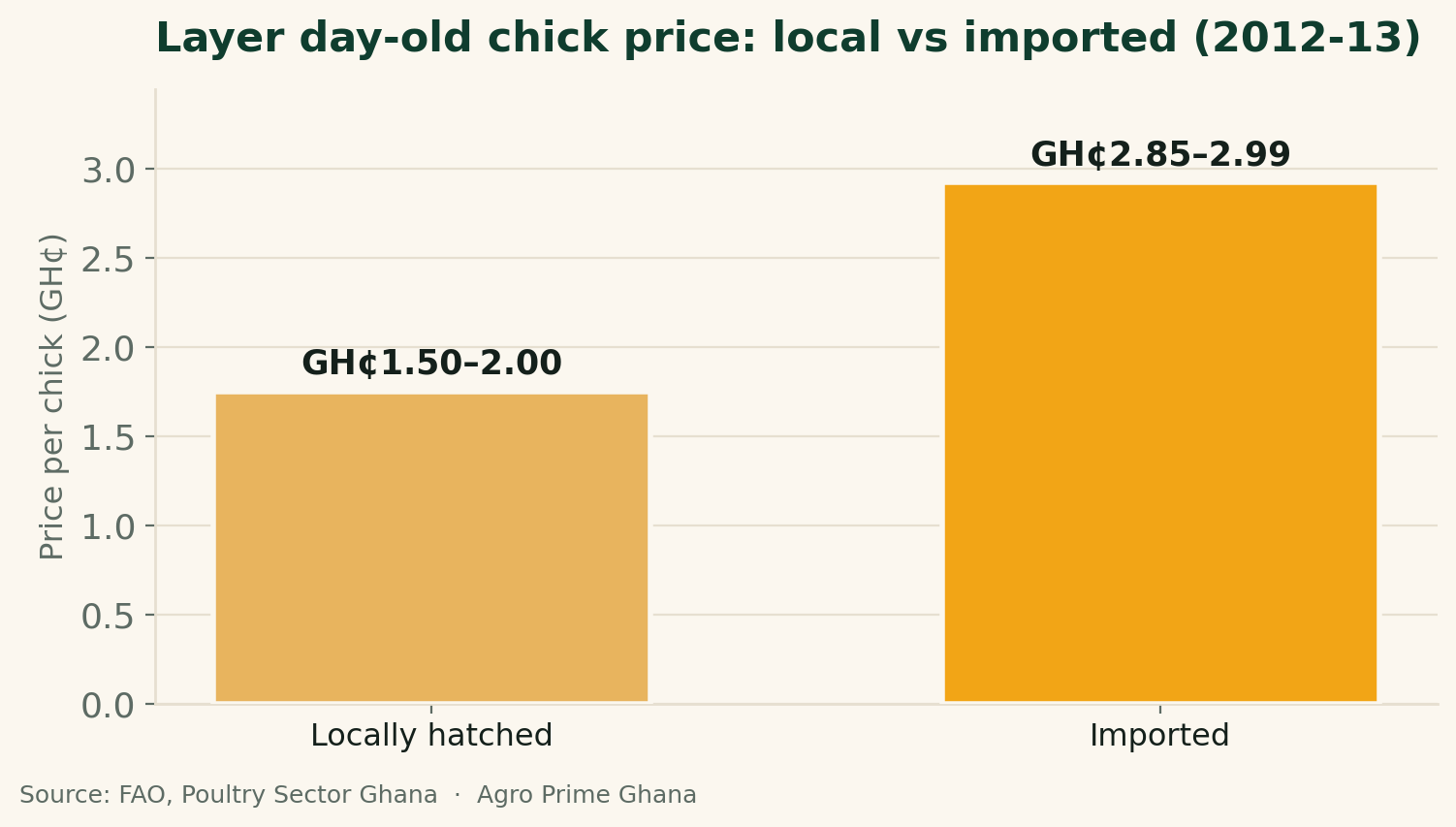
Ghana has long imported large numbers of day-old chicks — from around 553,000 in 2008 to over 2.2 million in 2010 — mainly layer chicks from the EU, USA and Brazil, according to the FAO. Imported chicks earned a name for lower lifetime mortality and reliable laying, and farmers historically paid a premium — roughly GH¢2.85–2.99 versus GH¢1.50–2.00 for local layer chicks in 2012–13. But imports carry a serious downside: they are a disease-import pathway, and Ghana has banned day-old chick imports from countries hit by bird flu (HPAI H5N8) — the Netherlands, Germany, Russia, Denmark and the UK — at short notice. Locally hatched chicks mean fresher birds, far less transport stress, dependable supply and money kept in Ghana. The right choice depends on breed availability, your programme and your supplier's quality — not on "imported" as a label.
Where do Ghana's day-old chicks come from?
Ghana's day-old chicks come from two channels: a substantial volume imported from abroad, and a growing output from domestic hatcheries. The FAO's review of Ghana's poultry sector documents that the country "imports large quantities of day-old chicks and hatching eggs from the European Union, USA and Brazil," with annual chick imports rising from about 552,900 in 2008 to over 2.2 million in 2010, layer chicks making up the largest share. On the domestic side, the FAO notes a handful of commercial hatcheries that "produce well below their installed capacities" — historically because of weaker demand for local chicks. In other words, Ghana has the hatching capacity; the constraint has been reputation and consistency, not machinery.
That balance has been shifting. Every time a bird-flu outbreak abroad triggers an import ban, farmers who depended on imported chicks are stranded, and local hatcheries become the only supply. This recurring shock has pushed both hatcheries and farmers to take domestic production more seriously, and it is one reason the quality gap that once favoured imports has narrowed for well-run Ghanaian hatcheries.
Why imported chicks earned their reputation — and why that's changing
Imported chicks built their reputation on consistency: they came from large, specialised parent flocks under strict health and genetic control, and tended to show lower mortality and dependable production. The FAO review reflects this, noting imported day-old chicks offered "lower mortality rates throughout the life of the bird and quality assurance for good laying performance," while local chicks were historically associated with higher mortality and poorer laying. For a farmer investing months of feed into a flock, that reliability was worth paying extra for, which is why imports commanded a premium for years.
But three things are changing the calculation. First, the same genetics are increasingly available to Ghanaian hatcheries, which import parent stock and hatching eggs of the same international breeds — a Lohmann or ISA Brown layer or a Cobb/Ross broiler hatched in Kasoa carries the same genetic potential as one hatched in Europe. Second, the quality difference was never about the breed alone but about hatchery hygiene, incubation and handling — all of which a well-run local hatchery controls just as tightly; see our note on hatchery hygiene and fumigation. Third, and decisively, an imported chick has already survived a long, stressful international journey before it reaches you, whereas a local chick has not — and transport stress is itself a major driver of early mortality. The old assumption that "imported equals better" deserves testing batch by batch.
Imported versus local: the full comparison
No single factor decides this — the right answer depends on weighing quality, cost, freshness, biosecurity and availability together. The table below sets out the honest trade-offs on each front, so you can see where imports genuinely lead and where local chicks now hold the advantage.
| Factor | Imported day-old chicks | Locally hatched day-old chicks |
|---|---|---|
| Genetics / breed | Same international breeds (Lohmann, ISA, Cobb, Ross) from specialised parent stock | Often the same breeds, hatched from imported parent stock or hatching eggs |
| Transport stress | High — long international flight plus onward road transport before placement | Low — short local journey, placed within hours of hatch |
| Freshness on arrival | Older on placement; more of the yolk reserve already used | Very fresh; more of the yolk "lunch box" intact for the brooder |
| Cost (layer chicks, 2012–13 basis) | Higher — around GH¢2.85–2.99 | Lower — around GH¢1.50–2.00 |
| Availability | Vulnerable to import bans and shipping delays | Dependable; not exposed to foreign outbreaks or bans |
| Biosecurity / disease risk | An import pathway for diseases like bird flu; tightly regulated | Lower cross-border risk; local health status is knowable |
| Economic impact | Money leaves the country | Supports Ghanaian jobs and hatcheries |
Prices are historical figures from the FAO review and are shown to illustrate the relative gap, not current rates — chick prices move with feed, fuel and exchange rates, so ask any supplier for today's price.
The biosecurity question: why imports can be banned overnight
The biggest hidden risk of imported chicks is that they are a doorway for foreign diseases — and Ghana closes that door hard when it has to. When highly pathogenic avian influenza (bird flu) breaks out abroad, the Ministry of Food and Agriculture bans imports of day-old chicks, hatching eggs, frozen chicken and poultry feed from the affected countries, and invalidates existing permits immediately. A MoFA notice did exactly this after a confirmed outbreak of HPAI subtype H5N8, banning products from the Netherlands, Germany, Russia, Denmark and the United Kingdom. For a farmer whose plan depends on imported chicks from one of those countries, such a ban can leave a planned batch with no chicks at all.
This is the double edge of imports. The same international supply chain that delivers tightly controlled genetics also connects your farm to bird-flu outbreaks thousands of kilometres away. Locally hatched chicks are insulated from that: they cannot be caught by a foreign import ban, their journey is short, and the health status of a nearby hatchery is something you can verify by visiting. Biosecurity is not only about keeping disease off your farm — it is also about how far your supply chain reaches, and a shorter chain is a safer one. Our guide to poultry biosecurity in Ghana covers the farm-level side.
Field note: a hatchery you can walk into tells you a lot
One quiet advantage of buying local that customers rarely think about is that you can simply come and look. When someone visits our hatchery, they see how chicks are handled at pull and what a healthy batch looks like before they commit — and they can ask what a batch was vaccinated against and get a straight answer. You cannot do that with a chick that arrived in a shipment from another continent. We would always rather a farmer judged us by what they see on the floor than by a label on a box.
Field note: the journey is part of the chick's quality
People compare imported and local chicks as if the only difference is where they were hatched, but on our hatchery floor we think about the whole journey the bird has taken before it reaches a brooder. A chick lives off its yolk reserves for its first days; every hour spent in a box — grading, waiting, flying, clearing at the airport, driving upcountry — is an hour of that reserve spent and a bit more stress on a fragile animal. A chick hatched locally and placed the same day arrives with more of that reserve intact and far less stress behind it. "Quality" is not only in the chick's parents, but in how gently and how quickly it got to your pen.
When imported chicks still make sense
Imported chicks remain the right call in specific situations — chiefly when you need a particular breed or strain that no local hatchery is currently producing, or when a very large operation must place tens of thousands of birds on a fixed schedule that only an importer can meet in one lot. Even then, decide with the risks in full view: build in a fallback in case an import ban lands, budget for the higher price and transport stress, and insist on the health certificates imported chicks must carry. Imports are a tool, not a badge of quality — use them when the specific advantage is real, not out of a blanket belief that foreign chicks are automatically better than what a good Kasoa hatchery can hatch for you this week.
The case for buying local — beyond patriotism
Buying locally hatched chicks is increasingly a hard-nosed commercial decision, not just a patriotic one. The practical advantages stack up: chicks are placed within hours of hatch, so they arrive fresh, unstressed and with more of their yolk reserve intact; supply is dependable and not hostage to foreign outbreaks, shipping delays or currency swings; the price is generally lower; and you can visit the hatchery, see the conditions, ask what the chicks were vaccinated against, and build a relationship you can lean on for advice or a replacement. None of that is available with a chick shipped from another continent.
There is a genuine economic dimension too. Every batch of locally hatched chicks keeps money inside Ghana's poultry economy — supporting hatchery jobs, local feed demand and the parent-stock farms that supply the eggs — and strengthens the domestic supply farmers fall back on every time imports are banned. The FAO's own diagnosis was that local hatcheries under-produce mainly because of demand and reputation, not capacity; farmers who choose good local chicks are directly closing that gap. The one honest caveat is that "local" is not automatically good either — a poorly run hatchery produces weak chicks just as a good one produces strong ones. The decision is not imported-versus-local in the abstract; it is this supplier versus that one, judged on hygiene, honesty, freshness and the strength of the chicks.
Buy fresh, strong local chicks from Agro Prime Ghana
We hatch day-old broilers and layers right here in Kasoa, so the chicks you collect were hatched days — often hours — before you place them, with their hatchery vaccinations done and their yolk reserves intact. That means no international journey, no import-ban surprises, dependable supply and a hatchery you can walk into and inspect. We're happy to talk breeds, tell you what a batch has been vaccinated against, and help you plan brooding and feed. Message us on WhatsApp at +233 24 915 1503 or book a visit to see the hatchery and place an order you can rely on.
How to judge chick quality, wherever they come from
Because "imported" and "local" are labels, not guarantees, the real skill is judging the chicks themselves — and the criteria are the same regardless of origin. Strong day-old chicks are alert and active, stand well on clean healthy legs, have bright eyes, dry fluffy down, and clean, fully healed navels with no protruding yolk sac. They should feel a good weight in the hand, and the batch should be uniform, not a mix of strong and weak birds. A quiet, huddled, listless group with pasted vents or unhealed navels is a warning sign no matter which country it came from; our guide to choosing healthy day-old chicks walks through what to look for. Alongside the birds, judge the supplier: ask where and when the chicks hatched, what they were vaccinated against, and what health documentation exists — imported chicks should carry health certificates, and a good local hatchery keeps its own records. Buy from sources you can trace, ideally ones you can visit, as covered in where to buy day-old chicks in Ghana.
The bottom line on imported versus local chicks
Imported day-old chicks earned their premium reputation on consistent genetics and reliable performance, and for certain breeds and volumes they still make sense. But the old rule that imported automatically beats local no longer holds. The same international breeds are hatched in Ghana today; a local chick arrives fresher, less stressed and cheaper; local supply cannot be cut off by a foreign bird-flu ban the way imports can; and buying local keeps money and resilience in Ghana's own economy. The genuine decision is not imported-versus-local as a slogan — it is choosing a supplier, of either kind, whose hygiene, honesty and chick quality you can verify. Judge the chicks and the hatchery, not the flag on the box, and a good Kasoa-hatched chick will usually serve a Ghanaian farmer at least as well as one that flew in — often better.
Frequently asked questions
Are imported day-old chicks better than local ones?
Where does Ghana import day-old chicks from?
Why are imported chicks more expensive?
Do imported chicks carry a disease risk?
Are local Ghanaian chicks lower quality?
What are the advantages of buying local day-old chicks?
When should I still choose imported chicks?
How do I judge whether day-old chicks are healthy?
Sources & further reading
- FAO — Livestock Country Reviews: Poultry Sector Ghana (import volumes, source countries, local hatchery capacity, mortality and price comparison).
- Ghana Ministry of Food and Agriculture — Ban on imports of day-old chicks and poultry products (HPAI H5N8, banned source countries, permit invalidation).
- Agro Prime Ghana guides: choosing healthy day-old chicks, where to buy day-old chicks, poultry biosecurity, hatchery hygiene & fumigation.
About Agro Prime Ghana
Agro Prime Ghana Limited runs a poultry hatchery and mixed agribusiness in Kasoa, hatching and supplying day-old chicks and working alongside poultry keepers across the country. We supply healthy day-old chicks (broilers & layers), point-of-lay pullets, quality feed and hands-on farm support — fresh, locally hatched, and traceable to a hatchery you can visit. This article is general educational information, not a substitute for professional veterinary or agronomic advice. Ready to start or expand? Book a visit or message us on WhatsApp (+233 24 915 1503) to order chicks, feed or advice.