Groundnut cake is one of the best locally available plant protein sources for Ghanaian poultry, carrying roughly 40–48% crude protein — close to soybean meal — which is why so many home mixers and small mills lean on it. But it comes with two real catches: it is low in the amino acid lysine, so it cannot simply replace soybean meal one-for-one, and it is the feed ingredient most likely to carry aflatoxin, an invisible mould poison that quietly wrecks growth and immunity. Used well — at sensible inclusion rates, balanced with lysine, and stored to keep mould out — it is an excellent, affordable protein. Used carelessly, it is one of the fastest ways to poison a flock. This guide explains how to get the value without the risk under Ghanaian conditions.
Written by the Agro Prime Ghana poultry team and reviewed against current industry references (Feedipedia/INRAE-CIRAD-AFZ feed tables and the MSD Veterinary Manual). Last updated September 2026.
Key takeaways
Groundnut cake (peanut meal) is a plant protein feed carrying about 40–48% crude protein as sold locally, with a metabolisable energy for poultry of roughly 2,700–2,800 kcal/kg. Its weakness is amino acids: it is deficient in lysine (~3.5% of protein) and low in methionine, so it must be balanced with lysine, fishmeal, soybean or synthetic amino acids. Practical inclusion is about 5–15% of the diet, mixed with other protein sources. The big danger is aflatoxin from Aspergillus mould — groundnut is a classic carrier, young birds tolerate only about 50 ppb in feed, and locally pressed cake with residual oil can turn rancid within 5–6 weeks in the heat. Buy clean, dry cake from a trusted source, balance the amino acids, and use it fresh.
What groundnut cake actually is
Groundnut cake — also called peanut cake or peanut meal — is what remains after the oil has been pressed or extracted from shelled groundnuts. In Ghana most of what you buy is expeller (mechanically pressed) cake: the nuts are crushed in a screw press, the oil runs off for cooking, and the dense, oily residue is left as a cake or coarse meal. Because a mechanical press never removes all the oil, local cake still holds a fair amount of residual fat — often 5–10% or more — which raises its energy but also shortens its shelf life. According to the Feedipedia peanut meal datasheet, low-oil meals run around 53% crude protein on a dry-matter basis while higher-oil expeller meals sit near 49% DM — which, once you account for moisture, lands most Ghanaian cake in the 40–48% crude protein range as fed. That protein is the whole point: it makes groundnut cake one of the few local ingredients that can seriously lift the protein of a home-mixed ration.
Why it matters so much in Ghana
Groundnut cake matters here because it is local, available and relatively cheap protein in a feed market dominated by two expensive, partly imported ingredients — soybean meal and fishmeal. Groundnut is grown widely across the northern regions, so the cake is a genuine by-product of a domestic crop. For a farmer trying to hold down the biggest cost in poultry — feed is typically 60–70% of the cost of producing a bird — a solid domestic protein source is valuable, and that is why it appears in so many self-mixed broiler, grower and layer rations. Feedipedia notes peanut meal is "often considered a conventional source of protein" in producing countries precisely because imported soybean meal is either unavailable or too costly. But the same climate that grows the groundnut also makes it dangerous: Ghana's warmth and humidity, and the common practice of drying nuts on bare ground and storing them in sacks, create repeated openings for Aspergillus mould and the aflatoxin it produces. So groundnut cake sits at a tension point — one of our most useful protein feeds and, handled poorly, one of our most hazardous.
How groundnut cake compares to other protein feeds
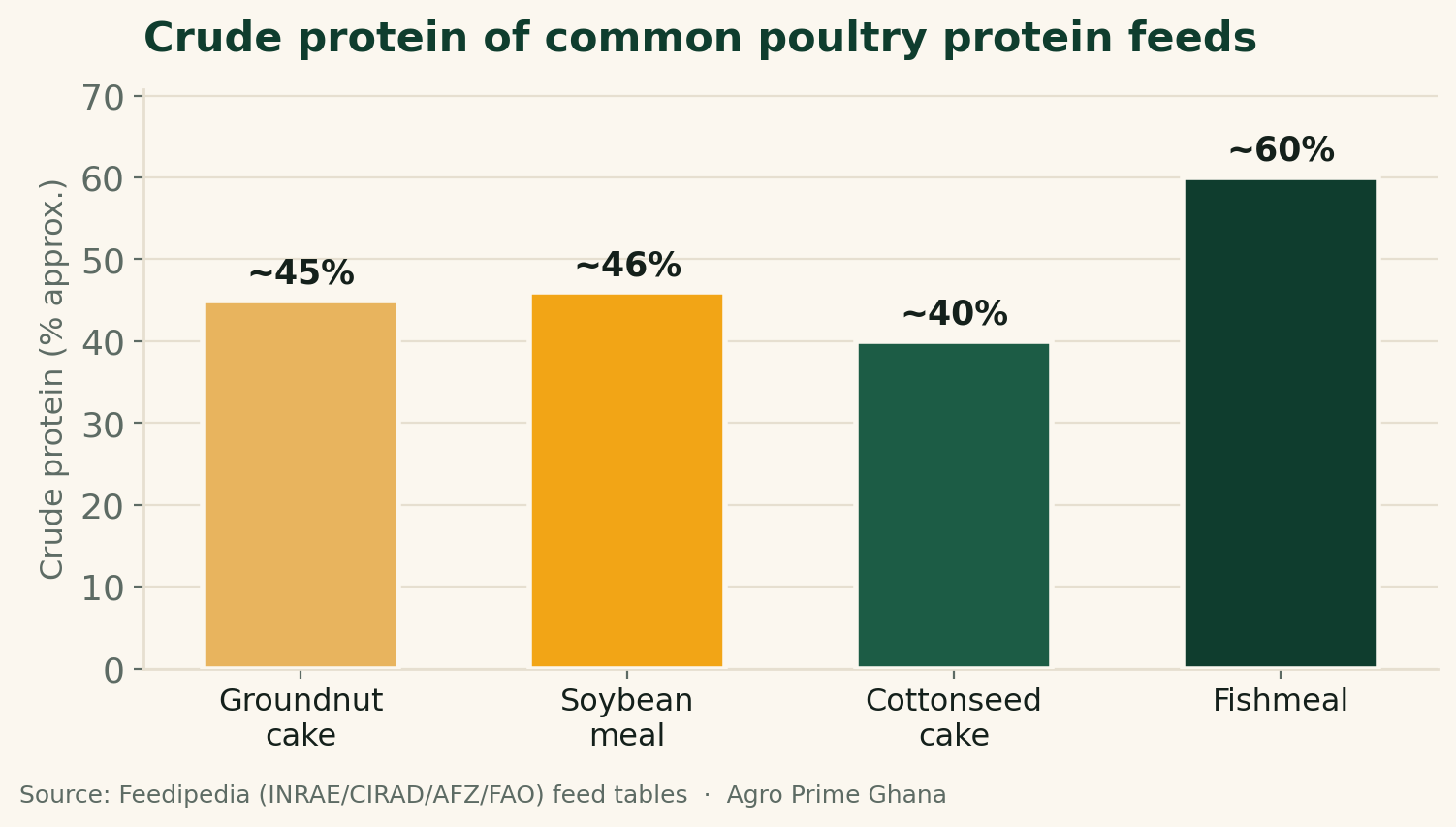
Groundnut cake is a protein source, not a complete feed, and it is best understood next to the other proteins a Ghanaian mixer might reach for. On crude protein it is competitive with soybean meal and well ahead of cottonseed cake; on amino-acid quality, though, it trails both soybean and fishmeal because of its lysine shortfall. The table below sets out the practical picture, drawn from the Feedipedia feed tables.
| Protein feed | Crude protein (approx.) | Main strength | Main limitation for poultry |
|---|---|---|---|
| Groundnut cake | ~40–48% | Local, affordable, high protein & energy | Low lysine; high aflatoxin risk |
| Soybean meal | ~44–48% | Best amino-acid balance of the plant proteins | Costly, often imported |
| Fishmeal | ~55–65% | Excellent lysine & methionine, very digestible | Expensive; adulteration/quality risk |
| Cottonseed cake | ~35–41% | Cheap local by-product | Gossypol; limited in layers |
The lesson from the table is that groundnut cake is a fine part of the protein supply — rarely the whole of it. Pairing it with a lysine-rich ingredient (fishmeal or soybean meal) or with synthetic lysine turns a lopsided protein into a balanced one. For the wider menu of what goes into a ration, see our guide to poultry feed ingredients in Ghana.
The amino-acid catch: why lysine is the problem
Protein percentage alone does not tell you whether a feed grows a chicken well — the balance of amino acids does. Poultry have specific requirements for lysine and methionine in particular, and groundnut cake falls short on both. Feedipedia puts lysine at roughly 3.5% of the protein and methionine near 1.0–1.1% — both low compared with soybean meal, and lysine is usually the first-limiting amino acid in groundnut-heavy diets. In plain terms, if you swap soybean meal out and pile groundnut cake in to hit the same crude-protein number on paper, the birds will still grow poorly, because they run out of lysine long before they run out of "protein." The fixes are straightforward: keep some soybean meal or fishmeal in the mix, add synthetic L-lysine (and DL-methionine), and formulate to the amino-acid target rather than the crude-protein target. Our note on amino acids in poultry feed explains how these limiting amino acids drive growth and lay.
Field note: don't chase the protein number alone
The commonest home-mixing mistake we see is treating groundnut cake as a drop-in for soybean meal because "it has the same protein." On paper the ration looks fine; in the pen the birds are uneven, feathering is poor and growth lags — and the issue is almost always lysine. When groundnut cake is doing a lot of the protein work, we keep a lysine source in the formula and add synthetic lysine rather than simply pushing the cake higher. Balancing the amino acids costs a little; unbalanced protein wastes the whole ration.
Aflatoxin: the risk you cannot see or smell
The most serious issue with groundnut cake is not nutrition — it is aflatoxin, a toxin produced by Aspergillus flavus and related moulds. Groundnut is one of the crops most prone to it, and the Feedipedia datasheet is blunt: aflatoxin is "a major concern in poultry," and cake "should be rejected if there is a suspicion of contamination (mould, bad storage, etc.)." The trap is that the toxin is invisible and tasteless to the bird, is not the same thing as visible mould, and survives ordinary milling and feed processing — so cake that looks and smells fine can still carry a dangerous dose. And the tolerances are tiny. The MSD Veterinary Manual gives tolerable dietary levels of only about 50 parts per billion (ppb) for young poultry and 100 ppb for adults, with clinical disease and deaths at roughly double those levels. The European Union caps aflatoxin B1 in complete poultry feed at just 0.02 mg/kg (20 ppb). Aflatoxin damages the liver, suppresses immunity (so vaccines take poorly and disease breaks through) and wrecks growth and feed conversion — and there is no cure once birds are poisoned. That makes clean sourcing and storage the entire game.
Storage and rancidity: why fresh matters
The residual oil that makes local groundnut cake energy-rich is also its shelf-life problem. Feedipedia notes that mechanically extracted (expeller) meal tends to become rancid if stored more than about 5–6 weeks in warm conditions — and "warm conditions" is Ghana most of the year. Rancid fat is not just unpalatable; it destroys fat-soluble vitamins in the feed and lowers the ingredient's value. On top of that, cake held warm and humid is cake given time to grow more mould and generate more aflatoxin. The practical rules follow directly:
- Buy in the quantities you will use quickly — do not stockpile months of groundnut cake in the heat.
- Store dry, cool, ventilated and off the floor, away from walls, rain, leaks and rodents, in bags that can breathe rather than sweat.
- Reject anything musty, caked, warm in the sack, discoloured or insect-damaged — those are the visible signs of the mould that makes aflatoxin.
- Use a toxin binder as insurance where grain quality is hard to guarantee, but never as a licence to use poor cake.
Good storage discipline applies to the whole feed store, not just the cake — the same principles that protect maize protect groundnut cake, and we cover them in our guide to making poultry feed in Ghana.
Field note: the sensory check is the floor, not the ceiling
Before any groundnut cake goes into a mix we look, smell and feel: fresh cake smells nutty and clean, breaks up dry and shows no green-grey mould, caking or weevils. That quick check catches the worst material and costs nothing. But we are honest about its limit — aflatoxin can be present with no visible mould at all, so a clean look is the minimum bar, never proof of safety. The real protection is a trusted supplier who dries and stores nuts properly, buying fresh and in small lots, and keeping your own store dry. Where the stakes are high, testing a suspect batch beats guessing.
How much groundnut cake to include
A safe, effective inclusion for groundnut cake is roughly 5–15% of the ration, used alongside other protein sources rather than as the sole protein — the level Feedipedia gives for poultry. Where you land depends on the bird class. Broilers, which grow fast and have high amino-acid demands, do best when fishmeal or soybean meal stays in the mix and groundnut cake is a supporting protein with added lysine; layers can carry a modest inclusion provided the amino acids are balanced and — critically — the cake is aflatoxin-clean, because layers live long and pass residues into eggs. Two rules keep you out of trouble: never push groundnut cake up simply to save money on soybean or fishmeal (you will hit the lysine wall), and never relax on quality to use a cheaper, older or mouldier lot. If cutting feed cost is the goal, formulate smartly rather than overloading one cheap protein — see reducing poultry feed cost in Ghana.
Get clean feed and healthy chicks from one source
Groundnut cake only pays off when the rest of the system is right — good chicks, a balanced ration and clean ingredients. Agro Prime Ghana supplies strong, vaccinated day-old broilers and layers, point-of-lay pullets and quality feed, and we help farmers formulate rations that use local proteins like groundnut cake safely and cost-effectively. If you are unsure whether your feed is well balanced or your groundnut cake is safe to use, talk to us before you mix a bad batch. Message us on WhatsApp (+233 24 915 1503) or book a visit to sort out chicks, feed and a ration plan together.
Processing and quality: what to look for
Not all groundnut cake is equal, and a few checks separate a good buy from a costly one. Oil content matters: expeller cake with more residual oil carries more energy but spoils faster, so it must be fresher. Adulteration is a real market risk — cake is sometimes bulked out with hulls, shells or fillers that dilute protein and raise crude fibre, so cake that looks unusually light, husky or fibrous deserves suspicion. Grind should be even, not a mix of fine meal and hard lumps. Above all, freshness and dryness trump everything, because they govern both rancidity and aflatoxin. Buy from a miller who moves stock quickly, and match the cake you buy to how fast you will use it. Groundnut cake is one of several local proteins worth knowing well; our overview of alternative protein sources for poultry sets it beside options like soybean, fishmeal and insect meal.
The bottom line on groundnut cake
Groundnut cake is a genuinely good Ghanaian poultry protein — local, affordable and rich in both protein and energy — and it deserves a place in many rations. But it rewards respect on two fronts. Nutritionally, it is lysine-short, so it must be balanced with a lysine source or synthetic amino acids, not simply swapped for soybean meal by matching the protein number. On safety, it is the ingredient most likely to carry aflatoxin, so it must be bought clean and fresh, stored dry and cool, and rejected the moment it looks or smells off. Get those two things right — balance the amino acids and keep the mould out — and groundnut cake earns its keep.
Frequently asked questions
What is the protein content of groundnut cake for poultry?
Can groundnut cake replace soybean meal in poultry feed?
How much groundnut cake can I put in poultry feed?
Why is aflatoxin such a concern with groundnut cake?
Can I see or smell aflatoxin in groundnut cake?
Why does groundnut cake go rancid, and how long does it keep?
Is groundnut cake safe for laying hens?
Does groundnut cake need any processing before feeding?
Sources & further reading
- Feedipedia (INRAE, CIRAD, AFZ & FAO) — Peanut meal (crude protein, energy, amino-acid profile, inclusion rates, aflatoxin and rancidity/storage notes).
- MSD Veterinary Manual — Aflatoxicosis in Animals (tolerable ppb levels, effects on liver, immunity and growth).
- Agro Prime Ghana guides: poultry feed ingredients, amino acids in poultry feed, how to make poultry feed, reducing poultry feed cost, and alternative protein sources.
About Agro Prime Ghana
Agro Prime Ghana Limited runs a poultry hatchery and mixed agribusiness in Kasoa, supplying day-old chicks and supporting poultry keepers across the country. These guides combine hands-on hatchery and farm experience with current industry and veterinary references. This article is general educational information, not a substitute for professional nutritional or veterinary advice — if you suspect aflatoxin or a feed problem in your flock, seek help and have feed tested where possible. We supply healthy day-old chicks (broilers & layers), point-of-lay pullets, quality feed and hands-on farm support. Ready to start or expand? Book a visit or message us on WhatsApp (+233 24 915 1503) to order chicks, feed or advice.