You open up a bird that died without much warning, and the sight is unmistakable once you have seen it: a fine, chalky-white coating over the heart, liver and lining of the body cavity, as if the organs had been dusted with powder. That powder is uric acid — urate crystals — and it means the bird's kidneys failed to clear the nitrogen waste birds normally pass as urates. Gout is not really a single disease; it is the visible end-point of kidney trouble, and it shows up for a handful of avoidable reasons: birds that ran short of water, feed with too much calcium for the bird's age, and a few others. This guide explains the two forms of gout, why urates pile up, and the management and feeding mistakes that cause it under Ghanaian conditions.
Written by the Agro Prime Ghana poultry team and reviewed against current veterinary references (MSD Veterinary Manual and The Poultry Site). Last updated September 2026.
Key takeaways
Gout in poultry is the deposition of uric acid (urate) crystals in the body because the kidneys cannot clear nitrogen waste fast enough. Birds excrete their nitrogen as urates, so kidney damage quickly leads to a build-up. There are two forms: visceral gout (acute — white urate coating on the heart, liver and body-cavity lining, after rapid kidney failure) and articular gout (chronic — urates in the toe and wing joints, causing swelling and lameness). The common triggers are water deprivation, too much dietary calcium fed to non-laying birds (the MSD Veterinary Manual flags feed above 3% calcium in non-layers; growers should get no more than about 1% up to 16 weeks), excess protein, vitamin A deficiency, nephropathogenic infectious bronchitis and mycotoxins. There is no effective treatment once the kidneys are damaged — prevention through water and correct feed is everything.
What gout in poultry actually is
To understand gout you have to start with how a bird handles nitrogen. Unlike mammals, which pass protein waste as urea dissolved in plenty of urine, birds convert nitrogen waste into uric acid and excrete it as urates — the white, pasty part of a normal dropping — bound in a semi-solid form with very little water. That water-thrifty system is brilliant for a flying animal, but it leans heavily on the kidneys and works only while the bird is well hydrated and the kidneys are healthy. When the kidneys are damaged or the bird is dehydrated, uric acid builds up in the blood (hyperuricaemia) and, past a point, comes out of solution and crystallises in the tissues. Those chalky urate crystals are gout. The MSD Veterinary Manual describes the deposits as white and semisolid, to be told apart from the inflammatory exudates of infectious disease. So gout is best thought of not as an infection but as a sign of kidney failure — a symptom with several possible causes, most of them things you can control.
The two forms: visceral and articular gout
Gout shows up in two quite different patterns, and knowing which you are looking at tells you how it happened. The MSD Veterinary Manual sets them out:
- Visceral gout is the acute form, following rapidly progressing kidney failure. Urates are deposited on the pericardium (the sac around the heart), the peritoneum (the body-cavity lining) and the liver capsule — the classic white "frosting" of internal organs found at post-mortem. This is the form most often seen as sudden deaths, including in very young chicks.
- Articular gout is the chronic form, developing after long-term raised uric acid in the blood, with urate crystals building up in the toe and wing joints, causing joint enlargement, foot deformities and lameness. It comes on slowly and is linked to a hereditary defect in uric acid metabolism or chronically excessive protein.
In Ghanaian flocks, visceral gout is by far the more common and dramatic presentation — the one that shows up as unexplained deaths in chicks or growing birds, often traced to a water or feed problem. Articular gout is less common and more of a slow, individual-bird problem.
Why urates build up: the real-world causes
Almost every case of gout traces back to something that damaged the kidneys or overwhelmed the bird's ability to excrete urates. The main causes, drawn from the MSD Veterinary Manual and The Poultry Site, each map onto a preventable management decision:
- Water deprivation and dehydration. The classic cause, and in a hot climate the most important. Any interruption of drinking water — an empty or blocked drinker, a broken supply, a hot spell — concentrates urates and stresses the kidneys. Very young chicks are especially vulnerable if water is delayed in their first days.
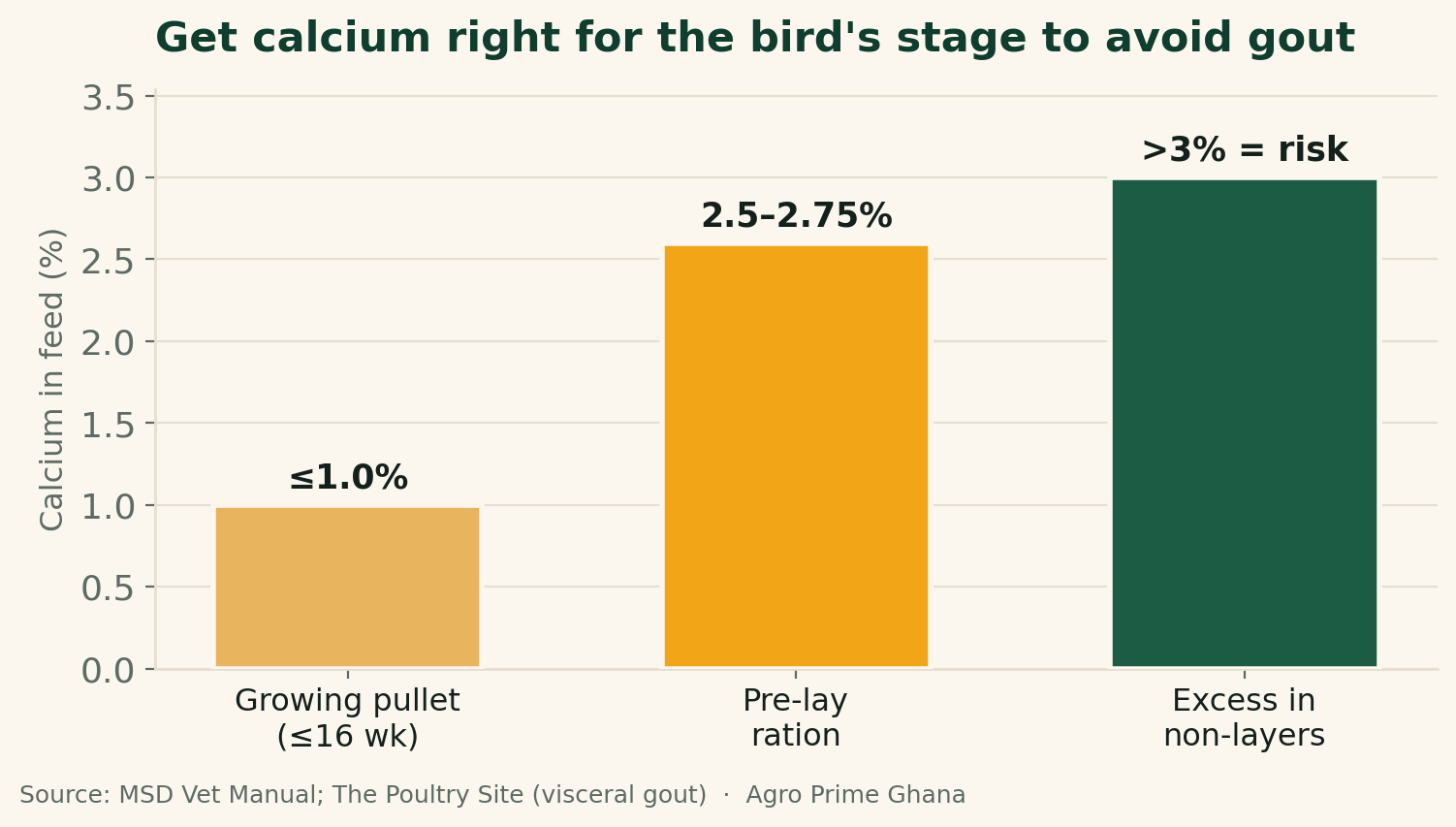
- Too much dietary calcium fed to the wrong bird. The MSD Veterinary Manual flags feed containing more than 3% calcium fed to non-laying chickens as a cause of gout — a common error, usually feeding high-calcium layer feed to growing pullets whose kidneys cannot handle the load (see the table below for the calcium ladder by stage).
- Excess dietary protein. Very high protein means more nitrogen for the kidneys to clear; extreme excess has produced gout experimentally, and chronically high protein is linked to articular gout.
- Vitamin A deficiency. Vitamin A keeps the kidney tubules and ureters healthy; a deficiency predisposes to urate build-up.
- Kidney-damaging infections. Nephropathogenic infectious bronchitis, avian nephritis virus and other agents damage the kidneys directly and can trigger visceral gout.
- Mycotoxins. Some mould toxins (such as oosporein and ochratoxin) are directly toxic to the kidneys — another reason mouldy feed is dangerous.
The through-line is clear: keep water flowing, match calcium and protein to the bird's stage, protect the kidneys from toxins and infection, and gout largely disappears. Calcium is worth pinning down by stage, since the right level at the wrong age is a common trigger:
| Bird's stage | Calcium in feed | Gout risk / note |
|---|---|---|
| Growing pullet (to 16 weeks) | No more than ~1% | Young kidneys cannot handle more — keep growers off layer feed |
| Pre-lay (approaching lay) | ~2.5–2.75% | Introduce only as the flock nears lay, not before ~16 weeks |
| Laying hen | Full layer level | The high calcium is safe once the hen is actually laying |
| Non-layer on high-calcium feed | Above 3% | Classic error — a recognised cause of gout in non-laying birds |
Field note: the wrong feed in the wrong bag is a classic gout trap
One of the most avoidable causes of gout we see is a feeding mix-up — growing pullets ending up on high-calcium layer feed, either because the wrong bag was opened or the flock was switched to layer ration too early, before the birds were laying. Young kidneys cannot cope with that calcium load, and the result can be a run of unexplained deaths with the tell-tale white urate coating inside. The discipline that prevents it is simple but easy to let slip: know which ration each pen should be on, introduce layer-level calcium only when the flock is genuinely coming into lay, and never assume a bag is the right feed just because it is the one to hand. Our layer feeding guide sets out the calcium-by-stage logic.
Recognising gout in the flock
Gout is often first found at post-mortem rather than in the live bird, especially the visceral form, because affected birds may simply be found dead. Still, watch for:
- Unexplained deaths, particularly in chicks and growing birds, sometimes in a cluster after a water interruption or a feed change.
- The post-mortem picture of visceral gout — a chalky white coating on the heart sac, liver surface and body-cavity lining, and sometimes swollen, pale kidneys with urate-filled ureters.
- Lameness and swollen joints in articular gout — enlarged, painful toe and wing joints, reluctance to move, and over time foot deformities.
- General signs — dullness, poor growth, weight loss and increased thirst.
When gout turns up, investigate the flock's water, feed and any kidney-damaging infection — the dead bird is flagging a problem the rest of the flock may still be living with.
Why kidney damage is so unforgiving
One reason gout is worth preventing rather than treating is how the avian kidney behaves under damage. As The Poultry Site notes, a bird can keep functioning and producing until less than about a third of its normal kidney mass is still working — so kidney damage builds up silently, with no outward sign, until a large part of the organ is already gone. And at the other end, a bird that tips into complete renal failure will likely die within around 36 hours. That combination — hidden until late, then rapidly fatal — is exactly why gout shows up as sudden, "unexplained" deaths, and why the sensible strategy is to protect the kidneys before they are harmed.
Water: the first and cheapest defence
If there is one lever that prevents more gout than any other in a hot country, it is constant access to clean, cool drinking water. Dehydration concentrates urates and pushes stressed kidneys over the edge, and in Ghana's heat the margin is thin. The habits that matter:
- Never let drinkers run dry. Check supply through the day, especially in hot weather; make sure every bird can physically reach water.
- Get chicks drinking early. Ensure day-old chicks find water quickly in the first days — early water deprivation is a real cause of chick gout.
- Keep water clean and lines flowing. Blocked nipples, kinked lines and dirty founts all reduce intake without being obvious.
- Manage the heat. Heat drives both dehydration and reduced feed intake, so the measures that reduce heat stress also protect the kidneys — see our guide to heat stress in poultry.
Water is nearly free, and getting it right removes the single biggest preventable cause of gout.
Field note: after any water interruption, watch the flock closely
A short water outage is easy to shrug off once it is fixed, but it is exactly the kind of event that produces a wave of gout deaths a day or two later — the damage is done to the kidneys during the dry spell and shows up afterwards. Whenever water has been interrupted for any length of time — a pump failure, an empty tank, a blocked line found late — treat the following days as a watch period: make sure recovery water is clean and freely available, keep the birds cool, and do not be surprised by deaths that follow. Treat the interruption as a near-miss to learn from, not a fixed-and-forgotten glitch.
Feed: matching calcium and protein to the bird
After water, feeding is where gout is won or lost, and the core principle is that calcium must match the bird's stage of life (see the table above). Getting the timing right — never switching to high-calcium layer feed before the flock is genuinely laying — matters as much as the numbers. Protein deserves the same discipline: feed to requirement, since surplus protein loads the kidneys with more nitrogen to excrete. If you mix your own feed, our guide on how to make poultry feed covers formulating to the bird's stage. Finally, keep feed free of mould, since kidney-toxic mycotoxins are a direct cause of gout.
Prevention checklist and the bottom line
Because there is no effective treatment once the kidneys are damaged and urates are deposited, gout is entirely a prevention game — and the measures are cheap and within every keeper's control. Pull them into a routine: constant clean water that never runs dry; calcium matched to stage, keeping growers off high-calcium layer feed; protein to requirement; adequate vitamin A; feed free of mould and mycotoxins; a guard against kidney-damaging infections such as nephropathogenic infectious bronchitis; and nephrotoxic drugs only on veterinary advice. Do these consistently and gout stops being a mysterious source of sudden deaths and becomes what it really is — a preventable sign of a kidney insult you can avoid. On flocks growing fast and being pushed to lay in a hot climate, the margin for error on water and calcium is small, but the cost of getting them right is close to nothing.
Frequently asked questions
What is gout in poultry?
What is the difference between visceral and articular gout?
What causes gout in chickens?
Why does feeding layer feed to young birds cause gout?
Can gout in poultry be treated?
How is gout diagnosed?
Why does gout show up as sudden deaths?
How do I prevent gout in my flock?
Sources & further reading
- MSD Veterinary Manual — Urate Deposition (Gout) in Poultry (visceral vs articular gout, urate excretion, causes including >3% calcium in non-layers, dehydration, vitamin A deficiency, infectious bronchitis, mycotoxins; white semisolid deposits).
- The Poultry Site — Avian Urolithiasis (Visceral Gout): An Overview (dietary calcium ≤1% to 16 weeks and 2.5–2.75% pre-lay, protein excess, kidney can function until <⅓ mass remains, ~36 hours to death in complete renal failure).
- Agro Prime Ghana guides: layer feeding guide, heat stress in poultry, and how to make poultry feed.
About Agro Prime Ghana
Agro Prime Ghana Limited runs a poultry hatchery and mixed agribusiness in Kasoa, supplying day-old chicks and supporting poultry keepers across the country. These guides draw on hands-on hatchery and farm experience, checked against current veterinary references. This article is general educational information, not a substitute for diagnosis by a qualified veterinary or extension officer — if you find unexplained deaths or urate deposits in your flock, get a post-mortem and review your water and feed. Need chicks, feed advice or farm support? Book a visit or message us on WhatsApp (+233 24 915 1503).