
Gari is one of Ghana's most-eaten foods and one of its most accessible agribusinesses. Made from cassava — a cheap, abundant crop — gari stores for months, sells everywhere, and turns a perishable root worth little into a durable staple worth far more. A gari processing business sits at the profitable heart of the cassava value chain, and it can start small, in a village or a backyard, and grow into a branded, packaged product with strong domestic and even diaspora-export demand. This guide covers how to start and run a gari processing business in Ghana.
Key takeaways
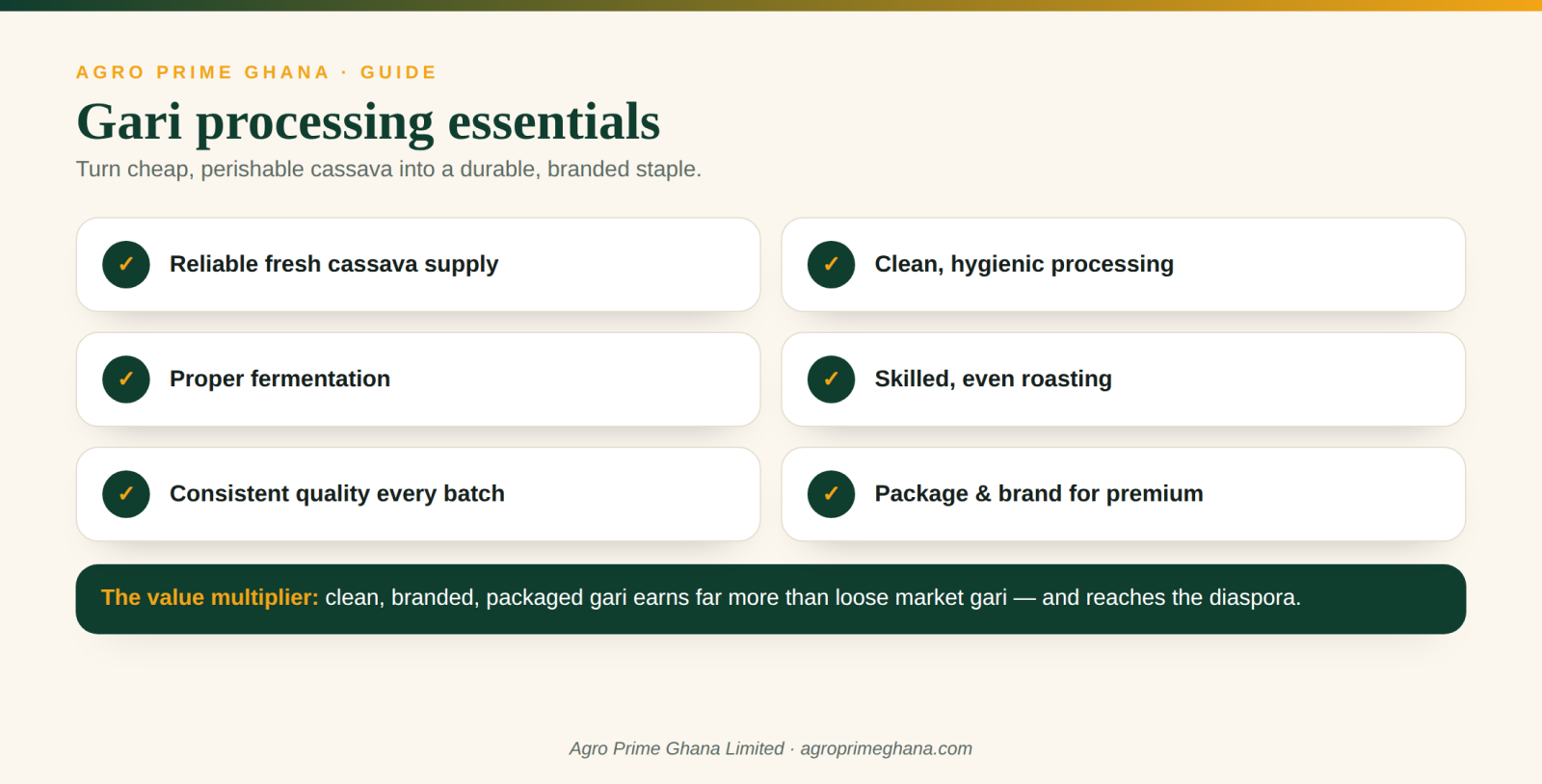
Gari turns cheap, perishable cassava into a durable, high-demand staple with a much better margin. Secure a steady supply of fresh cassava (roots must be processed within a day or two), follow the process cleanly — peel, wash, grate, ferment, dewater, sieve and roast — and focus on hygiene, consistent quality and good packaging. Clean, well-fermented, well-roasted, branded gari commands premium prices at home and among Ghanaians abroad.
Why gari processing is a smart business
Gari solves cassava's biggest problem — its roots spoil within days of harvest — by turning them into a product that keeps for months. That single transformation is where much of the cassava value chain's money is made. Demand is enormous and constant: gari is a daily food across Ghana, a student and household staple, cheap and filling, and it travels and stores well. The raw material is abundant and cheap, and the business scales gracefully from a small manual operation to a mechanised, branded enterprise. It is also a proven livelihood, especially for women's groups and rural entrepreneurs. For anyone with access to cassava — including a farmer who grows it, as covered in our cassava farming guide — processing it into gari captures far more value than selling perishable roots.
Securing your cassava supply
A gari business lives on a reliable flow of fresh cassava, and timing is everything. Because roots deteriorate within a day or two of harvest, you must process them quickly, which means your supply and your processing capacity have to match. Options are to grow your own cassava (giving you full control and the best margins), to contract nearby farmers to supply fresh roots on a schedule, or to buy from the market — but always so that roots reach your processing within a day of lifting. Build steady relationships with cassava farmers or aggregators, and plan harvesting and delivery around your daily processing capacity. High-starch, good-quality cassava varieties give better gari yield and quality. Getting this supply-and-timing link right is the foundation of the whole business; a processor who cannot get fresh roots reliably cannot run.
The gari-making process, step by step
Gari making follows a clear, traditional sequence that must be done cleanly:
- Peel and wash: peel the fresh cassava roots and wash them thoroughly clean.
- Grate: grate the peeled roots into a mash (a mechanical grater greatly speeds this up as you scale).
- Ferment: bag the mash and let it ferment for a few days — this develops gari's characteristic slightly sour taste, improves safety by helping reduce cyanide, and is essential to quality.
- Dewater (press): press the fermenting mash to squeeze out the water, using a press or weighted sacks, until it is a firm, dry-ish cake.
- Sieve: break up and sieve the pressed cake to remove fibre and lumps, giving a fine, even grit.
- Roast (garify): roast the sieved mash on a hot pan, stirring constantly, until it dries into the crisp, golden gari — the step that most defines quality and needs skill.
- Cool, sieve and pack: cool the gari, sieve again for uniformity, and package it clean and dry.
Each step affects the final quality, but fermentation and roasting are where good gari is truly made.
Hygiene and food safety: the foundation
Gari is a food that people eat directly, so hygiene is not optional — it is the product's credibility. Use clean water for washing, clean equipment and surfaces, and clean, healthy workers with good practices, and keep the processing area free of dust, pests and contamination. Because gari is dry-roasted and low in moisture, it is fairly stable once made, but contamination before or during processing — dirty roots, dirty water, unclean grating or roasting — shows up as poor, unsafe product that buyers reject. Proper fermentation also matters for safety, helping reduce the natural cyanogens in cassava. Clean, hygienic processing gives the white, clean, safe gari that quality-conscious buyers and shops want, and it is what lets you move from selling loose gari in the market to selling a trusted, packaged brand.
Quality: what makes gari sell
Not all gari is equal, and quality decides your price and repeat custom. Good gari is clean and free of grit, stones and fibre; uniform in size; well-roasted to a good colour and crispness (neither burnt nor under-dried); properly fermented to the right, pleasant sourness; and dry enough to store well without spoiling. Buyers and traders quickly learn which processors deliver consistent, clean, good-tasting gari, and they pay more and come back for it. Consistency across batches is as important as any single good batch — a brand people trust is built on gari that is the same, good quality every time. Paying attention to clean sourcing, correct fermentation, careful roasting and good sieving is what separates a premium gari business from one selling cheap, variable product.
Packaging, branding and premium markets
This is where a gari business earns real margins. Loose gari sold by the bowl in the market is the lowest-value route; clean, well-packaged, branded gari in sealed bags with a label is worth far more and reaches better markets. Good packaging keeps the gari clean, dry and fresh, signals quality, and lets you build a recognisable brand that shops, supermarkets and customers ask for by name. Branded, well-packaged gari sells into supermarkets and shops, to schools and institutions, and — a genuinely lucrative market — to the large Ghanaian diaspora abroad, who buy quality packaged gari at premium prices. Even simple, clean, sealed packaging with a clear label transforms the value of the same gari. For a processor, investing in hygiene, consistent quality and good packaging is the path from a village trade to a branded food business.
The economics
Gari processing turns a cheap input into a valuable product, which is the source of its margin. Your main costs are fresh cassava, labour (peeling, grating, pressing, roasting), fuel or power for roasting and grating, fermentation and pressing equipment, and packaging. Against that, gari sells steadily and, when clean, consistent and branded, at a good price — with packaged and export-grade gari earning far more than loose market gari. Because cassava is cheap and demand is constant, a well-run operation with reliable supply and good quality earns dependable returns, and it scales by adding mechanised graters, pressers and better roasting as volume grows. Keep clear records of cassava bought, gari produced and sold, and your costs, so you know your true margin per bag — the same discipline behind any serious enterprise.
Starting small and scaling up
Gari processing is one of the most accessible agribusinesses because it can start small and grow with demand. A modest operation — manual grating and pressing, traditional roasting, serving a local market — can begin with little capital and prove the trade, then reinvest into a mechanical grater and press (which hugely increase output and ease the hardest labour), better roasting setups, and clean packaging to move up-market. Starting small lets you master the process, especially fermentation and roasting, and build a supply of cassava and a base of buyers before committing more. As you grow, mechanisation, consistent quality and branding open supermarkets, institutions and the export market. This staged growth — prove the quality and supply small, then mechanise and brand — keeps risk low and lets the business fund its own expansion, which is why gari processing has lifted so many rural and women-led enterprises.
Common mistakes to avoid
- Unreliable cassava supply, since roots spoil in a day or two — match supply to your processing capacity.
- Poor hygiene, giving dirty, unsafe gari that quality buyers reject.
- Skipping or rushing fermentation, losing the right flavour and the safety benefit.
- Bad roasting — burnt or under-dried gari that tastes poor or spoils.
- Selling only loose gari when clean packaging and branding earn far more.
- Inconsistent quality across batches, which stops you building a trusted brand.
Frequently asked questions
Is gari processing profitable in Ghana?
How is gari made?
Why is fermentation important in gari?
How do I get cassava for gari processing?
Can I start a gari business small?
How do I make my gari worth more?
Is there an export market for gari?
What equipment do I need for gari processing?
The bottom line on gari processing
Gari processing sits at the profitable centre of the cassava value chain, turning a cheap, perishable root into a durable staple that Ghana eats every day and Ghanaians abroad pay a premium for. It is one of the most accessible agribusinesses — it can start small with little capital and grow into a branded, mechanised enterprise. Success comes down to a few essentials: a reliable supply of fresh cassava matched to your capacity; clean, hygienic processing; proper fermentation and skilled roasting for the right taste, safety and crispness; consistent quality across batches; and, to capture real margins, good packaging and branding. Get those right, start small and reinvest into mechanisation and branded packaging, and gari processing becomes a dependable, scalable food business — and, for a cassava farmer, the natural way to earn far more from the crop than selling perishable roots ever could.
Turn cassava into a branded product
Agro Prime Ghana Limited runs a hatchery and agribusiness in Kasoa. Processing crops like cassava into gari adds real value to a diversified farm. Talk to us about building a resilient agribusiness: book a visit or message WhatsApp (+233 24 915 1503).


