A layer flock that was laying well starts to fall apart over a week or two: birds go off feed, stand hunched with pale, shrunken combs, pass greenish-yellow diarrhoea, and deaths climb day after day with no obvious respiratory sign to explain it. Egg numbers collapse. You open a dead bird and the liver is enlarged and stained an odd bronze-green, the spleen swollen. That grim picture is the classic face of fowl typhoid — a bacterial disease of chickens caused by Salmonella Gallinarum that is one of the most serious killers of layers and growers in Ghana and across the tropics. Being a bacterium, it can be knocked back with antibiotics in an outbreak — but they never truly cure it, because survivors become lifelong carriers. This guide explains how fowl typhoid works, how it spreads, and why the real answer is prevention through biosecurity and clean stock rather than the medicine cabinet.
Written by the Agro Prime Ghana poultry team and reviewed against current veterinary references (MSD/Merck Veterinary Manual, WOAH and Ghanaian peer-reviewed research). Last updated September 2026.
Key takeaways
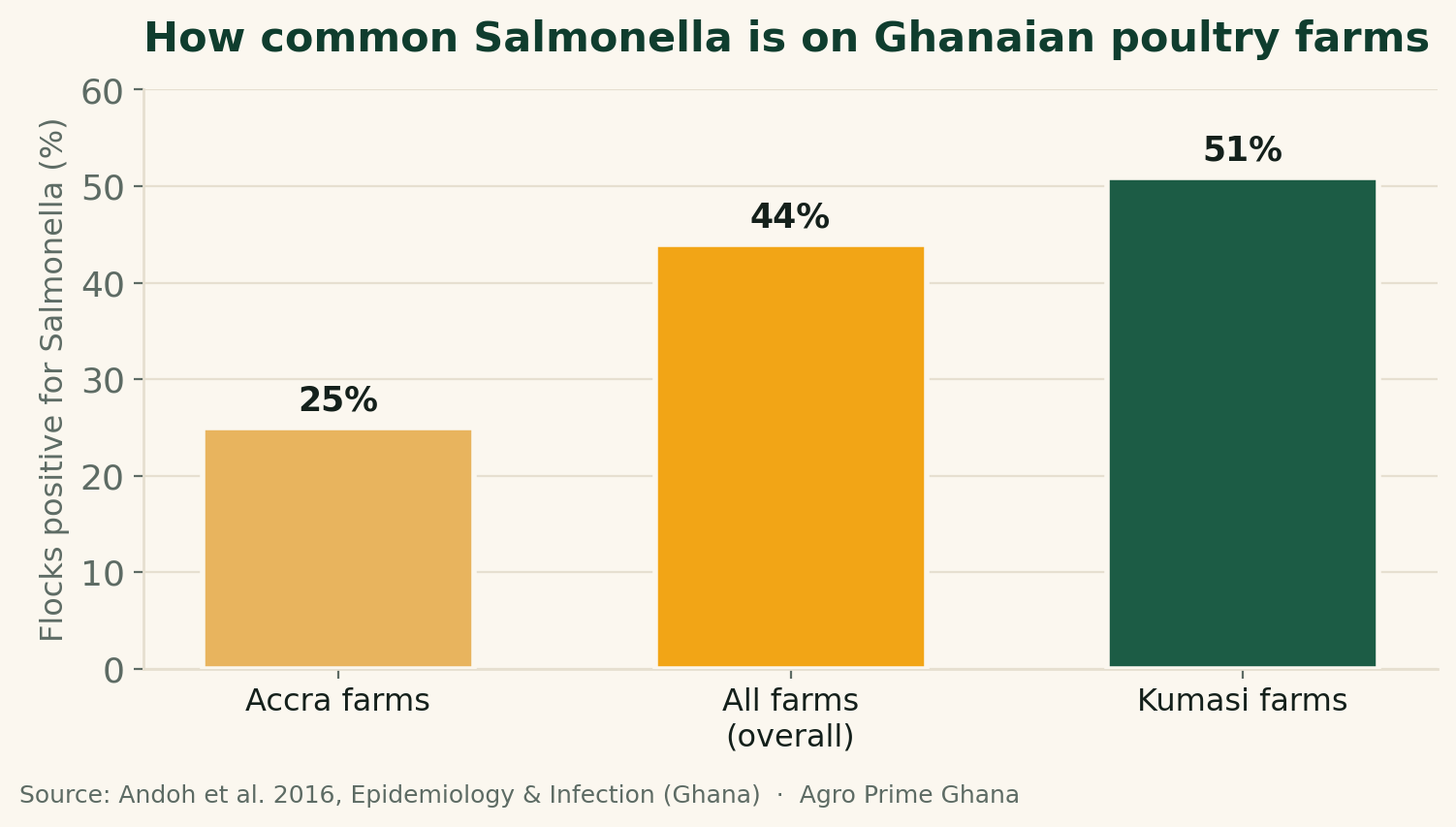
Fowl typhoid is a bacterial septicaemic disease caused by Salmonella enterica serovar Gallinarum, a host-adapted, non-motile bacterium that mainly attacks chickens. It hits growing and adult birds hard — especially layers, broiler breeders and brown-egg layers — with morbidity of 10–100% and mortality that can reach up to 100% in badly affected flocks. It spreads both vertically (from infected hen to chick through the egg) and horizontally (droppings, contaminated feed, water, equipment, people and rodents), and recovered birds become lifelong carriers that keep seeding the disease. Tell-tale post-mortem signs are a swollen, bronze- or bile-stained liver and an enlarged spleen. Antibiotics can cut deaths during an outbreak but do not eliminate carriers, so control rests on biosecurity, clean chicks, rodent control and, where whole flocks are affected, culling. Research across Ghanaian poultry has found Salmonella on 44% of farm flocks, underlining how present this family of bacteria is locally.
What fowl typhoid actually is
Fowl typhoid is caused by Salmonella enterica serovar Gallinarum (usually written S. Gallinarum). According to the Merck (MSD) Veterinary Manual, it is a gram-negative, non-motile, host-adapted avian pathogen — specialised to poultry, particularly chickens, rather than a broad environmental germ. That host-adaptation makes S. Gallinarum behave more like a true poultry plague than like the food-poisoning salmonellas. It is closely related to S. Pullorum, the cause of pullorum disease in chicks, and the two are often discussed together because they share the same species and many control measures. Fowl typhoid is primarily a septicaemic disease — the bacteria multiply in the bloodstream and internal organs, especially the liver and spleen — which is why it causes such heavy, rapid mortality rather than just a gut upset. Because it is host-adapted, S. Gallinarum does not usually cause illness in people, but its close relatives in the Salmonella family certainly do, which is why any salmonella problem on a farm deserves serious attention.
Why fowl typhoid is such a threat in Ghana
Fowl typhoid thrives where poultry are kept intensively without airtight biosecurity — many Ghanaian layer and grower operations. It is a particular danger to layers and breeders: the Poultry Site's disease guide notes that broiler parents and brown-shell egg layers are especially susceptible, and brown-egg layers dominate Ghana's commercial egg sector. Because the bacterium is egg-transmitted, a single infected parent flock can pass the disease down through its eggs into the chicks it produces, so buying day-old chicks or point-of-lay birds from an unverified source can import typhoid straight onto a clean farm. Once on a farm it spreads readily through droppings, shared feed and water, contaminated crates and equipment, and the movement of people, vehicles and — very importantly here — rodents and wild birds. The scale of the wider salmonella challenge locally is well documented: a peer-reviewed survey of commercial poultry across Accra and Kumasi in Epidemiology & Infection detected Salmonella on 44% of farm flocks (about half of Kumasi farms positive), with 60.6% of isolates resistant to at least one antibiotic. Those serovars were mostly environmental, food-poisoning types rather than Gallinarum itself, but the finding matters: it shows how widespread and drug-resistant salmonellas already are on Ghanaian farms, which makes leaning on antibiotics to manage a Gallinarum problem both unreliable and risky.
How deadly it is: morbidity and mortality
Fowl typhoid earns its reputation as a killer. The Poultry Site guide gives morbidity of 10–100% — the share of birds affected can range from a modest slice of the flock to the whole of it — and states that mortality may be up to 100%, especially in stressed or immunocompromised birds. Deaths typically build over days and can continue for weeks as the infection works through the flock. The Merck manual notes the disease can strike birds of any age, but here it differs from pullorum disease (mainly a chick disease): fowl typhoid is notorious for heavy losses in growing and adult birds, including productive layers mid-lay. That is what makes it so financially painful — it kills birds you have already invested months of feed into, at the point when they should be earning their keep through eggs.
| Fowl typhoid (S. Gallinarum) | Pullorum disease (S. Pullorum) | |
|---|---|---|
| Birds most affected | Growers and adults, esp. layers & breeders | Mainly young chicks (first weeks) |
| Classic signs | Pale combs, greenish diarrhoea, sudden deaths in lay | White pasty vent, huddling chicks, high chick deaths |
| Key post-mortem sign | Swollen bronze/bile-stained liver, big spleen | White nodules in organs; unabsorbed yolk |
| Egg (vertical) spread | Yes | Yes |
| Carrier state | Recovered birds carry for life | Recovered birds carry for life |
How to recognise fowl typhoid
The clinical picture depends a little on age, but in the growers and adults where typhoid does its worst damage the signs are fairly consistent. Affected birds become listless and depressed, stop eating, and stand hunched with ruffled feathers. Their combs and wattles turn pale and shrunken — a reflection of the anaemia the disease causes as it destroys red blood cells. Droppings often become watery and greenish-yellow, birds are dehydrated, and in laying flocks there is a sharp drop in egg production as deaths mount steadily. In very young birds, the Merck manual describes signs overlapping with pullorum disease — chicks that are anorectic, weak and depressed, with white faecal material pasted around the vent. The most reliable confirmation comes from a post-mortem: the hallmark is a markedly enlarged, friable liver stained a coppery bronze or greenish (bile-stained) colour, often with tiny pale necrotic spots, together with a swollen spleen and kidneys, anaemia and enteritis. That bronze liver is distinctive enough that experienced eyes often suspect typhoid on the spot — but a definitive diagnosis needs the laboratory.
Field note: the bronze liver is the giveaway
When a laying flock starts losing birds with pale combs and greenish droppings and no clear respiratory sign, fowl typhoid moves straight to the top of our list. What we look for on a fresh post-mortem is the liver: in typhoid it is swollen and often has that unmistakable bronze-to-greenish, bile-stained sheen, with a big spleen alongside. It is not proof on its own — Newcastle and other diseases can confuse the picture — so we treat it as a strong pointer that justifies getting samples to a vet or lab rather than guessing. Confirming the diagnosis matters, because the control plan for typhoid is quite different from a virus.
How fowl typhoid spreads
Fowl typhoid has two spread routes, and controlling the disease means blocking both. The first is vertical (egg) transmission: infected hens pass the bacterium into their eggs, so chicks hatch already carrying the disease — this is how typhoid jumps from one generation and farm to the next, and why the source of your chicks matters so much. The second is horizontal transmission. Sick and carrier birds shed S. Gallinarum in their droppings, contaminating litter, feed and water, and it travels on equipment, crates, feed bags, vehicles and footwear and between houses on rodents, wild birds and flies. The bacterium survives for weeks to months in the environment, so a contaminated house keeps re-infecting each new batch unless properly cleaned. The linchpin of the whole cycle is the carrier bird: survivors do not clear the infection — they harbour it for life in the reproductive tract and organs, shedding intermittently and seeding the next outbreak. This carrier state is precisely why "treat and move on" never works with typhoid.
Treatment: why antibiotics are not the answer
Here is the hard truth that catches many keepers out: fowl typhoid cannot be cured by treatment. Antibiotics — the Poultry Site guide lists amoxycillin, potentiated sulphonamides, tetracyclines and fluoroquinolones among those used — can reduce mortality and clinical signs during an acute outbreak, buying the flock time. But they do not eliminate the infection; birds that appear to recover remain carriers, so the disease resurfaces and the flock stays a reservoir. For this reason the Merck manual states that treatment of fowl typhoid is not recommended as a control strategy. There are two further problems. First, antimicrobial resistance is already widespread in Ghanaian poultry salmonellas — the Accra/Kumasi survey found the majority of isolates resistant to at least one drug — so treatment often fails anyway. Second, blanket antibiotic use in food-producing birds drives resistance further and leaves residues in eggs and meat, a food-safety concern. The practical position: in a valuable flock with an acute outbreak, a vet may prescribe antibiotics to cut immediate losses, but this is damage control, not a cure — and the infected flock should be regarded as permanently compromised.
Prevention and eradication: the real cure
Because you cannot medicate your way out of typhoid, control is built on keeping it out and, where it takes hold, removing it. The pillars are:
- Start with clean stock. Buy day-old chicks and point-of-lay birds only from suppliers that source from typhoid- and pullorum-free breeder flocks. Because the disease is egg-transmitted, clean parent stock is the single most powerful protection — the same logic behind our guide to choosing healthy day-old chicks.
- Run tight biosecurity. Control who and what enters the farm: footbaths and dedicated boots, hand hygiene, clean vehicles and crates, and all-in/all-out where possible so you are not mixing ages and infections. Our poultry biosecurity guide covers the detail.
- Wage war on rodents and wild birds. Rats, mice and wild birds carry salmonella between houses. Rodent-proofing feed stores, baiting and keeping the surroundings clear are core typhoid control, not optional extras.
- Clean and disinfect thoroughly between batches. Remove all litter and organic matter, wash, disinfect with an effective product, and rest the house — salmonella persists in dirty environments, so a proper turnaround breaks the cycle. See our litter management guide.
- Cull and depopulate infected flocks where feasible. Internationally, typhoid is controlled by test-and-cull and, for badly affected flocks, depopulation followed by cleaning — because carriers cannot be cleared. For a heavily infected commercial flock, planned early marketing or culling then a full clean-out before restocking is often the only way to truly end it.
- Consider vaccination where risk is high. In some countries live and killed S. Gallinarum vaccines are used in layers and breeders to reduce losses under heavy challenge. Availability and results vary, so use it on veterinary advice and always as support to — never a replacement for — biosecurity and clean stock.
Field note: the source of your birds decides your typhoid risk
The mistake we see most often is a clean farm bringing typhoid in with cheap chicks or point-of-lay pullets from an unknown source. Because the disease rides down through the egg from infected parent flocks, where your birds come from is not a small detail — it is the front line of your defence. That means asking hard questions about a supplier's stock rather than choosing on price alone. A batch of "bargain" birds that seeds typhoid into a laying house is the most expensive purchase a poultry keeper can make.
The bottom line on fowl typhoid
Fowl typhoid is one of the heaviest hitters in Ghanaian poultry: a host-adapted Salmonella Gallinarum infection that kills growers and productive layers with anaemia, greenish diarrhoea and septicaemia, leaving the tell-tale bronze liver at post-mortem. It spreads both through the egg from infected parent flocks and horizontally through droppings, equipment, people and rodents, and — crucially — survivors become lifelong carriers, so you cannot simply treat it away. Antibiotics may cut deaths in a crisis, but with resistance already common in local salmonellas and no way to clear carriers, they are damage control, not a cure. The disease is beaten before it arrives: source chicks from clean, tested breeder stock; run disciplined biosecurity; control rodents; clean houses between batches; and be prepared to cull and restock a heavily infected flock rather than nurse a permanent reservoir. Treat typhoid as a problem of prevention and clean stock, and it stops being the silent thief of your layer flock.
Frequently asked questions
What causes fowl typhoid in chickens?
What are the signs of fowl typhoid?
How deadly is fowl typhoid?
Can fowl typhoid be treated with antibiotics?
How does fowl typhoid spread?
Why do recovered birds stay a problem?
How do I prevent fowl typhoid on my farm?
Is fowl typhoid dangerous to people?
Sources & further reading
- Merck (MSD) Veterinary Manual — Fowl Typhoid (causative organism, host-adaptation, signs, gross lesions, egg transmission, treatment not recommended).
- The Poultry Site — Salmonella Gallinarum / Fowl Typhoid (morbidity 10–100% and mortality up to 100%, susceptibility of broiler parents and brown-egg layers, antibiotics used).
- Andoh et al., Prevalence and antimicrobial resistance of Salmonella serovars isolated from poultry in Ghana, Epidemiology & Infection (44% flock prevalence, 60.6% of isolates resistant to at least one antibiotic).
- WOAH (OIE) — Fowl typhoid (disease overview and international control).
- Agro Prime Ghana guides: poultry biosecurity, choosing healthy day-old chicks, and litter management.
About Agro Prime Ghana
Agro Prime Ghana Limited runs a poultry hatchery and mixed agribusiness in Kasoa, supplying day-old chicks and supporting poultry keepers nationwide. These guides combine hands-on hatchery and farm experience with current veterinary references. This article is general educational information, not a substitute for diagnosis and treatment by a qualified veterinary or extension officer — if you suspect fowl typhoid, get a proper diagnosis and act on professional advice. Need chicks from carefully managed stock, feed guidance or farm support? Book a visit or message us on WhatsApp (+233 24 915 1503).