The birds are pale, off their feed and laying badly, some are losing weight, and one morning you find one that cannot stand properly, its legs gone limp. You check for disease, you check the feed, and everything looks right — until you go into the house after dark with a torch and shine it into the cracks in the walls and the joints of the perches. There, tucked into the crevices, are flat, greyish, seed-sized creatures that swell and turn blue with blood: fowl ticks. They feed at night, hide by day, and can bleed a flock, spread disease and even paralyse birds while the keeper never sees them at work. This guide explains what the fowl tick is, why it thrives in warm-climate poultry housing, the damage it does, and how to get it out of your house and keep it out.
Written by the Agro Prime Ghana poultry team and reviewed against current veterinary references (MSD/Merck Veterinary Manual and peer-reviewed entomological research on Argas persicus). Last updated September 2026.
Key takeaways
The fowl tick (Argas persicus) is a soft tick that feeds on poultry at night and hides in cracks, crevices and under debris by day, so infestations are easily missed. Females are about 8–10 mm long; they lay eggs in batches of roughly 25–100 off the bird after each blood meal, and — the fact that makes them so hard to beat — adults can survive more than two years without feeding. Heavy infestations cause anaemia, weakness, weight loss and a drop in egg production, and feeding by these ticks can cause tick paralysis. The fowl tick also transmits serious poultry diseases, including avian spirochaetosis (Borrelia anserina) and Aegyptianella pullorum. Because the ticks live in the building rather than on the bird, control is about treating the house — sealing cracks, cleaning out hiding places and using appropriate acaricides — not just the flock.
What the fowl tick actually is
The fowl tick, Argas persicus, is a soft tick (family Argasidae) — a different animal from the hard ticks people know from dogs and cattle, and its habits are what make it such a distinctive poultry pest. According to the Merck Veterinary Manual, adults and nymphs feed at night and hide in cracks, crevices, or under debris during the day, while young larvae stay attached to the birds for 2–7 days. Unlike hard ticks that climb on and stay put for days, the adult fowl tick is a fast, repeat feeder: it comes out in the dark, fills up in minutes to hours, and drops off again to hide and digest. That is precisely why so many keepers never connect their sick, pale flock with ticks — by daylight, when you inspect the birds, the ticks are gone, sitting in the woodwork.
The tick changes dramatically with feeding: starved, it is flat and yellowish-brown; engorged, it swells and turns slaty blue-grey. The female is the larger sex, about 8–10 mm long, the male around 5 mm. After each blood meal she drops off the bird and lays a clutch of eggs — typically 25–100 at a time — hidden in the structure of the house, and she does this repeatedly. The life cycle runs through egg, a six-legged larva, several nymphal stages (usually two, sometimes up to seven) and the adult, and under warm, humid conditions with hosts available the whole cycle can complete in around a month. Merck describes A. persicus as an important poultry pest worldwide in warm regions — a good description of poultry housing across much of Ghana.
Why it thrives in Ghanaian poultry housing
Fowl ticks are a problem of the building as much as the bird, and the kind of housing common in Ghana gives them everything they need. Mud, timber, bamboo and older block structures, cracked plaster, unsealed joints, wooden perches, rough walls and accumulated debris all provide the daytime hiding places the tick depends on — the deep, dark cracks it retreats into after feeding and where the female lays her eggs. A smooth, sealed, easily-cleaned house denies the tick these refuges; a rough, cracked, cluttered one is an ideal reservoir. Warmth accelerates everything, and the warm conditions of a typical poultry house let the tick feed and breed year-round.
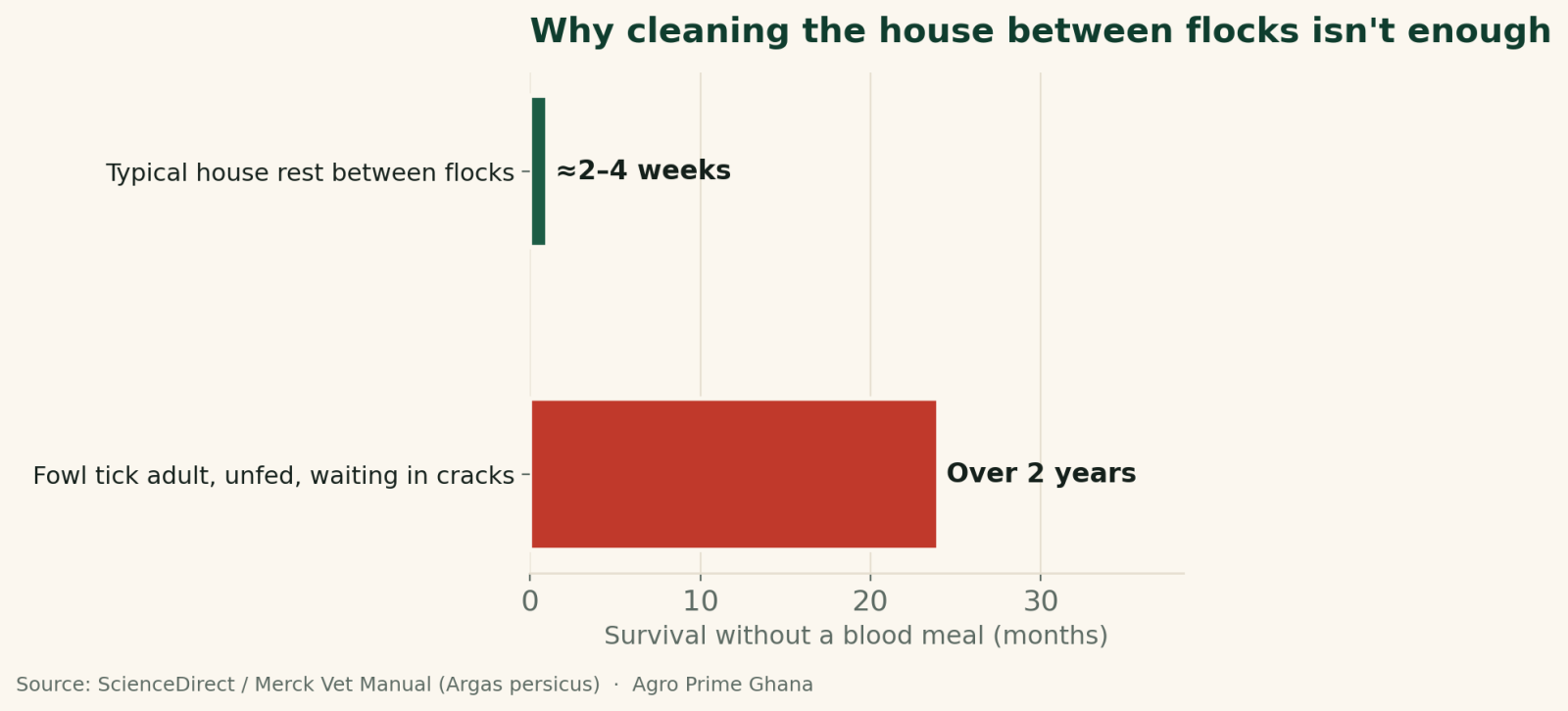
Two features turn a fowl-tick problem into a persistent infestation. The first is the tick's astonishing capacity to survive without feeding: research on Argas persicus reports that adults can last more than two years without a blood meal, with larvae and nymphs surviving for months. So resting a house for a few weeks between flocks — a downtime that would starve out many pests — does almost nothing; the ticks simply wait in the cracks for the next batch of birds. The second is sheer reproductive output: each female lays clutches of tens of eggs after every feed, again and again, tucked into the fabric of the building. Between long survival and repeated egg-laying, an untreated house steadily accumulates ticks, and each new flock walks into a bigger ambush than the last. Good building design and hygiene — the same thinking behind poultry biosecurity — is therefore the foundation of tick control, not an optional extra.
| Feature | Fowl tick (Argas persicus) |
|---|---|
| Type | Soft tick (Argasidae) — a night feeder, not a hard "stay-on" tick |
| Size & colour | Female ~8–10 mm, male ~5 mm; yellowish-brown when starved, slaty-blue when engorged |
| Where it lives | In the house: cracks, crevices, joints, perches, under debris — not on the bird by day |
| When it feeds | At night; adults and nymphs feed quickly and drop off; larvae stay on 2–7 days |
| Eggs | Clutches of ~25–100, laid in hiding places after each blood meal, repeatedly |
| Survival without feeding | Adults over 2 years; larvae and nymphs for months |
| Main harms | Anaemia, weakness, weight loss, lower egg production; tick paralysis; disease spread |
The damage it does to birds
Fowl ticks harm poultry in several ways at once. The most direct is blood loss and anaemia: each tick takes a blood meal, and with a large, repeatedly-feeding population the nightly drain adds up — Merck notes that heavy infestations and frequent bites of A. persicus lead to secondary infections, anaemia, weakness and weight loss. Anaemic birds show pale combs and wattles, become dull and lethargic, eat and grow poorly, and in laying flocks the constant stress and blood loss pull egg production down. For a layer or breeder operation, that quiet, continuous cost — birds that never quite thrive and never quite peak — can be as damaging as any outbreak.
The most alarming effect is tick paralysis. Substances in the tick's saliva can, during feeding, cause a progressive flaccid paralysis — birds go weak and unsteady, may be unable to stand, and in severe cases die, partly from the effects of prolonged paralysis. Like anaemia, it is easily blamed on something else if nobody has looked for ticks. On top of the direct harm, the constant nocturnal biting is simply stressful: birds harassed all night rest badly, and stressed, blood-drained birds are more vulnerable to every other disease pressure on the farm.
Field note: check the house at night, not the bird by day
The single most useful habit with fowl ticks is to inspect at the right time. Look at your birds only in daylight and you can have a serious infestation and see nothing, because the ticks are hidden in the structure. When a flock is unexplainably pale, off-lay or losing condition, go in after dark with a good torch and look at the building: shine into wall cracks, the joints and undersides of perches, behind loose boards, around nest boxes and into any debris. Engorged ticks are seed-to-bean-sized and slaty-blue; starved ones are flat and pale and easy to miss, so look into the deepest cracks. Finding them there — not on the bird — confirms the diagnosis and tells you the house itself is what to treat.
The diseases it carries
Beyond the direct damage, the fowl tick is a disease vector, and this is where it becomes genuinely dangerous rather than merely debilitating. Merck lists it as a transmitter of Borrelia anserina — the cause of avian spirochaetosis — and of Aegyptianella pullorum (formerly Anaplasma pullorum). Avian spirochaetosis is a serious, sometimes fatal septicaemic disease of poultry: birds become dull, feverish, greenish in the droppings and can die, and where fowl ticks are established the tick and the disease travel together. This changes the calculation entirely — a tick problem is not just a slow drain on condition but a route by which a killing disease can enter and move through a flock. It also means controlling the tick is part of controlling the diseases it carries, which is why serious tick management belongs alongside vaccination and biosecurity rather than being treated as minor housekeeping.
Getting the ticks out of the house
Because the fowl tick lives in the building and can survive years without feeding, you cannot solve it by treating the birds alone — you have to treat and, ideally, redesign the house. The approach that works combines physical control with careful, appropriate use of acaricides:
- Deny them hiding places. This is the foundation. Fill and seal cracks and crevices in walls, floors and around joints; smooth rough surfaces; remove or replace heavily infested wooden perches and fittings; and clear out debris, clutter and old litter where ticks shelter and lay. A house with nowhere to hide cannot hold a large tick population.
- Clean out thoroughly between flocks. A full clean-out — removing litter, cleaning, and getting into the cracks — reduces the reservoir. Remember, though, that ordinary downtime does not starve them out, so cleaning must be paired with treating the hiding places, not relied on alone.
- Apply an appropriate acaricide to the structure. Effective control usually needs a suitable acaricide (tick-killing insecticide) applied not just to birds but into the cracks, crevices, perches and surfaces where the ticks hide by day. Use a product approved for poultry premises, follow the label exactly, respect withdrawal and safety instructions, and treat on qualified advice — repeat applications are often needed to catch newly emerged ticks.
- Build (or rebuild) against ticks. Where infestations are chronic, the long-term fix is housing that gives ticks no refuge: smooth, sealable walls and floors, metal or easily-cleaned perches, and no deep cracks — the same logic as the cleanable surfaces in our note on poultry house design and ventilation.
- Stop them arriving. Ticks travel in on infested birds, equipment, crates and second-hand fittings. Inspecting and, where necessary, treating incoming birds and avoiding infested used equipment keeps a clean house clean — part of everyday litter and house management and biosecurity.
Field note: downtime alone will not starve them out
A mistake we see often is a keeper who has a tick problem, cleans the house, rests it two or three weeks, restocks — and is surprised when the new flock goes pale again within weeks. The reason is worth repeating: adult fowl ticks can survive well over two years without a single blood meal, sitting patiently in the cracks, so a few weeks of an empty house is nothing to them. That is why the effective plan is never "clean and rest" alone but "clean, treat the hiding places, and where possible seal them up" — so the ticks are killed or denied shelter rather than left waiting for the next birds.
The bottom line on fowl ticks
The cost of a fowl-tick infestation is mostly the slow, grinding kind — anaemic, harassed birds that convert feed poorly and lay below potential, day after day for the life of the flock — punctuated by the acute losses of tick paralysis and the diseases the tick carries, while money is quietly wasted chasing feed problems and "weak" birds when the real cause sits in the wall cracks. The fowl tick is a night-feeding soft tick that lives in the fabric of the poultry house, not on the bird — which is exactly why it is so often missed and so hard to shift. It drains birds of blood and drives anaemia, weakness, weight loss and poor laying; it can paralyse birds through its saliva; and it carries serious diseases, including avian spirochaetosis. Its two great strengths are patience and productivity: adults survive over two years without feeding, and females lay clutch after clutch of eggs deep in the building, so infestations build across flocks and ordinary downtime never starves them out. Beat it by inspecting the house at night rather than the bird by day, and then attacking where it actually lives — seal and smooth the cracks, clean out the hiding places, apply an appropriate acaricide to the structure on qualified advice, and build for cleanability. Deny the tick its refuge, and you deny it the flock.
Frequently asked questions
How do I know if my chickens have fowl ticks?
Why can't I see the ticks on my birds during the day?
What harm do fowl ticks do to poultry?
Can fowl ticks kill my chickens?
Why do the ticks keep coming back after I clean the house?
How do I get rid of fowl ticks?
Do fowl ticks spread disease to my flock?
Are fowl ticks a danger to people?
Sources & further reading
- Merck Veterinary Manual — Argas spp (soft ticks) and Fowl Ticks in Poultry (night feeding and hiding, anaemia/weakness/weight loss, tick paralysis, Borrelia anserina and Aegyptianella pullorum).
- ScienceDirect Topics — Argas persicus overview (adult size 8–10 mm, egg clutches of 25–100, survival over 2 years without feeding, ~30-day life cycle).
- Agro Prime Ghana guides: poultry biosecurity, poultry house design and ventilation, and poultry litter and house management.
About Agro Prime Ghana
Agro Prime Ghana Limited runs a poultry hatchery and mixed agribusiness in Kasoa, supplying day-old chicks and supporting poultry keepers nationwide. These guides combine hands-on hatchery and farm experience with current veterinary references. This article is general educational information, not a substitute for professional veterinary advice or licensed pest-control guidance — if you suspect ticks, paralysis or disease in your flock, seek help and use only products approved for poultry. Need chicks, feed advice or farm support? Book a visit or message us on WhatsApp (+233 24 915 1503).