You walk into the layer house one morning and find birds dead in the pen — not sick, not thin, just dead, with good flesh on them and full crops, as if they had simply dropped where they stood. A few survivors are dull, breathing fast, with a greenish watery scour and swollen, purplish faces. This is the classic, gut-wrenching picture of an acute fowl cholera outbreak, and it tends to strike the very birds you can least afford to lose: mature layers and breeders coming into or already in lay. Fowl cholera moves fast, it favours older birds, and once it is loose in a house it comes back in waves. This guide explains what it is, how to tell it apart from the other big killers, and how to keep it out of your flock under Ghanaian conditions.
Written by the Agro Prime Ghana poultry team and reviewed against current veterinary references (Merck/MSD Veterinary Manual and The Poultry Site disease guide). Last updated September 2026.
Key takeaways
Fowl cholera is a bacterial disease caused by Pasteurella multocida, a small gram-negative rod. Unlike coccidiosis or pullorum, it hits mature birds hardest — layers, breeders and growers rather than young chicks. In its acute form it appears as a sudden septicaemia with high morbidity and mortality (potentially up to 100%), often the first sign being dead birds with no warning. Chronic cases show up as swollen wattles, lameness and swollen joints. It spreads through the mouth, nose and eye discharges of sick and carrier birds, and is carried in by rodents, wild birds and contaminated equipment. Antibiotics and sulphonamides control deaths but do not clear the carrier state, so it returns when medication stops. Prevention rests on strict biosecurity, rodent control and, where cholera is a recurring problem, vaccination with a bacterin or live vaccine.
What fowl cholera actually is
Fowl cholera — also called avian pasteurellosis — is a contagious bacterial disease caused by Pasteurella multocida. According to the Merck (MSD) Veterinary Manual, the organism is "a small, gram-negative, nonmotile rod with a capsule," and it usually produces "a septicemia of sudden onset with high morbidity and mortality rates." The bacterium is not one uniform bug: it sorts into five capsular types (A, B, C, D and F) and sixteen somatic serotypes. That variety matters — it is why a vaccine against one strain may not protect against another, and why the disease behaves so differently from farm to farm, some outbreaks explosive and fatal, others simmering as a chronic problem of swollen joints and wattles. Crucially, this is a bacterium, not a virus or parasite, so unlike Newcastle disease it can be knocked back with antibiotics — but knocking it back is not the same as getting rid of it.
Why it is a real threat in Ghana
Fowl cholera earns its place among the diseases every Ghanaian keeper should recognise for one uncomfortable reason: it targets the birds that represent your biggest investment. The Merck manual is explicit that "older chickens are more susceptible than young ones," and that turkeys and waterfowl are more susceptible still. So while chicks in the brooder are relatively spared, your point-of-lay pullets, laying hens and breeding stock — the birds you have fed for months — are the ones at risk. The Poultry Site's disease guide notes that in an outbreak, morbidity and mortality may reach up to 100%, with an incubation period usually of about five to eight days. Local free-range and backyard flocks act as a hidden reservoir, so for a commercial keeper the threat is often sitting just outside the house — in the bush, the feed store and the drains — waiting for a lapse in biosecurity.
Acute versus chronic: two very different pictures
Fowl cholera does not always look the same, and learning its two faces is half the battle. In the peracute and acute form, the Merck manual notes that "finding a large number of dead birds without previous clinical signs is usually the first indication"; where signs do appear first, they include listlessness, loss of appetite, a mucoid discharge from the mouth, diarrhoea and fast breathing — the birds are dying of a whole-body blood infection (septicaemia), and it happens quickly. The chronic form is the opposite — slow, localised and disfiguring. Here the bacteria settle in particular tissues, and the signs, as Merck describes, relate to "localized infections of the sternal bursae, wattles, joints, tendon sheaths, and footpads": lame birds, hens with grossly swollen wattles, and twisted neck when the infection reaches the head. The table below lays the two forms side by side.
| Feature | Acute / peracute fowl cholera | Chronic fowl cholera |
|---|---|---|
| Main signs | Sudden deaths, mouth discharge, green diarrhoea, fast breathing, purplish head | Swollen wattles & joints, lameness, twisted neck, poor condition |
| Mortality | High, can approach 100% of affected birds | Lower death rate but persistent culls and poor performance |
| Birds affected | Mainly mature layers, breeders, growers | Survivors of acute outbreaks; localised infections |
| Post-mortem clue | Enlarged liver & spleen, pinpoint haemorrhages on heart fat | Caseous (cheesy) material in joints, wattles, oviduct |
How to recognise it early
The single most useful trigger in your head should be this: sudden deaths in otherwise good-looking mature birds. When healthy layers or breeders start dying with no wasting and no long illness, fowl cholera belongs at the top of your list, alongside Newcastle disease. Look for the cluster: dead birds in good flesh, a handful of dull survivors with laboured breathing, a mucoid dribble from the beak, greenish watery droppings, and — a strong clue — swollen, dark, bluish wattles and face. On post-mortem of a fresh carcase, an experienced eye will often find an enlarged, mottled liver and spleen and tiny pinpoint (petechial) haemorrhages on the heart fat. Because acute cholera can be confused with the velogenic (deadly) form of Newcastle disease — and the two need completely different responses, since cholera responds to antibiotics and Newcastle does not — getting a proper diagnosis early is worth the vet's fee.
Field note: sudden deaths in layers — think cholera, but rule out Newcastle
On the farm, the pattern that makes us reach for the phone is a run of dead layers or breeders that were laying and eating normally the day before. Two diseases sit at the front of our minds: fowl cholera and Newcastle. The quick separators we look at are age (cholera favours mature birds), the wattles (swollen and dark points strongly to cholera), and whether there are nervous signs like twisted necks across the flock (more typical of Newcastle). But we do not gamble on it — a post-mortem settles the question, because treating a Newcastle outbreak as cholera wastes the antibiotics and the days you cannot get back.
How fowl cholera spreads and persists
Understanding the spread is what makes prevention make sense. The Merck manual explains that spread occurs through "excretions from the mouth, nose, and conjunctiva of diseased birds that contaminate their environment," and, critically, that "chronically infected birds and subclinical carriers are considered to be major sources of infection." That last point is the whole problem in a sentence: birds that survive an outbreak, and birds that never look sick at all, can carry Pasteurella multocida and shed it, seeding the next outbreak from inside your own flock. On top of that, Merck names rodents, wild birds, pets and other animals as carriers that should be excluded, and the organism survives on contaminated equipment, sacks, crates and boots long enough to move between houses. The good news is that the bacterium is not hardy in the open: it is readily killed by "ordinary disinfectants, sunlight, drying, and heat," so a clean, dry, well-managed house with good rodent control is genuinely hostile to it.
Treatment: buys time, does not cure the flock
If an outbreak is underway, prompt treatment can dramatically cut deaths — but go in with clear eyes about what it does and does not achieve. The Merck manual lists sulphonamides (such as sulfadimethoxine) in feed or water as usually controlling mortality, along with tetracyclines like oxytetracycline. Because sick birds keep drinking even off feed, water-soluble medication reaches them best during an outbreak. Use any of these strictly on veterinary advice, to the correct dose and withdrawal period — sulphonamides in particular are not for laying hens because of residues in eggs. Here is the hard part every keeper must absorb: the manual is blunt that treatment "does not eliminate P multocida from a flock," and deaths often resume once the drug is stopped. Antibiotics buy you time and save birds in the moment; they do not clean the disease out — which is exactly why prevention, and in problem situations vaccination, matter so much.
Vaccination: for farms with a recurring problem
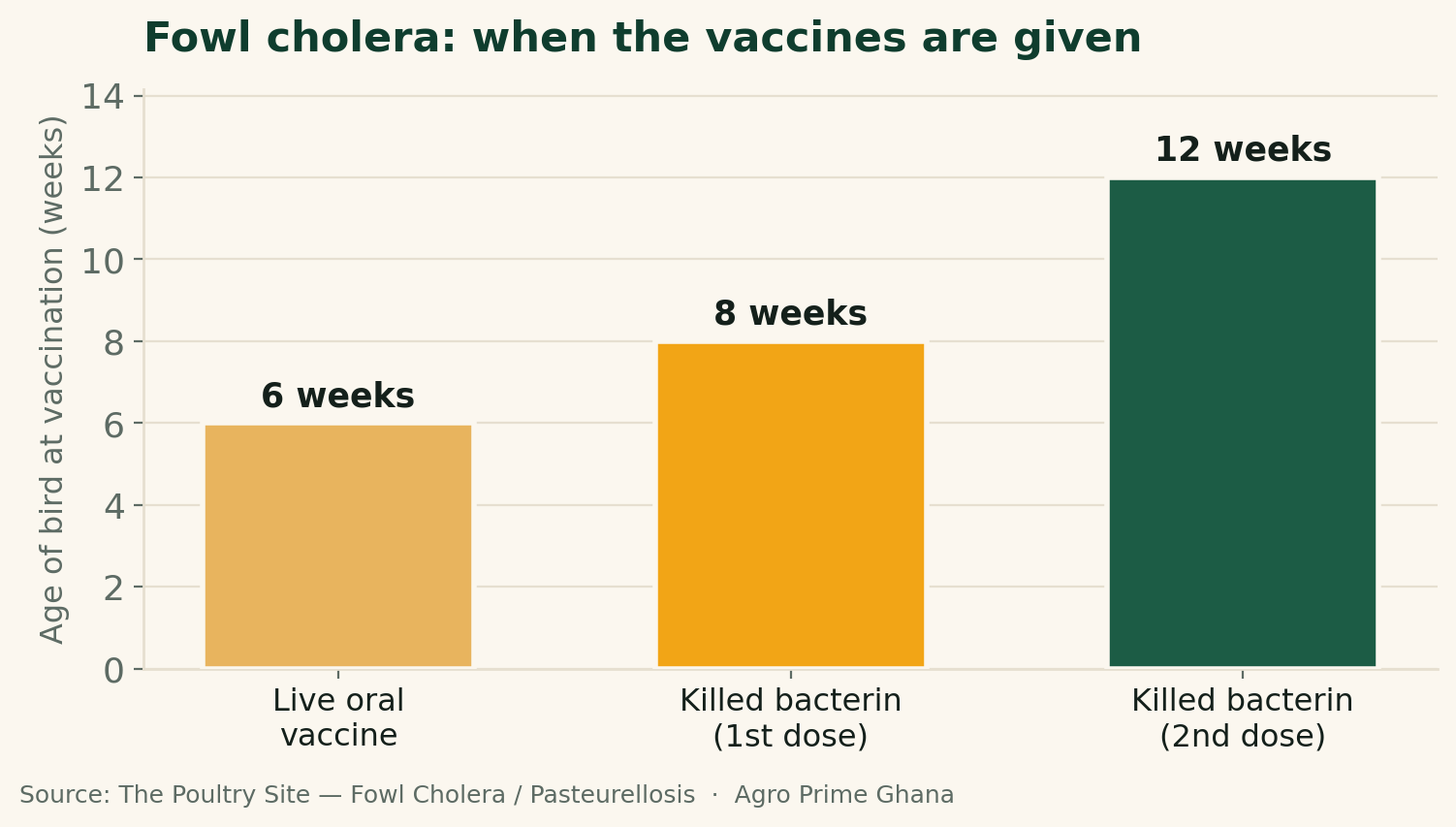
Vaccination is not a routine, must-do for every Ghanaian flock the way Newcastle vaccination is — but on farms where cholera keeps coming back, it is often the difference between control and chronic loss. Killed bacterins are, in Merck's words, "widely used and generally effective," with the important caveat that they only protect against the serotypes they contain — which is why, on a farm with a stubborn strain, an autogenous vaccine (made from bacteria isolated on that farm) is sometimes recommended when off-the-shelf products fail. Live vaccines are also available — given in water to turkeys and by wing-web stab to chickens — and can induce broader immunity, but are for healthy flocks only. The Poultry Site guide describes a workable pattern of killed bacterins around 8 and 12 weeks of age, with a live oral option from about 6 weeks — the ages shown in the chart above. If your farm has a cholera history, do not fight it with antibiotics alone: talk to a veterinarian about the right vaccine, ideally strain-matched, well before the age the disease usually strikes.
Field note: rats and open drains are doing the spreading
When cholera keeps returning to a house despite treatment, we have learned to stop blaming bad luck and start walking the perimeter at dusk. Rodents running the drains at night, wild birds at spilled feed, standing water in blocked channels, and crates and boots moving between houses without a wash — these are the quiet highways the bacterium travels. Baiting rat runs, keeping feed in closed bins, screening against wild birds, draining wet ground and disinfecting equipment are unglamorous jobs, but on a cholera farm they do more than any drug. The bacterium is easily killed by disinfectant, drying and sunlight — so a genuinely clean, dry, rodent-free house is already most of the cure.
Prevention: the strategy that actually works
Because antibiotics cannot clear the carrier state, real control of fowl cholera is built on keeping the bacterium out and denying it the conditions to spread. The pillars are straightforward:
- Serious rodent control. Rats and mice are prime suspects for carrying Pasteurella multocida. Bait and block runs, store feed in closed containers, and clear the surroundings of harbourage.
- Keep wild birds and other animals out. Screen openings, keep feed hygiene tight, and keep dogs, cats and stray fowl away from the houses.
- Tight biosecurity around houses. Wash and disinfect equipment, crates and vehicles; use footbaths and dedicated boots; control people's movement. Our guide to poultry biosecurity sets out a practical routine.
- Do not mix ages or bring in unknown birds. Carrier birds are the classic way cholera enters a clean flock — practise all-in/all-out and start with clean stock, so see choosing healthy day-old chicks.
- Clean, dry, well-ventilated housing. The bacterium hates drying and sunlight; damp, dirty corners help it persist. Good ventilation and litter management work against it.
- Vaccinate where the disease is established, and depopulate, clean, disinfect and rest badly affected houses before restocking, since survivors carry the organism.
The economics: why prevention pays
The money case for taking fowl cholera seriously is stark because of which birds it kills. Coccidiosis mostly robs growth from cheap young stock; cholera kills mature layers and breeders you have already carried through months of feed and labour, so losing a hen in full production means losing your entire investment in that bird plus every egg she would have laid. Add that antibiotics only suppress the disease — so the losses and drug bills recur — and the arithmetic strongly favours prevention over medicating outbreak after outbreak.
The bottom line on fowl cholera
Fowl cholera is a bacterial killer that goes after your most valuable birds. In its acute form it appears as sudden, heavy deaths in mature layers and breeders; in its chronic form as swollen wattles, lame joints and lingering culls. It is spread by survivors and hidden carriers within the flock, and ferried in from outside by rodents, wild birds and dirty equipment. Antibiotics and sulphonamides pull mortality down in a crisis but never clear the carrier state, so the disease returns once the drugs stop. The winning strategy is therefore prevention: ruthless rodent control, tight biosecurity, clean and dry housing, careful stock management, and — on farms where cholera keeps coming back — the right vaccine. Get a firm diagnosis early so you do not confuse it with Newcastle, treat decisively when you must, but put your real effort into keeping Pasteurella multocida out of the house in the first place.
Frequently asked questions
What are the first signs of fowl cholera in chickens?
What causes fowl cholera?
Why does fowl cholera affect older birds more than chicks?
How is fowl cholera treated?
Can I vaccinate my flock against fowl cholera?
How do I stop fowl cholera coming back?
Is fowl cholera the same as Newcastle disease?
Can fowl cholera spread to my other poultry?
Sources & further reading
- Merck / MSD Veterinary Manual — Fowl Cholera in Poultry (causative organism, serotypes, susceptibility, clinical forms, transmission, treatment, vaccination, biosecurity).
- The Poultry Site — Fowl Cholera, Pasteurellosis (morbidity/mortality, incubation period, vaccination schedule).
- Agro Prime Ghana guides: poultry biosecurity, poultry house ventilation, and choosing healthy day-old chicks.
About Agro Prime Ghana
Agro Prime Ghana Limited runs a poultry hatchery and mixed agribusiness in Kasoa, supplying day-old chicks and working alongside poultry keepers across the country. These guides draw on that hands-on hatchery and farm experience, checked against current veterinary references. This article is general educational information, not a substitute for diagnosis by a qualified veterinary or extension officer — if your flock is dying, get it seen and get a proper diagnosis. Need chicks, feed advice or farm support? Book a visit or message us on WhatsApp (+233 24 915 1503).