Every livestock farmer in Ghana knows the pattern: animals thrive and gain weight through the green months of the rains, then lose condition — sometimes dramatically — through the long dry season when grazing withers and feed runs short. That dry-season feed gap is the single biggest brake on livestock productivity in the country. The answer is fodder production: deliberately growing forage crops and conserving feed so that animals are fed well all year round, not just when nature provides. This guide covers how to grow and conserve fodder in Ghana — the grasses and legumes to plant, and how to make hay and silage — to keep livestock productive through the dry season.
Key takeaways
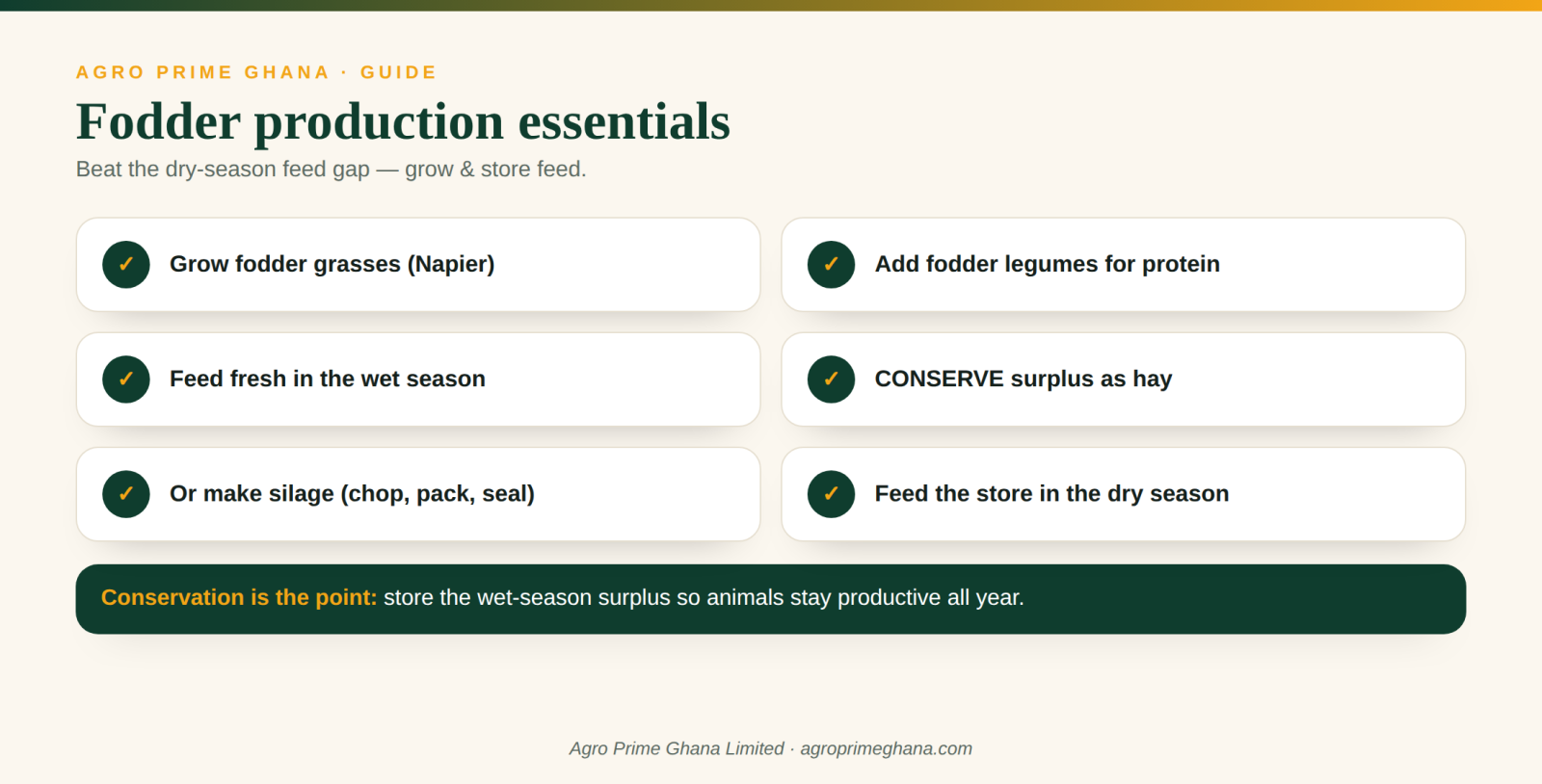
The dry-season feed gap is the biggest constraint on Ghanaian livestock; fodder production solves it. Grow high-yielding fodder grasses (like Napier/elephant grass) and fodder legumes (which also boost protein and soil), and — crucially — conserve surplus wet-season forage as hay (dried) or silage (fermented) to feed in the dry months. Well-fed animals through the dry season keep growing and producing instead of losing condition. Growing and storing your own feed also cuts feed costs and dependence on scarce natural grazing.
Why fodder production matters
Fodder production addresses the core problem of Ghanaian livestock farming: the seasonal feed cycle. In the rainy season, pasture and grazing are abundant and green, and animals gain weight and produce well; but in the long dry season, natural forage withers, becomes scarce and loses nutritional quality, and animals commonly lose condition and weight, milk yields fall, growth stalls, and losses rise — undoing much of the wet-season progress in a wasteful annual cycle. This dry-season feed gap is the biggest single constraint holding back cattle, sheep, goats and other livestock. Fodder production breaks the cycle by deliberately producing feed: growing high-yielding forage crops and, above all, conserving the surplus of the plentiful season to feed in the lean season, so animals are fed adequately all year. The benefits are large: animals keep growing and producing instead of shrinking, productivity and returns rise, losses fall, and the farmer becomes less dependent on scarce, variable natural grazing and on buying expensive feed in the dry season. For any serious livestock enterprise — beef, dairy, small ruminants — fodder production is one of the highest-impact investments a farmer can make, turning the dry season from a period of loss into one of continued productivity. It is the practical solution to livestock's biggest problem.
Growing fodder grasses
The backbone of fodder production is fodder grasses — grasses grown specifically to feed livestock, which yield large amounts of forage from a plot of land. The best known and most widely used is Napier grass (elephant grass), a high-yielding perennial grass that produces abundant forage, regrows after cutting, and is a mainstay of cut-and-carry feeding across the tropics; other productive fodder grasses are also used. These grasses are typically grown in a dedicated fodder plot, established (often from cuttings or splits for Napier), managed with reasonable fertility and moisture, and cut repeatedly as they regrow to provide a steady supply of green forage. Grown well, a fodder grass plot yields far more feed per area than relying on natural pasture, and it can be cut and fed fresh (cut-and-carry) or, importantly, its surplus conserved for the dry season. Establishing a good stand of a high-yielding fodder grass like Napier is often the first and most impactful step in fodder production: it gives the farmer a reliable, productive source of forage under their own control, rather than depending on the vagaries of natural grazing. Fodder grasses are the volume base of the livestock feed supply.
Growing fodder legumes
Alongside grasses, fodder legumes are a valuable and complementary part of fodder production, adding what grasses lack. Legumes grown for forage — various fodder legume species, and dual-purpose crops whose residues feed livestock (like the haulms of cowpea and groundnut) — provide higher protein than grasses, improving the quality and balance of the animals' diet (grass alone is often low in protein, limiting growth and production). Feeding legume forage together with grass gives animals a better, more productive ration. Fodder legumes bring a second benefit: as legumes, they fix nitrogen and improve the soil, so growing them enriches the land as well as feeding stock — a useful fit in mixed crop-and-livestock farming. Legumes can be grown in dedicated plots, intercropped or in rotation, and, like grasses, their forage can be fed fresh or conserved. The practical approach is to combine grasses for volume and legumes for protein, giving livestock both enough feed and good-quality, balanced nutrition. Adding fodder legumes to a grass-based fodder system noticeably improves animal performance and adds soil-building value, making them an important complement to fodder grasses in a well-rounded fodder production plan.
Conserving fodder: hay
Growing fodder is only half the answer; the other half — and the key to beating the dry season — is conserving it, and the simplest method is hay. Hay is forage (grass, legumes) that has been cut and dried to a low moisture so it can be stored for months without spoiling, then fed in the dry season when fresh forage is scarce. Making good hay involves cutting the forage at the right stage (young enough to be nutritious), drying it well — spreading and turning it to dry in the sun to the right low moisture — and then storing it in a dry, protected place, because hay that is baled or stored while still too moist will mould and spoil, and hay left exposed to rain deteriorates. Ghana's long dry season actually makes hay-making feasible, since there is reliable drying weather to conserve the surplus forage of the wet season. Hay is a practical, low-technology way for a farmer to capture the abundance of the green season and store it as feed for the lean months, and it is often the easiest conservation method to start with. Good hay-making — cut at the right stage, dried properly, stored dry — turns surplus wet-season grass and legume forage into a valuable dry-season feed store that keeps animals fed and productive when natural grazing fails.
Conserving fodder: silage
The other main conservation method is silage, which preserves forage by fermentation rather than drying. To make silage, fresh forage (commonly grasses like Napier, or other fodder crops) is chopped, packed tightly to exclude air, and sealed (in a pit, drum, bag or other silo), where it ferments and is preserved in a moist, palatable state that can be stored for months and fed in the dry season. Silage has advantages: it preserves forage without needing it to be fully dried (useful when drying conditions are imperfect), retains good nutrition and palatability, and stores a lot of feed compactly. It does require more care and technique than hay — the forage must be chopped, well compacted to exclude air, and properly sealed, because air causes spoilage — and it suits farmers ready to invest a bit more effort and simple infrastructure. Silage is especially useful for conserving large volumes of forage (like a Napier grass surplus) in good, moist condition for the dry season. Whether a farmer chooses hay (simpler, needs good drying) or silage (more involved, preserves moist forage well), or both, the essential point is the same: conserving surplus forage from the plentiful season is what makes it possible to feed animals well through the dry season, which is the whole purpose of fodder production. Conservation, by hay or silage, is the bridge across the feed gap.
Putting it together: a year-round feed supply
The power of fodder production comes from combining these elements into a year-round feeding plan. In practice this means: establishing productive fodder grass plots (like Napier) for volume and fodder legumes for protein; using the abundant wet-season growth to both feed animals fresh (cut-and-carry) and produce a surplus; conserving that surplus as hay and/or silage during the green months; and then feeding the conserved fodder, along with crop residues and any supplements, through the dry season so animals stay well-fed and productive. Done consistently, this transforms livestock performance: instead of the annual boom-and-bust of fattening in the rains and starving in the dry season, animals grow and produce steadily all year, and the farmer controls their own feed supply rather than depending on scarce grazing or costly bought feed. Fodder production integrates naturally with mixed farming — legumes build soil, crop residues feed animals, and manure feeds crops — and scales from a smallholder's plot to larger enterprises. The key mindset shift is treating feed as something to be produced and stored deliberately, like any crop, rather than left to nature. A farmer who grows good fodder and conserves it to bridge the dry season has solved livestock's biggest problem, and everything else — growth, milk, meat, profit — follows from having well-fed animals year-round.
Common mistakes to avoid
- Not conserving forage, so wet-season surplus is wasted and animals starve in the dry season — conservation is the whole point.
- Relying on grass alone, missing the protein that fodder legumes add.
- Poor hay-making, baling or storing forage too moist so it moulds, or letting it get rained on.
- Poor silage technique, failing to chop, compact and seal so air spoils it.
- Cutting forage too late, when it is stemmy and low in nutrition.
- No dedicated fodder plot, depending entirely on variable natural grazing.
Frequently asked questions
Why is fodder production important in Ghana?
What fodder grasses should I grow?
Why grow fodder legumes as well as grass?
What is the difference between hay and silage?
How do I make good hay?
How do I make silage?
Does fodder production really improve livestock productivity?
Can smallholders do fodder production?
The bottom line on fodder production
Fodder production is the practical answer to the single biggest problem in Ghanaian livestock farming: the dry-season feed gap that strips condition from animals every year and holds productivity down. The solution is to stop leaving feed to nature and start producing and storing it deliberately, like any crop. That means growing high-yielding fodder grasses such as Napier for volume, and fodder legumes for the protein and soil-building that grasses lack; using the abundance of the wet season to feed animals fresh and produce a surplus; and — crucially — conserving that surplus as hay (dried) or silage (fermented) so it can be fed through the lean dry months. A farmer who does this breaks the wasteful boom-and-bust cycle, keeps cattle, sheep, goats and other stock well-fed and productive all year round, cuts losses and feed costs, and gains control over their own feed supply. For any serious livestock enterprise, growing and conserving fodder is among the highest-impact things a Ghanaian farmer can do — the foundation of well-fed, productive, profitable animals in every season.
Feed your animals all year round
Agro Prime Ghana Limited runs a hatchery and agribusiness in Kasoa. Growing and conserving fodder is one of the highest-impact steps in livestock farming. Talk to us about building a resilient, mixed farm: book a visit or message WhatsApp (+233 24 915 1503).