Cocoa is Ghana's most famous crop and one of its greatest exports — the beans behind the world's chocolate and a mainstay of the national economy and of hundreds of thousands of farming families. Growing cocoa is a long-term commitment to a tree crop that yields for decades, and Ghana's cocoa is prized worldwide for its quality. But that quality, and the farmer's income, depend on a chain of things done right: good planting material, careful management of a shaded tree crop, disciplined control of the diseases and pests that threaten it, and — crucially — proper fermentation and drying of the beans. This guide covers how to grow cocoa successfully in Ghana and how to produce the quality beans that command the best returns.
Key takeaways
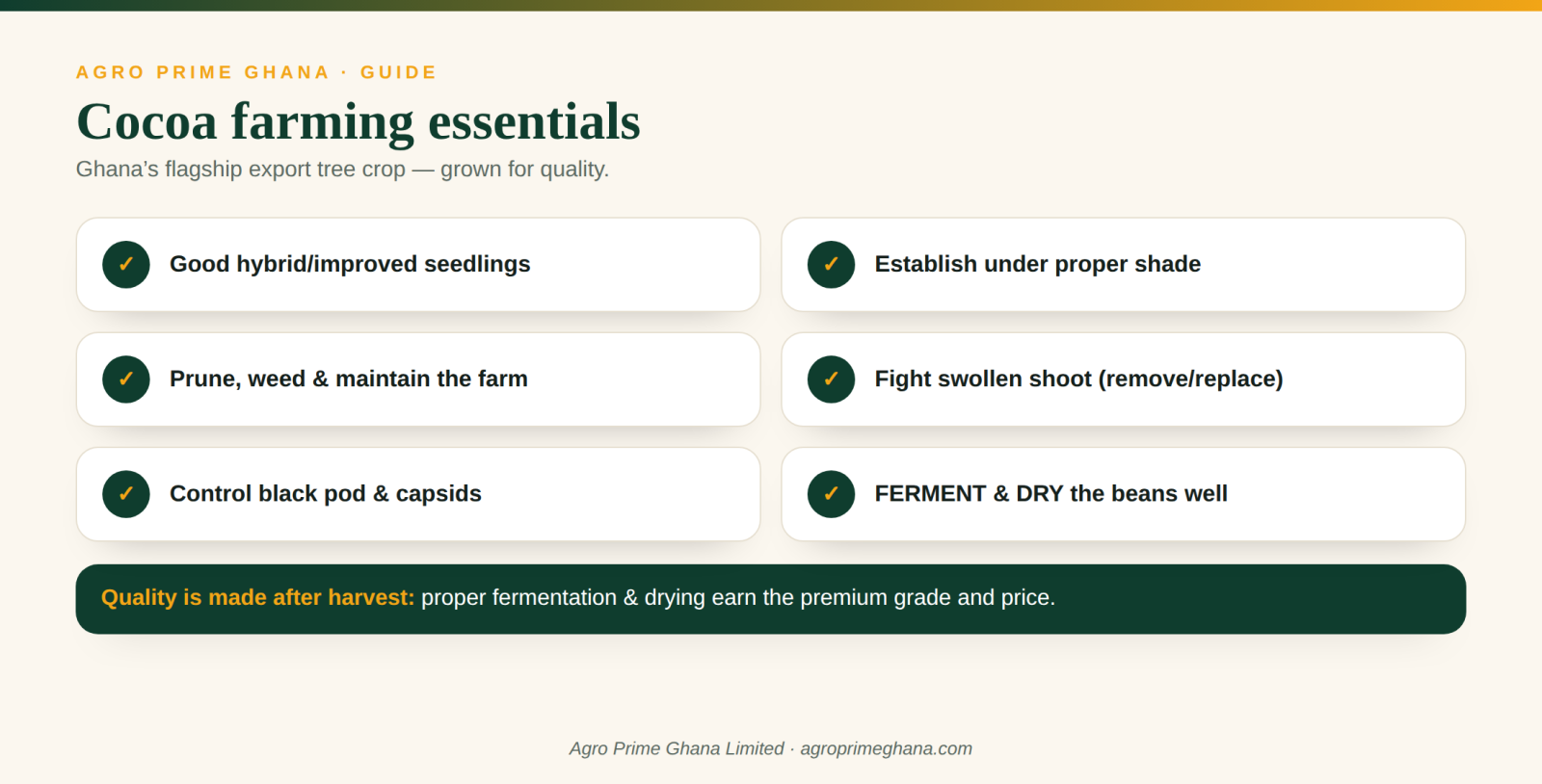
Cocoa is Ghana's flagship long-term export tree crop, prized for quality and yielding for decades. Plant good hybrid/improved seedlings, establish with shade, and manage the crop over years. The major threats are swollen shoot virus (CSSVD) and black pod disease, plus capsids — control them rigorously. Bean quality and price are decided after harvest by proper fermentation and drying. Cocoa is marketed through the established COCOBOD system. A patient, quality-focused crop that underpins many Ghanaian farms.
Why cocoa matters
Cocoa holds a place no other Ghanaian crop can claim. It is the country's flagship export, a major earner of foreign exchange, and the livelihood of a huge number of farming families, with a long history and deep institutional support. Ghanaian cocoa enjoys a global reputation for quality, which underpins its value. For the farmer, cocoa is a long-term tree crop: once established, a cocoa farm yields for decades, providing a durable, recurring income and a genuine family asset passed down generations. Demand is strong and global, and cocoa is marketed through Ghana's established, organised system (COCOBOD and licensed buyers), giving farmers a structured, guaranteed route to sell their beans. The trade-off is that cocoa is a patient, demanding crop — years to full bearing, real disease and pest threats, and quality that must be earned through proper post-harvest handling. It is a crop for the committed farmer thinking in decades, and for that farmer it remains one of the most important and rewarding crops in Ghana.
Planting material and establishing the farm
A good cocoa farm starts with good planting material and careful establishment. Use improved, hybrid cocoa seedlings from a reliable source (such as recommended hybrid varieties) rather than random seed, because improved planting material bears earlier, yields better, and can carry more tolerance to disease — an important advantage over an old-style farm from unselected seed. Raise or obtain healthy seedlings and establish them well. Cocoa is traditionally grown under shade, especially when young: the seedlings need protection from harsh sun as they establish, so cocoa is often planted with temporary shade (like plantain or bananas) and permanent shade trees, which also help the farm's microclimate and can add extra produce. Plant on suitable, fertile, well-drained forest-type soils at the recommended spacing, and care for the young trees — weeding, protecting, managing shade — through the early years before they bear. Getting good hybrid seedlings established under proper shade on suitable land sets up a farm that will yield well for decades, so this early investment and care matter enormously.
Managing the cocoa farm
A productive cocoa farm needs steady, ongoing management across its long life:
- Manage shade correctly. Young cocoa needs shade; as trees mature, shade is adjusted — enough to protect the trees and farm, but not so much that it reduces yield. Getting shade right is a real skill.
- Weed and keep the farm clean, which also reduces pest and disease pressure and makes spraying and harvesting easier.
- Prune the trees, removing unwanted growth (like chupons) and shaping the canopy for health, airflow and manageable, productive trees.
- Maintain fertility and, where appropriate, feed the trees, supporting good pod production over the years.
This consistent care — shade, weeding, pruning, fertility — across many years is what keeps a cocoa farm healthy and productive, and neglect shows up as low yields and worsening disease. Good husbandry is the foundation on which disease control and quality rest.
The major threats: swollen shoot and black pod
Cocoa faces serious diseases and pests, and controlling them is central to keeping a farm productive. Two diseases stand out. Cocoa swollen shoot virus disease (CSSVD) is a devastating virus, spread by mealybugs, that swells shoots, damages the tree and eventually kills it, and it has destroyed large areas of cocoa; because there is no cure for an infected tree, control relies on prevention and on removing and replacing infected trees to stop it spreading — a hard but necessary discipline, supported by official programmes. Black pod disease is a fungal disease (worse in wet, humid conditions) that rots the pods and can cause heavy losses; it is managed through farm sanitation (removing diseased pods), good shade and airflow, and well-timed fungicide application. On the pest side, capsids (mirids) are major insect pests that damage shoots and pods and must be controlled, along with other pests. Managing these threats rests on the familiar disciplines: healthy, more-tolerant planting material, good farm hygiene and pruning for airflow, regular monitoring, removing and replacing swollen-shoot-infected trees, and correct, safe, well-timed use of recommended fungicides and insecticides, ideally with extension and official guidance. The farmers who stay on top of swollen shoot, black pod and capsids keep their farms productive; those who ignore them lose trees and yield. Rigorous disease and pest management is essential to cocoa.
Harvest, fermentation and drying: where quality is made
Here is what turns a cocoa harvest into valuable, quality beans: proper fermentation and drying. Cocoa is harvested by cutting the ripe pods, then breaking them open and removing the wet beans — but the beans as they come from the pod are not yet the product buyers want. Two post-harvest steps make the quality that Ghana is famous for. First, fermentation: the wet beans are heaped or boxed and fermented for several days, a process that develops the chocolate flavour precursors and the proper colour, and is absolutely essential — unfermented or poorly fermented beans are low quality and heavily downgraded. Second, drying: the fermented beans are dried (traditionally slowly in the sun on mats or raised platforms) down to the correct moisture, which preserves them, prevents mould, and finishes the flavour development. Good, careful fermentation and drying are what produce the well-fermented, properly dried, clean, mould-free beans that meet Ghana's quality standards and earn the best grade and price. This is not an optional finishing touch — it is where much of the value is made or lost, and it is a large part of why Ghanaian cocoa is prized. A farmer who grows good pods but ferments and dries carelessly throws away quality and money; one who ferments and dries properly delivers the premium beans the system rewards. Mastering post-harvest handling is as important as growing the crop.
Marketing and the economics
Cocoa's economics combine long-term investment with a structured, reliable market. On the cost side, cocoa requires patient investment: establishing the farm (seedlings, shade, land, and years of care before full bearing), then ongoing management, and — significantly — disease and pest control and the labour of harvesting, fermenting and drying. Income builds as the trees mature and then continues for decades. On the market side, cocoa benefits from Ghana's organised marketing system: beans are sold through the established COCOBOD structure and licensed buying companies at a known producer price, giving farmers a structured, guaranteed route to market that many other crops lack. The keys to cocoa economics are therefore establishing a good farm with improved planting material, keeping it healthy and productive over its long life by controlling swollen shoot, black pod and capsids, and — to capture full value — fermenting and drying the beans properly to earn the best quality grade. Because it is a decades-long asset with a reliable market, cocoa remains a cornerstone crop, and a well-managed, disease-controlled, quality-focused cocoa farm is a durable, valuable source of income for a Ghanaian farming family. It rewards patience, good husbandry and attention to quality above all.
Common mistakes to avoid
- Poor fermentation and drying, downgrading otherwise good beans — the biggest avoidable loss of quality and price.
- Ignoring swollen shoot, letting the virus spread instead of removing and replacing infected trees.
- Neglecting black pod and capsid control, losing pods and yield.
- Planting unselected seed instead of improved hybrid seedlings.
- Getting shade wrong, too little for young trees or too much on mature ones.
- Neglecting weeding and pruning, letting the farm decline into low yields and disease.
Frequently asked questions
Is cocoa farming profitable in Ghana?
What is cocoa swollen shoot disease?
Why are fermentation and drying so important for cocoa?
What causes black pod disease and how do I control it?
Do I need shade to grow cocoa?
How long before a cocoa farm produces?
Where do I sell my cocoa beans?
Should I use hybrid cocoa seedlings?
The bottom line on cocoa farming
Cocoa is Ghana's signature crop and one of its most enduring sources of income — a long-term tree crop that yields for decades, enjoys a global reputation for quality, and is sold through an organised, reliable marketing system. Growing it well is a chain of disciplines carried out over years. It begins with good hybrid planting material established under proper shade on suitable land; continues with steady husbandry — shade management, weeding, pruning and fertility — across the farm's long life; and depends critically on rigorous control of the crop's major threats, above all swollen shoot virus and black pod disease, plus capsids. And it is completed by the step that makes Ghana's cocoa famous and determines its price: proper fermentation and drying of the beans. Establish a good farm, keep it healthy, control the diseases, and ferment and dry your beans with care, and cocoa remains what it has long been — a patient but durable and valuable crop that underpins Ghanaian farming families for generations.
Grow Ghana's flagship long-term crop
Agro Prime Ghana Limited runs a hatchery and agribusiness in Kasoa. Long-term tree crops like cocoa build lasting, diversified income. Talk to us about planning a resilient, long-term farm: book a visit or message WhatsApp (+233 24 915 1503).