Smoked fish is a cornerstone of Ghanaian cooking — in soups, stews and everyday meals — and the trade behind it is one of the country's most established agribusinesses. Fish smoking turns fresh, highly perishable fish into a durable, flavourful product that keeps for weeks, travels well, and sells strongly at home and to Ghanaians abroad. For anyone near a source of fish — including catfish and tilapia farmers — a fish smoking and processing business captures the value in a catch that would otherwise spoil. This guide covers how to start and run a fish smoking business in Ghana, using cleaner, safer methods that protect both quality and health.
Key takeaways
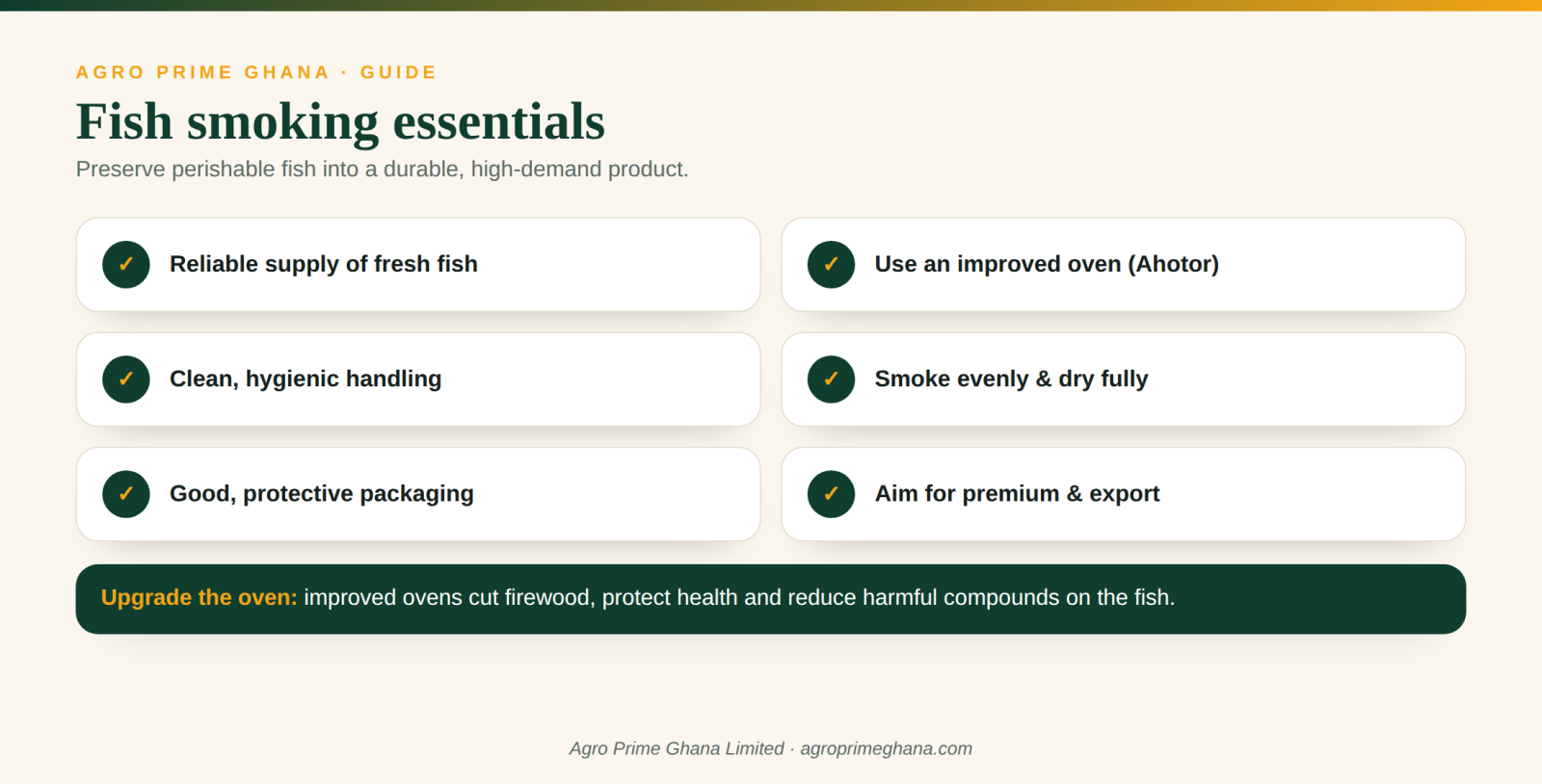
Smoking preserves highly perishable fresh fish into a durable, high-demand product. Secure a reliable supply of fresh fish, clean and prepare it well, and smoke it in an improved, efficient oven (such as the Ahotor oven) rather than a smoky open fire — cleaner ovens give better, safer fish with fewer harmful compounds and less fuel. Focus on hygiene, consistent quality and good packaging. Smoked fish sells strongly at home and to the diaspora abroad.
Why fish smoking is a strong business
Fish is central to the Ghanaian diet, and smoked fish in particular is used in a huge range of dishes, giving it deep, constant demand. Fresh fish spoils within hours in the heat, so smoking — which dries and preserves it — solves that problem and turns a perishable catch into a product that keeps for weeks and sells year-round. The trade is well established, especially among coastal and inland fishing communities and women's enterprises, and it links naturally to fish farming: a catfish or tilapia farmer who smokes some of the harvest captures far more value and avoids the price dips of selling fresh at the glut. Demand comes from households, markets, the food trade, and a large diaspora abroad who buy quality smoked fish at premium prices. For anyone with access to fish, smoking is a proven, durable-demand agribusiness.
Securing your fish supply
A smoking business runs on a steady flow of fresh fish, and freshness is everything, because you can only make good smoked fish from good fresh fish — smoking preserves quality, it cannot restore fish that is already going off. Source options include buying from fishers at landing sites, from fish farmers (a natural fit if you or nearby farmers raise catfish or tilapia), or from traders — always taking the fish as fresh as possible and keeping it cool until you smoke it. Building reliable relationships with fishers or fish farmers, and matching your intake to your smoking capacity, keeps the operation running. Handle fresh fish quickly and cleanly from the moment you receive it; the cold chain from catch to smoker protects the quality that your finished product depends on. A smoker who cannot get fresh fish reliably cannot produce good smoked fish.
Preparing and smoking the fish
Good smoked fish follows a clean, careful sequence:
- Clean and prepare: wash the fresh fish thoroughly, gut and clean it as needed, and sort by size for even smoking.
- Brine or salt (optional): many processors brine or lightly salt the fish, which improves flavour, texture and preservation.
- Arrange: lay the fish neatly on the smoking racks or trays, sized and spaced for even heat and smoke.
- Smoke and dry: smoke the fish over a controlled fire until it is well dried and cured through — the core step that both flavours and preserves it.
- Cool and pack: cool the smoked fish and package it clean and dry to protect it and keep it fresh.
The smoking step is where skill matters most: too little and the fish is under-dried and spoils; too much or too dirty a fire and the fish is burnt or contaminated. Even, controlled smoking gives well-preserved, good-tasting, safe fish.
Use an improved oven — for quality, safety and fuel
This is the single most important upgrade a fish smoker can make. Traditional open-fire and basic-drum smoking is smoky, wasteful of firewood, hard on the processor's health, and — importantly — can leave harmful compounds (polycyclic aromatic hydrocarbons, or PAHs) on the fish from heavy smoke, which are a genuine food-safety concern. Improved smoking ovens, such as the Ahotor oven developed for Ghana, are designed to fix this: they burn less firewood, produce cleaner heat and smoke, reduce the harmful compounds deposited on the fish, and are far better for the processor's health and the surrounding environment, while giving a more uniform, better-quality product. Adopting an improved oven raises the quality and safety of your smoked fish, cuts your fuel costs, and increasingly matters for reaching quality-conscious and export markets. For a serious fish smoking business, moving from the smoky open fire to a clean, efficient oven is one of the best investments you can make.
Hygiene and quality
Smoked fish is a food, and hygiene runs through the whole process. Use clean water and clean equipment, handle the fish with good personal hygiene, keep the preparation and smoking areas clean and pest-free, and package the finished fish cleanly. Because smoked fish is dried and cured, it keeps well, but contamination before or during smoking — dirty fish, dirty water, a dirty smoker — shows up as poor, unsafe product. Quality shows in fish that is clean, evenly and well-dried (so it stores without spoiling or growing mould), good in colour and flavour, and free of the burnt or overly-smoky taste of a bad fire. Consistent quality across batches builds the reputation and repeat custom that a smoking business depends on. Clean sourcing, an improved oven, careful smoking and good packaging together give the premium product that better markets want.
Packaging, markets and the export opportunity
Where and how you sell decides your margin. Smoked fish sold loose in the market is the basic route; clean, well-packaged smoked fish reaches better markets and prices. Good packaging keeps the fish clean, dry and protected, extends its shelf life, signals quality, and lets you build a recognisable brand. Domestic buyers include households, market traders, chop bars and restaurants, and food processors. The standout opportunity, though, is the export market to the diaspora: large Ghanaian and West African communities abroad buy quality, hygienically-processed, well-packaged smoked fish at premium prices, and this market rewards exactly the hygiene, improved-oven quality and packaging discussed above. Meeting quality and safety standards — clean processing, reduced harmful compounds, proper packaging — is the gateway to these higher-value domestic and export buyers. For a processor, investing in quality and packaging turns a local trade into a branded food business with real reach.
The economics
Fish smoking profits by turning cheap-when-fresh, perishable fish into a durable, higher-value product. Your main costs are fresh fish (the largest), firewood or fuel, the smoking oven and racks, salt/brine, labour, and packaging — and an improved oven notably cuts the fuel cost while raising quality. Against that, smoked fish sells steadily and, when clean, consistent and well-packaged, at good prices, with export-grade fish earning far more. Because demand is constant and smoking preserves value, a well-run operation with reliable fresh-fish supply and good quality earns dependable returns, and it scales by adding ovens and capacity. Managing fish supply and price (buying more when fresh fish is abundant and cheap) and capturing the packaged and export markets are the main levers on profit. Keep clear records of fish bought, smoked fish produced and sold, and your costs, so you know your true margin.
Starting small and scaling
Fish smoking is an accessible business that rewards a staged start. You can begin at a modest scale — one improved oven, a small, steady supply of fresh fish, and a local market — and learn the craft of clean, even smoking and the discipline of fresh-fish sourcing before investing more. Starting small lets you master quality, build relationships with fishers or fish farmers, and establish a base of buyers who trust your product. As demand grows and your reputation for clean, well-smoked fish spreads, you add ovens and capacity, improve your packaging to reach shops and the export market, and can take in more fish at the peak when it is cheap and abundant. Reinvesting proven earnings into better ovens, packaging and volume keeps the business funding its own growth. This measured path — prove quality and supply small, then scale into better markets — suits both an individual entrepreneur and a fish farmer extending into processing, and it keeps risk low while building toward the premium, branded and export sales where the real margins lie.
Common mistakes to avoid
- Smoking poor or stale fish, since smoking preserves quality but cannot restore it — start with fresh fish.
- Sticking to smoky open fires, which waste fuel, harm health and leave harmful compounds — use an improved oven.
- Under-drying the fish, so it spoils or moulds in storage.
- Poor hygiene, giving contaminated, unsafe smoked fish.
- Selling only loose fish when clean packaging and branding earn far more and open export markets.
- Inconsistent quality across batches, which prevents building a trusted brand.
Frequently asked questions
Is fish smoking profitable in Ghana?
What is an Ahotor oven?
Why should I not use an open fire?
How do I get fish to smoke?
How long does smoked fish keep?
Can fish farmers smoke their own harvest?
Is there an export market for smoked fish?
What equipment do I need to start?
The bottom line on fish smoking
Fish smoking is a well-proven Ghanaian agribusiness that preserves a highly perishable food into a durable, in-demand product sold at home and abroad. For fishers, traders and especially fish farmers, it captures the value that would otherwise be lost to spoilage and price dips. Success rests on a few essentials: a reliable supply of genuinely fresh fish; clean, hygienic handling; thorough, even smoking; and, above all, using an improved smoking oven such as the Ahotor, which gives cleaner, safer, better fish with less firewood and protects the processor's health. Add consistent quality and good packaging, and you unlock the premium domestic and diaspora-export markets that reward hygiene and quality. Start at a manageable scale, invest in a clean oven, and build a reputation for consistent, safe, well-packaged smoked fish — and this age-old trade becomes a modern, profitable business, and a natural extension of a fish farm.
Add value to fish and diversify
Agro Prime Ghana Limited runs a hatchery and agribusiness in Kasoa. Smoking fish captures more value from a fish enterprise on a diversified farm. Talk to us about building a resilient agribusiness: book a visit or message WhatsApp (+233 24 915 1503).