Tilapia is the fish Ghanaians eat most, the star of every "banku and grilled tilapia" joint, and demand runs far ahead of what the country produces — which is exactly why tilapia farming has become one of Ghana's most exciting agribusinesses. Farmed tilapia grow fast on affordable feed, tolerate a range of conditions, and sell strongly fresh and grilled. Whether you use a pond, tanks or cages on a lake, tilapia can turn water and feed into a steady, high-demand income. This guide covers how to start and run a profitable tilapia farm in Ghana.
Key takeaways
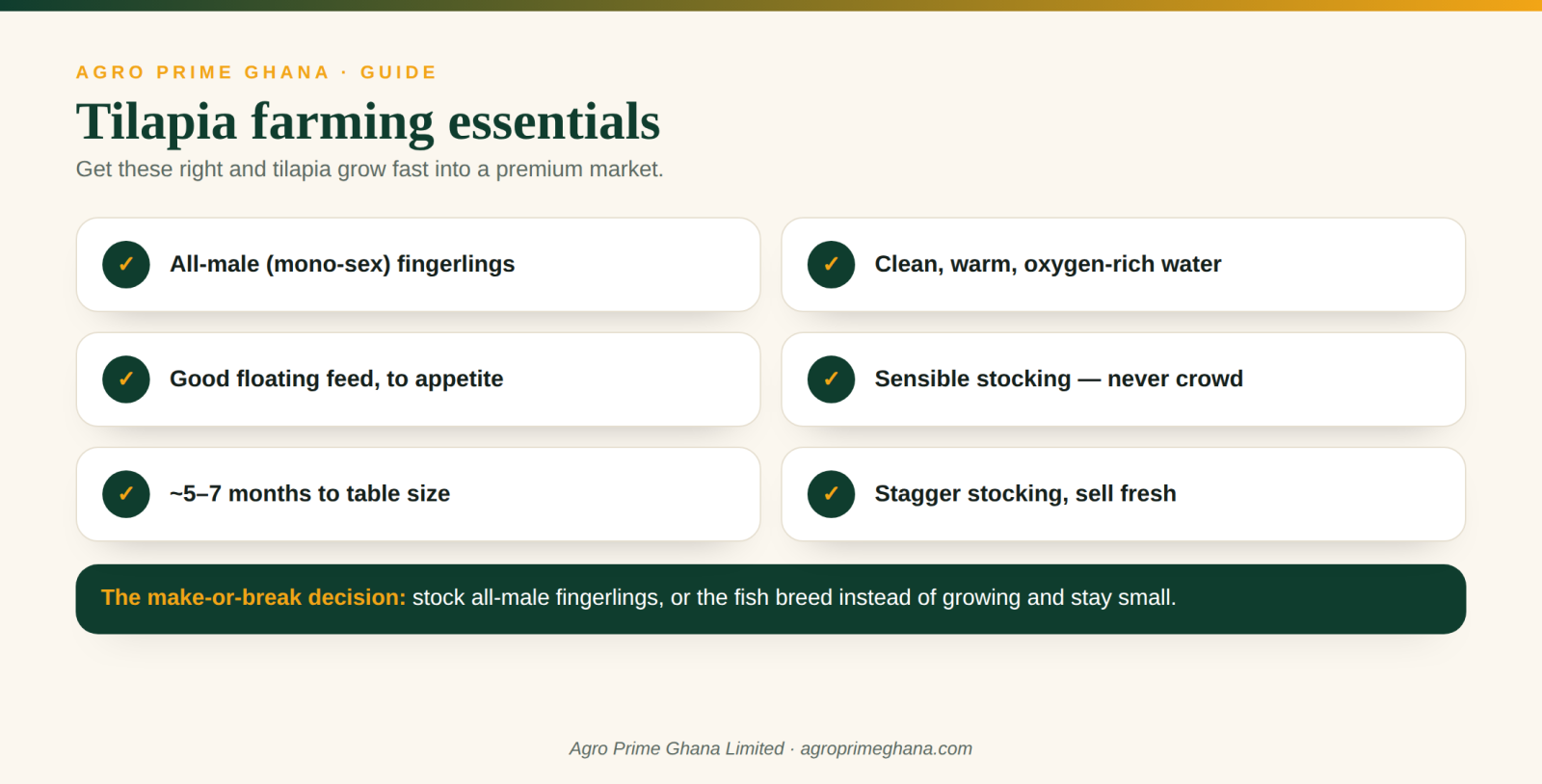
Tilapia are hardy, fast-growing and hugely in demand in Ghana. Stock all-male (mono-sex) fingerlings so the fish grow fast instead of over-breeding, choose a system that fits your water (pond, tank or cage), feed a good floating feed, and manage water quality closely. They reach a good table size in roughly 5–7 months. Strong local demand and thin domestic supply make the market reliable.
Why tilapia farming works in Ghana
Tilapia is the national fish — eaten grilled, in soups and stews, at chop bars and homes across the country — and Ghana imports a great deal of fish to meet demand that local production cannot fill. That gap is a standing opportunity for farmers. Tilapia suit local farming because they are hardy, breed and grow readily in our warm climate, and eat a largely plant-based diet, making their feed cheaper than that of many species. They grow to a marketable table size in months, sell reliably fresh at a good price, and can be raised in ponds, tanks or floating cages depending on your water and capital. For a farmer with access to water, tilapia offer a fast-turning, high-demand enterprise.
Tilapia or catfish? Choosing your fish
Many Ghanaian fish farmers weigh tilapia against catfish, and the honest answer is that they suit different situations. Catfish are exceptionally hardy, tolerate crowding and poor water, and grow very fast, which makes them forgiving for a beginner — see our full guide to catfish farming. Tilapia are a little more demanding on water quality and oxygen, but they command the stronger fresh-market price and are what most consumers actually ask for. Tilapia also breed very readily, which is a problem you must manage with all-male stock (below). A common path is to start with catfish to learn water and feeding cheaply, then add tilapia for the premium market — or to run both. Choose tilapia when you can give clean, well-oxygenated water and want the higher-value fish that buyers prize.
The single most important decision: all-male fingerlings
Here is the make-or-break point that separates profitable tilapia farms from disappointing ones. Tilapia breed constantly, and if you stock mixed males and females, they spend their energy producing thousands of tiny fingerlings instead of growing to size — you end up with a pond full of stunted, unsellable small fish. The answer is to stock mono-sex, all-male tilapia fingerlings, which do not breed among themselves and instead put all their energy into growth (males also grow faster than females). Buy sex-reversed or hand-sorted all-male fingerlings from a reputable hatchery. This one decision, more than any other, determines whether your tilapia reach a good market size. Never stock random mixed tilapia from an unknown source and expect them to grow out evenly.
Choosing your system
Match the system to your water, land and capital:
| System | Good for | Watch out for |
|---|---|---|
| Earthen pond | Larger scale, natural food supplements feed, lower cost per fish | Needs water-holding soil; predators; harder to monitor |
| Concrete/tarpaulin tank | Control and durability on limited land, easy monitoring | Higher build cost; needs good water exchange and aeration |
| Floating cage (in a lake/dam) | Large-scale grow-out where good open water exists (e.g. Volta Lake) | Needs suitable, clean, deep water; theft; higher management skill |
Ponds and tanks suit most farmers starting out. Cage culture in the Volta Lake and large dams has driven much of Ghana's tilapia growth, but it needs suitable open water, more capital and skill, and careful siting. Whatever the system, tilapia reward clean, well-oxygenated water.
Feeding for fast growth
Feed is the largest cost and the biggest driver of profit. Use a good-quality floating pelleted tilapia feed matched to the fish's size:
- Match pellet size to fish size, starting with fine crumble for fingerlings and moving up to grow-out pellets.
- Feed to appetite a few times a day, watching how eagerly the fish eat and stopping before feed goes uneaten.
- Floating feed lets you watch the feeding response — a drop in appetite is an early warning of stress or poor water.
- In ponds, natural food (algae, plankton) supplements the feed, which can lower cost, but do not rely on it alone for good growth.
As with poultry, judge feed by how much fish it produces per bag, not just its price — the logic of feed conversion applies to fish too. Overfeeding wastes money and fouls the water, so feed generously but never past appetite.
Water quality: the quiet make-or-break
Tilapia grow best in clean, warm, well-oxygenated water, and most avoidable losses trace back to water. Keep it right by not overstocking, not overfeeding, changing or exchanging water regularly (especially in tanks), and removing waste. Watch the fish: crowding at the surface gulping air in the early morning is a classic sign of low oxygen, and going off feed signals a problem. In tanks and cages, aeration or good water flow keeps oxygen up as fish grow. Warm, clean, oxygen-rich water grows fast, healthy tilapia; stagnant, overcrowded, overfed water stunts and kills them.
Growth, harvesting and the cash cycle
With all-male fingerlings, good feed and clean water, tilapia reach a marketable table size in roughly 5–7 months. Harvest by netting or draining, and sell promptly since fresh fish is perishable and tilapia command the best price fresh. Many farmers stagger stocking across several ponds, tanks or cages so they harvest and earn continuously through the year rather than all at once, smoothing cash flow and keeping regular buyers supplied.
The economics and finding buyers
Your main costs are the system, fingerlings and — by far the largest — feed. Against that, tilapia sell reliably and at a premium fresh, into a market that consistently wants more than local farms supply. Buyers include market traders and fishmongers, the many chop bars and restaurants serving grilled tilapia, hotels, and households. Line up buyers before harvest, and consider supplying regular customers on a schedule. Keep records of stocking, feed and sales so you know your true cost per kilo of fish — the same discipline behind good farm record keeping. Because tilapia is what consumers most want, a farmer who can supply good, fresh fish reliably rarely struggles to sell.
Cage culture on the Volta Lake
Much of Ghana's fast-growing tilapia output comes from floating cages on the Volta Lake and large reservoirs, and it is worth understanding even if you start in ponds. Cages let farmers grow large volumes of fish in existing open water without building ponds, and the constant water exchange helps with oxygen and waste — which is why commercial tilapia farming has scaled this way. But cage culture demands suitable, clean, reasonably deep water, more capital for cages and feed, strong management to feed and monitor fish on the water, and real attention to security against theft and to environmental good practice so the water is not overloaded. It is a serious step up, not a beginner's starting point. Most farmers are wiser to master tilapia in ponds or tanks first, prove they can grow an even, healthy batch on all-male stock, and only then consider scaling into cages where good water exists.
Pond fertilisation and natural food
One way pond-based tilapia farmers cut their biggest cost is by encouraging natural food to grow in the water. Tilapia are happy to eat plankton and algae, and a well-managed pond can grow a bloom of this natural food that supplements the pelleted feed and lowers your feed bill. Farmers do this by carefully fertilising the pond — using well-rotted animal manure (for example from poultry) or appropriate inputs — to feed the microscopic plants and animals that tilapia graze. The skill is balance: a light, greenish "tea" colour in the water shows a healthy plankton bloom, while over-fertilising fouls the water and strips oxygen, which is dangerous. This is an advanced touch rather than a beginner's first move, and it suits earthen ponds far more than tanks, but for a farmer integrating poultry and fish it turns manure into fish food and stretches the feed budget. Used carefully, natural pond food is a real cost saver; overdone, it becomes a water-quality problem, so start cautiously and watch the water.
Common mistakes to avoid
- Stocking mixed-sex tilapia, which breed instead of growing and leave you with stunted small fish. Use all-male fingerlings.
- Overstocking, which crashes water quality and stunts growth.
- Overfeeding, fouling the water and wasting your biggest cost.
- Ignoring oxygen, especially in tanks and cages as fish grow.
- Poor fingerlings from an unknown source, giving weak, uneven, mixed-sex stock.
- No market plan, leaving perishable fresh fish unsold at harvest.
Frequently asked questions
Is tilapia farming profitable in Ghana?
Why should I stock all-male tilapia?
How long does tilapia take to reach market size?
Can I farm tilapia in tanks?
Is tilapia or catfish better to farm?
What do farmed tilapia eat?
Do I need a lake to farm tilapia?
How much water do tilapia need?
The bottom line on tilapia farming
Tilapia is the fish Ghana most wants and least fully supplies, which makes it one of the most reliable markets a fish farmer can serve. Success rests on a few decisions made well: stock all-male fingerlings so the fish grow instead of breeding; give them clean, warm, well-oxygenated water; feed a good floating feed to appetite without overfeeding; and match your system — pond, tank or cage — to your water and capital. Start at a scale you can manage, prove you can grow an even, healthy batch to market size, line up buyers before harvest, and keep records so you know your true cost per kilo. Do that, and tilapia turn water and feed into a fast-turning, high-demand income that sits naturally alongside catfish, poultry and crops in a diversified farm. The farms that struggle almost always stocked mixed-sex fish, overstocked or ignored the water; the ones that succeed simply got the fingerlings, the oxygen and the feeding right.
Diversify into fish
Agro Prime Ghana Limited runs a hatchery and agribusiness in Kasoa. Adding fish like tilapia and catfish alongside poultry spreads your risk and steadies income. Talk to us about building a resilient, diversified farm: book a visit or message WhatsApp (+233 24 915 1503).