A hen that was laying well suddenly slows down. Over a week or two she stops laying altogether, her belly feels swollen and doughy, and she stands upright like a little penguin with her tail down. She may still eat a bit, then one morning you find her dead with no warning. Open her up and the body cavity is full of yellow, cheesy, foul-smelling material like scrambled egg gone wrong. That is egg yolk peritonitis — one of the quietest, most under-diagnosed killers of good laying hens in Ghana, and a problem that hits your best, hardest-working birds first. This guide explains what it is, why it happens, how to spot it, and — since there is rarely a cure — how to keep it out of your flock.
Written by the Agro Prime Ghana poultry team and reviewed against current veterinary references (MSD Veterinary Manual and poultryDVM). Last updated September 2026.
Key takeaways
Egg yolk peritonitis (EYP), also called egg peritonitis or coelomitis, is inflammation of the body cavity caused by yolk material ending up loose in the abdomen instead of travelling down the oviduct into an egg. That yolk is a perfect food for bacteria — above all Escherichia coli — so a sterile mess quickly becomes a raging infection. It is a common cause of sporadic death in layers and breeders, and can become the leading cause of flock mortality around and after peak lay. It strikes high-producing hens hardest and is often only diagnosed at post-mortem. Antibiotics usually fail once it is established, so the real answer is prevention: correct body weight and uniformity into lay, clean water, good ventilation, and controlling internal laying and vent damage. E. coli is regarded as the single biggest cause of layer mortality worldwide.
What egg yolk peritonitis actually is
To understand the disease you have to understand how a hen makes an egg. Each yolk starts as a follicle on the ovary; when ripe it is released (ovulation) and should be caught by the funnel-shaped mouth of the oviduct, which wraps it in albumen, membranes and shell over the next 24 hours. Egg yolk peritonitis begins when that hand-off fails — a yolk is dropped into the body cavity instead of being picked up, or yolk leaks backwards out of the oviduct. The MSD Veterinary Manual defines egg peritonitis as inflammation of the abdominal serosal surfaces in response to yolk material deposited there, and notes it is a common cause of sporadic death in layers and breeders that can become the major cause of flock mortality before or after peak production.
The trouble is what yolk does once it is in the wrong place. Yolk is rich, warm and nutritious — as the MSD manual puts it plainly, "yolk material is an excellent bacterial growth medium." The inflammation may be sterile at first, but it rarely stays that way: bacteria from the gut, the oviduct or the environment move in and multiply, turning a bit of misplaced yolk into a body cavity full of infected, cheesy exudate. That is why a hen can look "off" for only a few days before she dies.
Why it matters so much for Ghanaian layer keepers
Egg yolk peritonitis deserves far more attention than it gets from small and medium layer farms here, for three reasons. First, it targets your most valuable birds: high egg production is itself a risk factor, and poultryDVM lists high-production breeds, along with stressed, overweight or immunocompromised hens, as those most at risk. The disease quietly skims off your top layers, the ones paying your feed bill. Second, it is largely invisible until it kills — no dramatic outbreak like Newcastle, just a hen here and a hen there, week after week, written off as "she just died." A steady trickle of dead layers around peak production is one of its classic signatures.
Third, the organism that drives it — E. coli — is everywhere on a poultry farm, and is regarded across the industry as the biggest single cause of laying-hen mortality worldwide. E. coli usually acts as a secondary invader that takes advantage of an opening: misplaced yolk, a damaged oviduct, a prolapsed vent, dirty water, or dusty, ammonia-laden air. Ghanaian layer houses — often warm, sometimes crowded, frequently open-sided with variable ventilation and water hygiene — offer plenty of those openings. The Poultry Site notes that E. coli salpingitis (infection of the oviduct) is one of the most common causes of mortality in commercial layer and breeder chickens, and that egg-yolk-like caseous material in the cavity is a hallmark of the disease.
When it strikes in the laying cycle
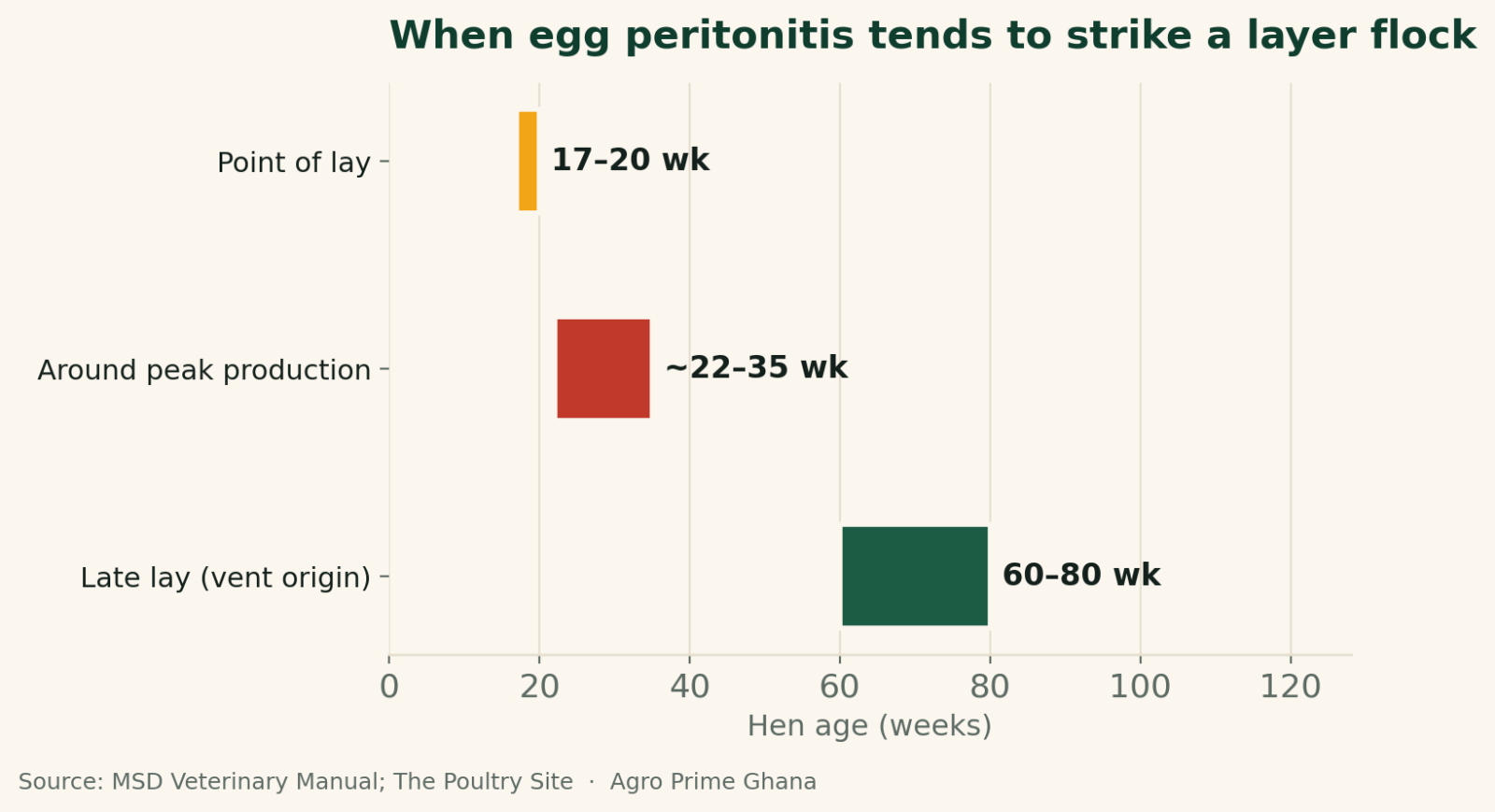
Egg peritonitis clusters around predictable moments. The first risk window is at point of lay and the run-up to peak, when the reproductive machinery switches into top gear and any mismatch — pullets brought into lay underweight or over-fat, uneven flocks, follicles released faster than a young tract can handle — shows up as misdirected ovulations. The Poultry Site describes peritonitis raising mortality especially around the peak of egg production. The second window is late lay, when tissues are tired, vents are more prone to damage and prolapse, and infection travels "up" from the vent. As that overview notes, peritonitis around peak often has a respiratory or internal origin, while in late lay a vent origin becomes more important — telling you when to be most watchful about the basics.
| Feature | Egg yolk peritonitis (EYP) | What sets it apart |
|---|---|---|
| Underlying cause | Yolk released into the body cavity + bacterial infection (usually E. coli) | Not a contagious "outbreak" disease — driven by reproduction going wrong |
| Birds affected | Laying hens and breeders, often the best producers | Rarely young growers or cockerels; needs an active ovary |
| Typical pattern | Sporadic, steady trickle of deaths around/after peak lay | No sudden mass die-off; easy to overlook |
| Live signs | Drop in lay, penguin stance, swollen doughy abdomen, dull, weight loss | Signs are vague and slow — often mistaken for "just a sick hen" |
| Diagnosis | Usually confirmed only at post-mortem (cheesy yolk-like material in cavity) | You must open a bird to be sure |
| Treatment | Antibiotics usually ineffective once established | Prevention, not cure, is the real lever |
How to recognise it in a live bird
Keepers who never open a dead bird almost never "see" egg peritonitis — but there are live clues. The most useful is a hen that stops laying and stands in a penguin-like, upright posture, tail pointed down, easing the pressure of fluid and inflammation in her abdomen. poultryDVM describes affected hens becoming less active, sitting excessively in the nest box, and adopting that penguin stance to relieve discomfort. Feel the belly: often it is swollen, warm and doughy or fluid-filled (ascites), and the hen may waddle or breathe with difficulty as the swelling presses on her air sacs. Add a pale, shrunken comb, weight loss over the breast even as the abdomen swells, and misshapen or soft-shelled eggs, and egg peritonitis belongs high on your list.
Field note: open the birds you lose
The single most useful habit we can recommend to any layer keeper is simple: when you lose a hen, do a basic post-mortem rather than just burying her. You do not need to be a vet to recognise the classic picture of egg peritonitis — a body cavity smeared or filled with yellow, cheesy, egg-like material, often with loose yolks or an inflamed, thickened oviduct. If you keep seeing that in dead layers around peak lay, you have a management problem to fix, not bad luck. Note the bird's age and how many you have lost, and take a fresh carcass to a veterinary or extension officer if deaths are climbing.
What actually goes wrong — the root causes
Egg peritonitis is best thought of as the end-point of several possible problems, not a single disease you "catch." The main roads that lead to it are:
- Internal laying (ectopic ovulation). The yolk is released but not caught by the oviduct, so it falls into the body cavity. poultryDVM names ectopic ovulation — where the follicle ruptures and the yolk does not enter the oviduct normally — as a primary cause. Some hens are simply prone to this; excess, over-large or too-rapid follicle development makes it more likely.
- Coming into lay wrong. Pullets that reach point of lay underweight, over-fat or in an uneven flock are more likely to misfire early in production. The MSD manual links egg peritonitis to erratic ovulation and defective egg syndrome, where hens develop excessive large follicles and internal ovulation follows — and points prevention at managing body weight, uniformity and reproductive development.
- Reproductive-tract disease. Salpingitis (an infected oviduct), an impacted oviduct, tumours and cystic disease can all push yolk and albumen backwards into the abdomen.
- Vent damage and prolapse — an "up-and-in" route. In late lay especially, a damaged or prolapsed vent lets bacteria travel up the tract. This is why prolapse control matters here too; see our guide to why hens stop laying for the reproductive problems that overlap with this one.
- Bacterial infection to finish the job. E. coli is the organism most often isolated, with Klebsiella, Proteus, Staphylococcus and Streptococcus also found. Whatever starts the process, it is bacteria multiplying in misplaced yolk that turns it into fatal peritonitis.
Why treatment usually disappoints
It is worth being honest about this, because false hope wastes money. Once egg yolk peritonitis is established, the cavity is full of infected, walled-off, cheesy material that antibiotics struggle to penetrate, and the underlying reproductive fault is still there. The MSD Veterinary Manual states plainly that antimicrobial treatment is usually ineffective, and poultryDVM rates the prognosis as poor unless a hen is seen promptly by a veterinarian. In a valuable individual bird a vet may attempt supportive care, antibiotics, fluid drainage or surgery, but on a commercial layer farm none of that is practical for routine cases. The realistic message for a Ghanaian layer keeper is blunt: you will not medicate your way out of an egg-peritonitis problem. You prevent it, or you keep paying for it.
Prevention: managing the flock so yolks go where they should
Because there is no reliable cure, everything sits on prevention — and the good news is that the same disciplines that prevent egg peritonitis also give you a more productive, longer-lived flock. Focus on these levers:
- Get pullets to point of lay at the right body weight and uniformity. This is the foundation. Rear to breed-standard body-weight targets, keep the flock even, and do not switch on the "lay" signal (long day-length and layer feed) until pullets are physically ready. Bringing hens into lay too young, underweight or over-fat is a direct route to erratic ovulation and internal laying.
- Feed correctly for the stage. Match energy and protein to the phase so hens are neither too fat nor too lean, and get calcium right so shells are strong and the tract is not straining on soft or oversized eggs. Our layer feeding guide for Ghana covers phase feeding and calcium in detail.
- Protect water and air quality. E. coli thrives in dirty drinkers and biofilm, and dusty, ammonia-heavy air opens a respiratory route to infection. Sanitise water lines, clean drinkers, and ventilate to clear moisture, dust and ammonia — see poultry house ventilation.
- Control prolapse and vent pecking. A damaged vent is a doorway for bacteria, so everything that reduces prolapse — correct body weight into lay, sensible light intensity, avoiding oversized eggs early — also reduces peritonitis in late lay.
- Reduce stress, crowding and cull sensibly. Heat stress and overcrowding suppress immunity and tip birds towards infection. Track mortality by age, and cull chronic "internal layers" that have stopped producing rather than letting them linger as a source of infection.
Field note: the "penguin hen" is telling you something about the whole flock
When we see a single hen standing upright with a swollen belly, we treat it as a flock question, not just a bird question. One penguin hen at 30 weeks can be bad luck; three or four over a month, all around peak lay, usually means something upstream is off — pullets that came into lay unevenly, feed pushing production too hard, drinkers that need cleaning, or a house that gets too hot in the afternoon. The bird is rarely worth heroic treatment, but she is a free warning to go back and check body weights, water hygiene and ventilation before the trickle becomes a stream.
The economics: a slow leak that adds up
Egg peritonitis rarely bankrupts a farm in a week the way a Newcastle wipe-out can, and that is exactly why it is dangerous — it hides. Every hen lost costs not just the price of the bird but all the pullet-rearing you already spent to get her to lay, plus the months of eggs she would have produced, with no salvage value. When those losses concentrate in your best producers around peak, they quietly pull down flock average lay, feed conversion and margin — and because the birds "just die," the cause is never fixed. Against that, prevention costs almost nothing extra: it is mostly good pullet rearing, correct feeding, clean water and decent ventilation you should be doing anyway.
The bottom line on egg yolk peritonitis
Egg yolk peritonitis is the hidden tax on a hard-laying flock: yolk loose in the body cavity, infected by E. coli, killing your best hens one at a time around and after peak production. It is confirmed at post-mortem, responds poorly to antibiotics, and is part of the biggest cause of layer mortality worldwide — common, costly, hard to treat and easy to overlook. That makes it a disease you design out rather than cure. Rear pullets to target weight and uniformity, feed them right for each stage, keep water clean and air fresh, control prolapse, and open the birds you lose so you actually know what is killing them. Get those basics right and the trickle of "she just died" layers dries up — and your peak-production hens live long enough to pay you back.
Frequently asked questions
What is egg yolk peritonitis in hens?
What are the signs of egg peritonitis in a live hen?
What causes it?
Can egg peritonitis be treated or cured?
Is it contagious to the rest of my flock?
Why does it hit my best-laying hens?
How do I know for sure a hen died of it?
How can I prevent egg peritonitis on my farm?
Sources & further reading
- MSD Veterinary Manual — Egg Peritonitis in Poultry (definition, E. coli and yolk as growth medium, EODES/internal laying, ineffective treatment, prevention through body weight and uniformity).
- poultryDVM — Egg Yolk Peritonitis (ectopic ovulation, bacteria isolated, penguin stance and clinical signs, at-risk hens, poor prognosis).
- The Poultry Site — Colibacillosis in Layers: an Overview (E. coli salpingitis and peritonitis as major layer mortality, respiratory vs vent origin, timing around peak and late lay).
- Agro Prime Ghana guides: layer feeding guide, why hens stop laying, and poultry house ventilation.
About Agro Prime Ghana
Agro Prime Ghana Limited runs a poultry hatchery and mixed agribusiness in Kasoa, supplying day-old chicks and supporting layer and broiler keepers across the country. These guides combine hands-on hatchery and farm experience with current veterinary references. This article is general educational information, not a substitute for diagnosis by a qualified veterinary or extension officer — if your layers are dying steadily, have a fresh carcass examined. Need point-of-lay pullets, feed advice or farm support? Book a visit or message us on WhatsApp (+233 24 915 1503).