You notice it in the first week or two: a few chicks walking oddly, resting back on their hocks, and when you look closely their toes are curled inward and under, as if permanently clenched. The birds try to walk on these curled feet, stumble, and gradually stop competing for feed. This is curled-toe paralysis, and unlike a simple positional toe curl it has a specific, well-documented cause: a shortage of riboflavin (vitamin B2) in the diet — either the chick's own feed or, before that, the breeder hen's. It is one of the clearest examples in poultry of a nutritional deficiency writing itself onto the bird's body, and it carries a hard lesson: caught early it is correctable, but left too long the nerve damage becomes permanent. This guide explains what it is, why home-mixed Ghanaian rations are especially at risk, and how to prevent and manage it.
Written by the Agro Prime Ghana poultry team and reviewed against current veterinary references (Merck Veterinary Manual and The Poultry Site). Last updated September 2026.
Key takeaways
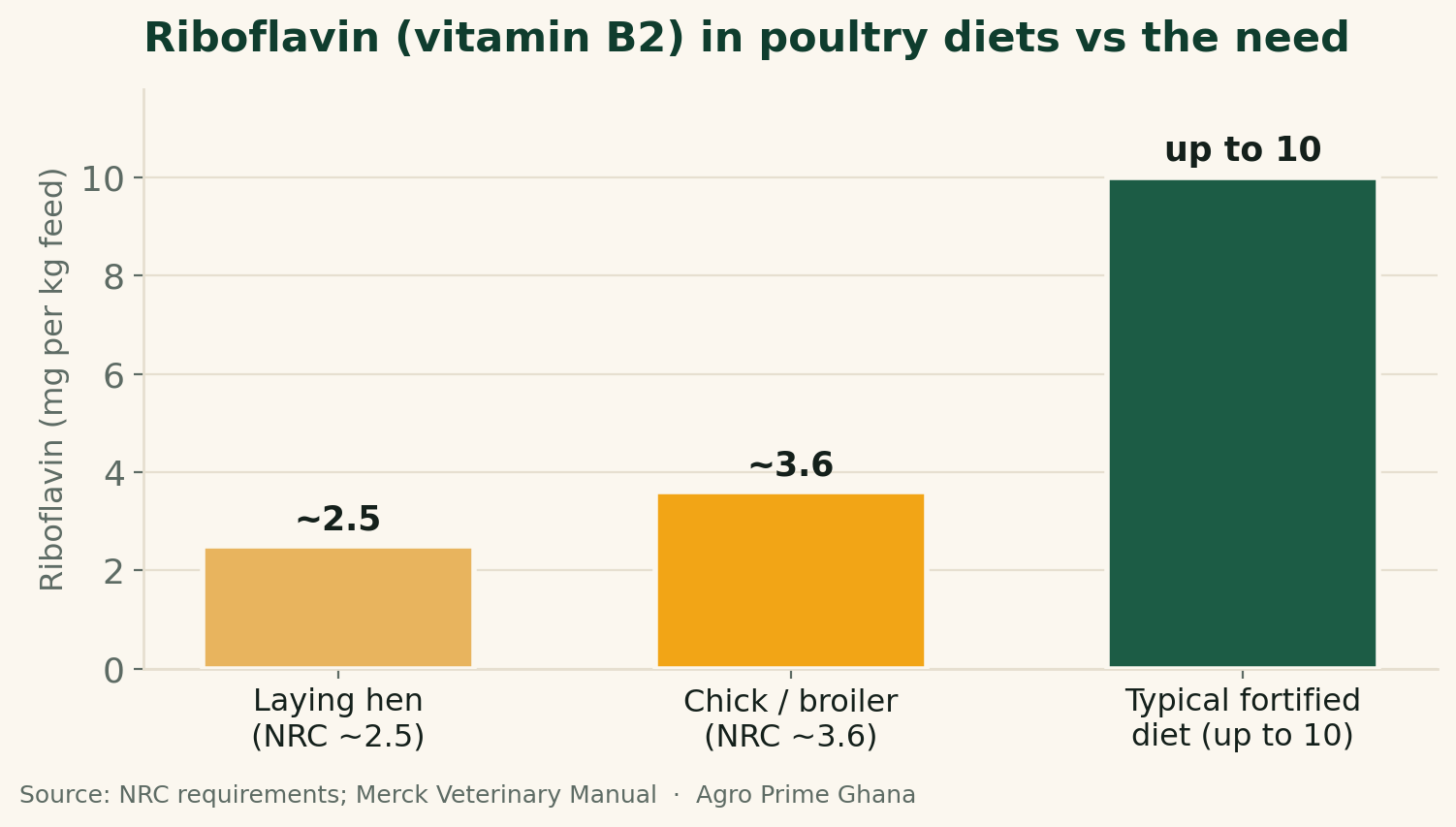
Curled-toe paralysis is the classic sign of riboflavin (vitamin B2) deficiency in growing chicks. The toes curl inward and under, birds walk on their hocks using their wings for support, and it typically appears in the first and second weeks of life. The cause is nerve damage — the sciatic and brachial nerves swell and their myelin sheaths degenerate, pinching the nerve. Caught early it can be corrected by restoring riboflavin; left too long the damage is permanent and no longer curable. Well-formulated poultry diets carry up to about 10 mg of riboflavin per kg, comfortably above chick needs — the risk lies in home-mixed rations built on maize and cereals without a proper vitamin premix. Breeder deficiency also cripples hatchability, producing dead or "clubbed-down" embryos.
What curled-toe paralysis actually is
Curled-toe paralysis is a nervous-system disorder, not a joint or foot problem — the curled toes are the visible end of nerve damage happening further up the leg. It is the textbook clinical sign of riboflavin deficiency, one of the B-complex vitamins. Riboflavin (vitamin B2) is essential to the enzymes that run energy metabolism in every cell, and nerve tissue is especially sensitive to a shortage. According to the Merck Veterinary Manual, when chicks are short of riboflavin the sheaths of the sciatic and brachial nerves swell markedly and the myelin (the insulating layer around the nerve) degenerates; when this is severe it pinches the nerve, creating a permanent stimulus that pulls the toes into the curled position. The Poultry Site describes the same progression from the outside: at first the toes are only slightly flexed and the chicks tend to stand on their hocks, and as it worsens the toes curl completely downward and inward with full weakness of the legs. So the "paralysis" is real nerve dysfunction, and the curled toe is its signature.
Why it matters in Ghana — the home-mix problem
Curled-toe paralysis matters here for one specific reason: a great deal of Ghanaian poultry feed is home-mixed or bought from small mills, built around maize, wheat bran, and locally available protein sources — and these cereal-based rations are naturally low in riboflavin unless a proper vitamin premix is added. Merck notes that most commercial diets contain up to about 10 mg of riboflavin per kilogram, which is well above what a chick needs; that safety margin comes almost entirely from the added vitamin premix. Leave out the premix, use an old or heat-damaged one, or stretch a bag of premix too far across too much feed, and riboflavin is exactly the kind of vitamin that falls short first. The result shows up quickly and unmistakably in the youngest birds. This is why curled-toe paralysis is far more common on farms mixing their own feed than on those buying complete commercial starter, and why it is really a feed-formulation and quality-control problem wearing the costume of a leg disease. If you mix your own rations, our guide to making poultry feed covers getting the vitamin and premix side right — it is not optional.
How to recognise it
Curled-toe paralysis has a distinctive look that, once seen, is hard to confuse with anything else:
- Toes curled inward and under. Rather than spreading flat to grip, the toes clench downward and inward, so the chick effectively walks on the tops or knuckles of curled feet.
- Walking on the hocks. Merck describes affected chicks walking on their hocks with the aid of their wings — squatting back on the leg joints and using the wings as props because the feet no longer work properly.
- A first-and-second-week onset. Merck places the onset between the first and second weeks of life, so this is an early-life sign in young growing chicks.
- Poor growth and falling behind. Because affected chicks cannot get to feed and water normally, they eat less, grow poorly and drop out of the flock's uniformity — the deficiency and the disability compound each other.
- Usually several birds, not one. Because it is a diet problem, it tends to show in a number of chicks on the same ration, not a single isolated bird — an important clue that separates it from a one-off mechanical injury.
The pattern of multiple young chicks, on the same home-mixed feed, curling their toes and sitting on their hocks in the first fortnight is close to diagnostic for riboflavin deficiency, and should send you straight to the feed and the premix.
Field note: count the birds and question the feed batch
The thing we always check first with curled toes is how many and on what feed. One chick with a curled toe in an otherwise fine batch is probably positional or a minor injury. But several chicks curling their toes and dropping onto their hocks in the first two weeks — all eating from the same home-mixed bag — points hard at the ration. When that happens, the questions are simple: did this feed get its vitamin premix, was the premix fresh, and was it mixed evenly through the whole batch? A premix that was skipped, stale, or poorly blended is the usual answer, and it is fixable — but only if you catch it before the nerve damage sets.
The window that closes: why timing decides the outcome
The single most important thing to understand about curled-toe paralysis is that it has a window. In the early stage, the nerve is swollen and irritated but not destroyed, and Merck is clear that partial deficiencies can recover spontaneously because the riboflavin requirement falls rapidly as the bird ages, and The Poultry Site notes that considerable improvement can be expected if treatment starts in the initial stage. But that window closes. Merck states plainly that when the curled-toe deformity is longstanding, irreparable damage occurs in the sciatic nerve, and giving riboflavin is no longer curative. In other words, the same deficiency that is correctable in week one becomes permanent if it runs on untreated. This is the practical crux of the whole disease: the difference between a full recovery and a crippled, cull-only bird is often just a few days of recognition and action. It is a powerful argument for walking your young chicks daily and reacting the moment you see toes starting to curl.
| Stage | What you see | Outlook with riboflavin |
|---|---|---|
| Early / partial deficiency | Toes slightly flexed, chick stands back on hocks | Correctable — often recovers when riboflavin is restored |
| Progressing | Toes curling inward, walking on hocks with wings | May still improve if treated promptly |
| Longstanding / severe | Toes fully curled under, marked leg weakness | Permanent nerve damage — no longer curative; cull |
Prevention: get the vitamins right, from breeder to chick
Curled-toe paralysis is one of the most preventable poultry problems there is, because it comes down to one nutrient being present in the feed. The measures that matter:
- Use a complete, properly formulated starter — or a proper vitamin premix. Good commercial chick starter already carries ample riboflavin (recall Merck's figure of up to ~10 mg/kg in typical diets). If you home-mix, you must include a quality vitamin-mineral premix at the correct rate; cereal grains alone will not supply enough riboflavin.
- Keep premix fresh and store it well. Vitamins degrade with heat, humidity and time. Buy premix from a reliable source, use it within its shelf life, and store it cool, dry and sealed — our hot, humid climate is hard on vitamins, and a stale premix can leave feed short even when it was "added."
- Mix evenly and don't dilute the rate. A premix that is dumped in one spot and poorly blended leaves some feed rich and some feed deficient. Mix thoroughly, and never stretch a fixed amount of premix across more feed than it was meant for.
- Feed breeders properly. Riboflavin status starts before hatch. A breeder hen short of riboflavin passes the problem into the egg, so breeding birds need a proper breeder ration, not a plain layer feed.
- Watch the youngest birds daily. Because the correctable window is short, early detection is itself a prevention tool — daily observation of chicks in the first two weeks lets you act while riboflavin can still help.
The breeder and hatchery angle: it starts in the egg
Riboflavin deficiency is not only a chick-feed issue — it strikes at the breeding flock and the hatch too, and this is easy to miss. Merck notes that when hens are fed a riboflavin-deficient diet, hatchability falls within about two weeks, and returns to near normal once riboflavin is restored — so a dip in hatch rate can itself be a riboflavin signal. The embryos that do develop under deficiency show a characteristic sign: defective, "clubbed" down (short, curled feathering), a recognised marker of riboflavin deficiency in the egg. For anyone running a hatchery or saving eggs for hatching, this makes breeder-flock riboflavin a double concern: too little and you lose both the hatch and, in the chicks that do hatch, you set the stage for curled-toe paralysis. It reinforces the same message from a different direction — the vitamin has to be right in the breeder's feed, not just the chick's. Getting your chicks from a source that feeds its breeders properly is part of why chick quality varies so much between hatcheries; our guide to choosing healthy day-old chicks touches on judging that quality.
Field note: don't just dose vitamins and carry on
When curled toes appear, a water-soluble vitamin B-complex in the drinking water is a sensible first response — the early-stage birds may improve, and it does no harm to the rest. But the mistake we warn against is stopping there and treating it as solved. If the feed was short of riboflavin, every new chick on that same batch is heading the same way. The real fix is to correct the ration: check the premix, replace it if it is stale, mix the next batch properly, and switch to a complete starter if you cannot guarantee your own. Treat the sick birds, yes — but fix the feed, or you will be dosing vitamins batch after batch.
Treatment and honest expectations
Treatment is straightforward in principle: restore riboflavin — correct the diet to a properly formulated feed and, for affected birds, give a readily-absorbed water-soluble vitamin B2 or B-complex supplement, which The Poultry Site notes is well absorbed, with meaningful improvement expected if treatment begins at the initial stage. But be realistic about which birds this saves. Chicks caught early, while toes are only starting to flex, often recover well. Chicks whose toes are fully, longstanding-curled have permanent sciatic nerve damage and will not straighten no matter how much riboflavin you give — these are welfare culls, because they cannot compete for feed. This split outcome is not a failure of the vitamin; it is the nature of nerve damage — and the strongest possible reason to prevent the deficiency and to act on the very first curled toe rather than the tenth.
The bottom line on curled-toe paralysis
Curled-toe paralysis is nutrition made visible: a shortage of riboflavin (vitamin B2) that swells and degrades the leg nerves until a chick's toes curl under and it walks on its hocks, typically in the first two weeks of life. In Ghana it is above all a home-mix and premix problem — cereal-based rations are naturally low in riboflavin, and the safety margin comes from a vitamin premix that must be present, fresh and evenly mixed. Caught early, the deficiency is correctable and birds recover; left too long, the nerve damage is permanent and the birds are lost. Prevent it by feeding a complete starter or a properly premixed ration, keeping premix fresh, feeding breeders correctly, and watching your youngest chicks every day. Get the vitamin right and curled-toe paralysis simply does not appear — which is exactly how it should be.
Frequently asked questions
What causes curled-toe paralysis in chicks?
How do I recognise curled-toe paralysis?
Can curled-toe paralysis be cured?
How much riboflavin do chicks need?
Why is this common in home-mixed feed?
Does riboflavin deficiency affect laying and hatching?
What should I do the moment I see curled toes?
Is curled toe the same as spraddle leg?
Sources & further reading
- Merck Veterinary Manual — Vitamin Deficiencies in Poultry (riboflavin deficiency, curled-toe paralysis, sciatic/brachial nerve changes, ~10 mg/kg in diets, onset weeks 1–2, permanence when longstanding, hatchability and clubbed down).
- The Poultry Site — Vitamin B2 Deficiency (progression of toe curling, standing on hocks, nerve degeneration, recovery when treated early).
- Agro Prime Ghana guides: how to make poultry feed and choosing healthy day-old chicks.
About Agro Prime Ghana
Agro Prime Ghana Limited runs a poultry hatchery and mixed agribusiness in Kasoa, supplying day-old chicks and supporting poultry keepers nationwide. These guides combine hands-on hatchery and feed experience with current veterinary references. This article is general educational information, not a substitute for professional veterinary or nutritional advice — if leg problems persist despite corrected feed, have the flock assessed. Need chicks, feed advice or farm support? Book a visit or message us on WhatsApp (+233 24 915 1503).