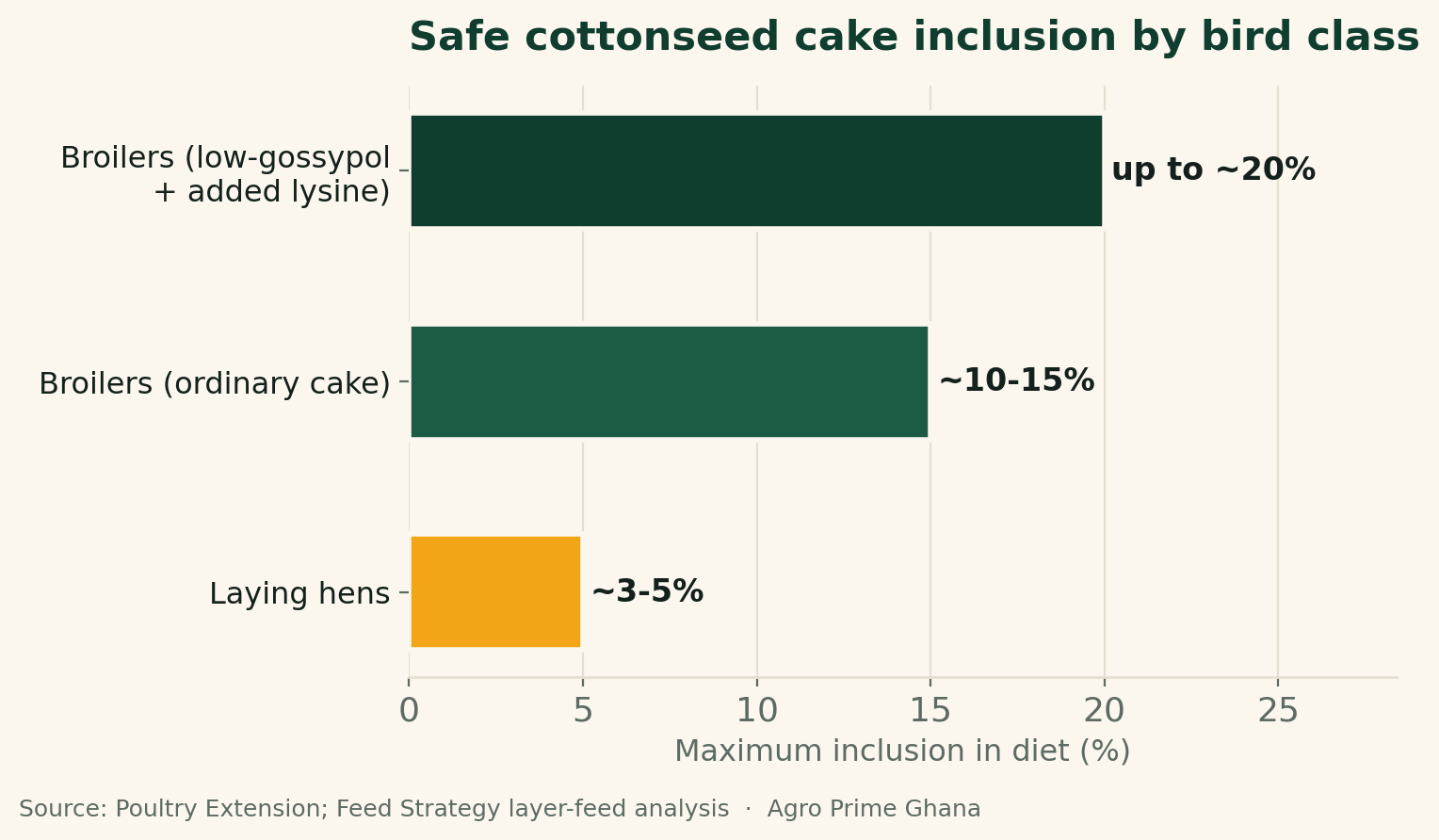
Cottonseed cake (cottonseed meal) is a cheap local protein by-product that can work well in broiler and grower diets but must be used with great caution in laying hens. The reason is a natural toxin in cotton called gossypol: in layers it turns egg yolks olive-green and mottled and can cause pink egg whites, while at higher levels it depresses growth and intake in any bird. For broilers, ordinary cottonseed cake can safely supply part of the protein — up to around 10–15% of the diet, and up to 20% with low-gossypol meal and added lysine — but for layers the safe inclusion is far lower, often just a few percent, unless the free gossypol is bound or the meal is low-gossypol. This guide explains how to use cottonseed cake profitably in Ghana without spoiling your eggs or stunting your birds.
Written by the Agro Prime Ghana poultry team and reviewed against current industry references (eXtension/Poultry Extension and Feedipedia feed data). Last updated September 2026.
Key takeaways
Cottonseed cake carries about 35–41% crude protein but is lower in energy and lysine than soybean meal, and it contains gossypol, a toxin present as "free" (harmful) and "bound" (harmless) forms. In layers, free gossypol causes olive-green, mottled yolks, and cyclopropenoid fatty acids cause pink egg whites in stored eggs — so inclusion should stay low (often only about 3–5% of the diet, higher only with low-gossypol meal or added iron). In broilers, it is far more forgiving: up to about 10–15%, or 20% of low-gossypol meal with supplemental lysine. Adding ferrous sulphate at roughly 1:1 with free gossypol binds the toxin. Screw-press (heat) processing lowers free gossypol; solvent extraction leaves more.
What cottonseed cake is and where it comes from
Cottonseed cake is the protein-rich residue left after oil is pressed from cotton seeds. Cotton is grown mainly in the northern savannah zones of Ghana, and when the seed is ginned and crushed for oil, the leftover cake and meal become a locally available animal feed. Its crude protein sits around 35–41% — the Poultry Extension network puts typical cottonseed meal at about 40% crude protein — which makes it a useful, cheaper stand-in for part of the soybean meal or fishmeal in a ration. But that same source is clear about the trade-off: cottonseed meal has "less crude protein, dietary energy, and lysine content than more-conventional soybean meal," and it carries anti-nutritional factors that soybean does not. So cottonseed cake is best thought of as a budget protein extender — genuinely useful, but with rules attached, especially the toxin gossypol.
Why gossypol is the whole story
Gossypol is a natural yellow pigment concentrated in the tiny glands of the cotton seed, and it is the single factor that decides how much cottonseed cake you can safely feed. It exists in two forms, and the difference is everything. Free gossypol is the toxic form; bound gossypol — attached to protein — is essentially non-toxic. As the Poultry Extension gossypol article explains, the processing method changes the balance: screen- or screw-pressing with heat drives gossypol to bind to protein (less free, safer), while solvent extraction leaves more in the free, toxic form. In poultry, free gossypol depresses appetite, growth and, in breeders, hatchability — and in layers it produces the notorious egg-quality faults. According to the analysis in Feed Strategy, cottonseed meal typically contains about 1% total gossypol, of which roughly 0.1% (about 1,000 ppm) is in the free, active form. Because the tolerable amount in the finished feed is small, that concentration is what limits how much cake you can add — particularly for eggs.
Layers versus broilers: the crucial split
The single most important rule with cottonseed cake is that layers and broilers are not the same case. Broilers are slaughtered young and do not produce eggs, so the egg-quality problems never arise and their tolerance is set mainly by growth and intake. Layers, by contrast, convert even modest gossypol into visible, saleable-egg-destroying faults. The table below lays out the practical difference, drawn from the Poultry Extension network and the Feed Strategy analysis.
| Bird class | Practical cottonseed cake limit | Why |
|---|---|---|
| Broilers (finishing) | ~10–15% (up to 20% low-gossypol + added lysine) | No eggs; short life; tolerance set by growth & feed intake |
| Growers / pullets | Low–moderate, well below broiler levels | Long-lived birds; avoid gossypol build-up before lay |
| Laying hens | ~3–5% (higher only with low-gossypol meal or bound gossypol) | Free gossypol → olive/mottled yolks; CPFA → pink whites |
| Breeders | Minimal / avoid | Gossypol reduces hatchability |
In short: cottonseed cake is a broiler-and-grower ingredient first, and a layer ingredient only with real care. For how the two feeding programmes differ overall, see our broiler feeding guide and layer feeding guide.
What gossypol does to eggs
The egg faults from cottonseed cake are specific and unmistakable once you know them. Free gossypol causes olive-green, greenish or mottled yolks — the yolk membrane is affected and iron from the yolk reacts with gossypol to discolour it, especially after the eggs are stored or cooked. Separately, cotton contains cyclopropenoid fatty acids (CPFA), and the Poultry Extension network notes these cause yolk mottling and a pink discolouration of the egg white (albumen), most visible in stored eggs. None of this changes the egg's nutritional value or flavour meaningfully, but it destroys consumer acceptance — no buyer wants a green-yolked, pink-whited egg, and a farm that ships them loses trust fast. This is why the safe limit for layers is governed not by the hen's health alone but by egg appearance, which is a lower bar. The Feed Strategy analysis suggests keeping free gossypol in the final layer feed to around 30 ppm, which — at typical gossypol concentrations — works out to only about 3% cottonseed meal on a conservative basis, though some allow up to 10%.
Field note: watch the yolks before you trust the feed
When cottonseed cake goes into a layer ration, the eggs tell you the truth faster than any table. We crack and inspect a sample of eggs a few days after a feed change, and again after holding some for a week — gossypol discolouration often shows up more strongly in stored eggs than in fresh ones. Olive-tinged or blotchy yolks, or any pink cast in the white, mean the gossypol is too high and the inclusion must come down (or the meal switched to a low-gossypol source). It is far cheaper to catch this in a dozen test eggs than in a rejected market load.
The amino-acid gap: lysine again
Like groundnut cake, cottonseed cake is lysine-deficient, and this is a bigger deal than its modest protein percentage suggests. The Poultry Extension network points out that broiler diets can carry up to 20% low-gossypol cottonseed meal only when the diet is supplemented with lysine — without that correction, the shortfall caps performance well before you reach high inclusions. So cottonseed cake, like most oilseed by-products, should be formulated to the amino-acid requirement, not the crude-protein number, with synthetic L-lysine or a lysine-rich partner ingredient making up the gap. Our guide to amino acids in poultry feed explains why lysine and methionine, not crude protein, are what actually build muscle and eggs. Treated this way, cottonseed cake becomes a sensible way to stretch a protein budget; treated as a straight protein swap, it disappoints.
Taming gossypol: processing, iron and low-gossypol meal
There are three practical ways to make cottonseed cake safer, and they can be combined. First, choose the right processing: screw-press cake made with heat has more of its gossypol bound and less free, so it is safer than solvent-extracted meal for the same crude gossypol. Second, bind the free gossypol with iron. The Feed Strategy analysis recommends adding iron at roughly a 1:1 ratio to free gossypol — for example, about 0.5 kg of ferrous sulphate per tonne of feed neutralises around 30 ppm of free gossypol — which lets you include more cake, or protect layers, safely. Third, use low-gossypol (glandless) cottonseed meal where you can source it, which sidesteps most of the problem; the one caution is that glandless varieties can carry cyclopropenoid fatty acids that still cause pink egg whites in storage. None of these is exotic or expensive, and together they turn a risky ingredient into a manageable one. For the broader menu of local proteins you can rotate through, see alternative protein sources for poultry.
Cut feed cost without cutting corners
Cottonseed cake is one of the levers Ghanaian farmers use to hold down feed cost — but only when the ration is balanced and the bird class is right. Agro Prime Ghana helps farmers build least-cost rations that use local by-products like cottonseed and groundnut cake safely, and we supply strong day-old broilers and layers, point-of-lay pullets and quality feed so you are not gambling on inputs. If you are thinking of putting cottonseed cake into a layer ration, talk to us first — a quick check can save a market load of green-yolked eggs. Message us on WhatsApp (+233 24 915 1503) or book a visit for chicks, feed and a ration plan.
Quality and sourcing in Ghana
Because gossypol level depends on processing, knowing your cottonseed cake's origin matters more than with most feeds. Cake from a screw press run hot is usually safer than cold-pressed or solvent-extracted meal; ask how it was made where you can. Watch for the same general quality signals that apply to any oilseed cake: reject material that is mouldy, musty, caked, discoloured or insect-damaged, since cottonseed — like groundnut — can also carry aflatoxin when badly dried or stored. Beware adulteration with excess hulls, which raises fibre and dilutes protein. And because free gossypol and residual oil both vary from batch to batch, treat each new lot as a new ingredient rather than assuming last month's cake behaves the same way. For where cottonseed sits among the ingredients you might blend, our overview of poultry feed ingredients in Ghana is a useful companion.
Field note: ask how the cake was pressed before you buy
Because the gossypol risk depends so much on processing, the most useful question we ask a cottonseed supplier is a simple one: was it hot screw-pressed, or solvent-extracted? Hot-pressed cake has more of its gossypol bound to protein and is the safer choice, especially for anything going near layers. We also treat a new supplier's cake as an unknown until we have used it once and watched the birds and — for layers — the eggs. A slightly higher price for well-processed, low-gossypol cake from a source you trust is cheaper than the loss from stunted broilers or a batch of discoloured eggs.
The bottom line on cottonseed cake
Cottonseed cake is a cheap, locally produced protein that earns a place in Ghanaian poultry feeding — but on terms set by gossypol. In broilers and growers it is genuinely useful, supplying part of the protein at up to roughly 10–15% of the diet (or 20% for low-gossypol meal with added lysine), provided the amino acids are balanced. In layers it demands respect: keep inclusion low, watch the yolks and whites, and lean on iron binding or low-gossypol meal to avoid olive-green yolks and pink egg whites that no customer will buy. Get the bird class right, correct the lysine gap, control the gossypol, and buy clean, well-processed cake — do that, and cottonseed cake is a smart way to stretch your protein budget. Ignore those rules, and it quietly damages either your birds' growth or your eggs' saleability.
Frequently asked questions
Can I feed cottonseed cake to laying hens?
How much cottonseed cake can broilers eat?
What is gossypol and why is it dangerous?
Why do my eggs have green or olive yolks?
How does iron (ferrous sulphate) make cottonseed cake safer?
Is screw-pressed or solvent-extracted cottonseed meal better for poultry?
Does cottonseed cake have aflatoxin risk too?
Is cottonseed cake a good way to save on feed cost in Ghana?
Sources & further reading
- Poultry Extension (eXtension) — Cottonseed Meal in Poultry Diets and Gossypol (protein and lysine, free vs bound gossypol, broiler inclusion, layer egg-quality effects).
- Feed Strategy — Limits of cottonseed meal in layer feeds (free gossypol content, 30 ppm feed limit, iron/ferrous sulphate binding ratio).
- Agro Prime Ghana guides: broiler feeding guide, layer feeding guide, amino acids in poultry feed, alternative protein sources, and poultry feed ingredients.
About Agro Prime Ghana
Agro Prime Ghana Limited runs a poultry hatchery and mixed agribusiness in Kasoa, supplying day-old chicks and supporting poultry keepers nationwide. These guides combine hands-on hatchery and farm experience with current industry references. This article is general educational information, not a substitute for professional nutritional or veterinary advice — if you are formulating rations with cottonseed cake, verify gossypol control and test egg quality. We supply healthy day-old chicks (broilers & layers), point-of-lay pullets, quality feed and hands-on farm support. Ready to start or expand? Book a visit or message us on WhatsApp (+233 24 915 1503) to order chicks, feed or advice.