If you are looking for Cobb 500 chicks for sale in Ghana, you want a broiler: a fast-growing meat bird that reaches market weight in about six weeks when it is fed and housed well. The Cobb 500 is one of the most widely used commercial broiler strains in the world. Agro Prime Ghana is a working poultry hatchery in Kasoa. We supply day-old chicks, point-of-lay pullets and feed, and we arrange transport to farmers across Ghana. Ask us which strains we have available now, because we confirm stock when you message us rather than promising a strain in advance. The rest of this page covers what the Cobb 500 can do, what it needs from you, and how to order.
From the Agro Prime Ghana team — a working hatchery in Kasoa supplying day-old chicks, point-of-lay pullets and feed across Ghana. Last updated October 2026.
Quick answer
The Cobb 500 is a fast-growing broiler for meat, not a dual-purpose or free-range bird. The breeder's performance objectives put a male Cobb 500 at about 3.5 kg live weight at 42 days, with a cumulative feed conversion of about 1.53. It needs a controlled house, a steady feed programme and good heat and water management to reach those figures. Agro Prime Ghana can supply day-old broiler chicks, point-of-lay pullets and feed. To order, or to ask which strains we have available now, message WhatsApp (+233 24 915 1503). Delivery across Ghana is arranged by agreement, and we confirm the details when you message us.
What the Cobb 500 is and who it suits
A broiler is bred for one job: converting feed into meat quickly and efficiently. The Cobb 500 does that job well, which is why it is so widely kept. A flock placed as day-old chicks can be sold in about six weeks, which gives you a short, predictable cycle and quick turnover. That is a big advantage if you sell to households, market women, chop bars or restaurants that want regular supply.
The same speed is the reason the Cobb 500 is not a good match for every setup. A fast-growing bird needs steady feed, clean water, good ventilation and tight control of disease and heat. It is not designed to be kept as a dual-purpose or long-cycle free-range bird. If your plan is to raise birds on open ground for a year and keep the hens for eggs, a dual-purpose strain is a better fit, and our best chicken breeds for Ghana guide explains the options.
What the performance objectives show
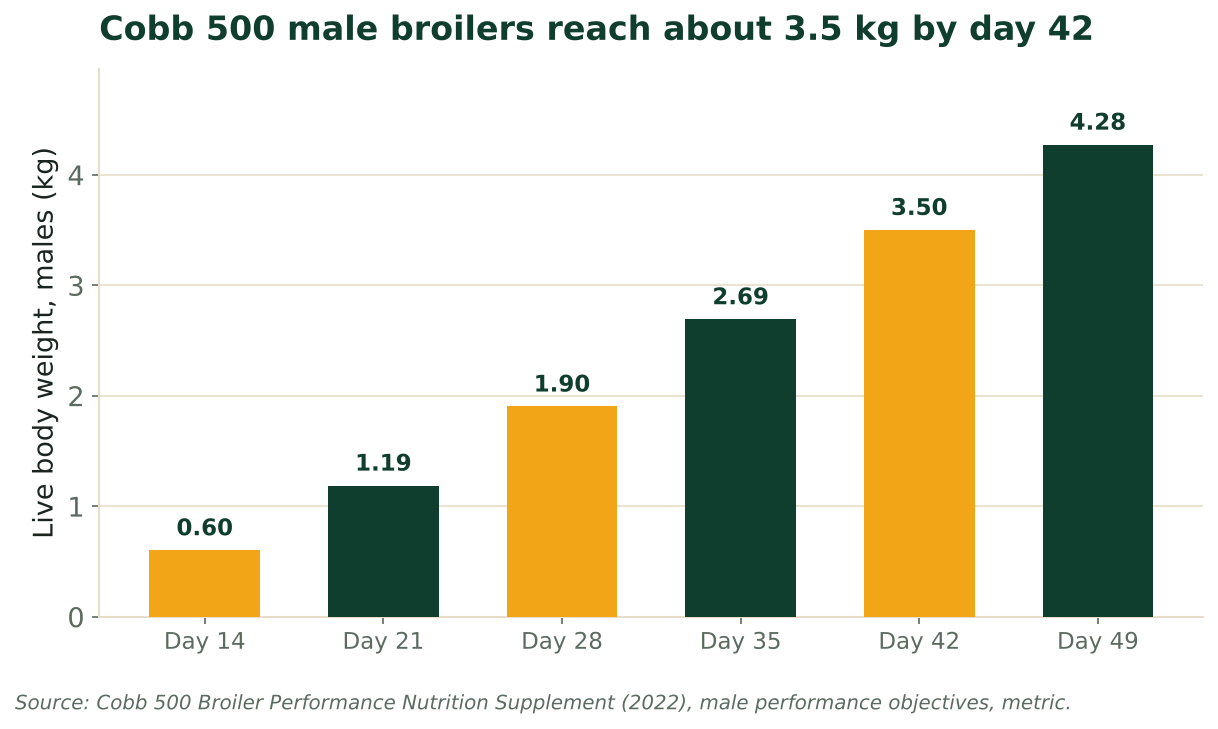
The clearest benchmark for a Cobb 500 is the breeder's own performance objective table. The Cobb 500 Broiler Performance Nutrition Supplement (2022) gives male birds a live weight of about 603 g at day 14, 1,188 g at day 21, 1,904 g at day 28, 2,694 g at day 35, 3,503 g at day 42 and 4,275 g at day 49. Cumulative feed conversion for males is about 1.53 at day 42 and 1.65 at day 49. Females are lighter, at about 3,052 g at day 42. As-hatched figures, mixing males and females, come to about 3,278 g at day 42 with a feed conversion of 1.555.
Read those figures carefully. The table is a target for a well-managed flock in a controlled house, and it does not account for mortality. A flock that loses birds, has uneven feed intake or suffers from heat stress will fall short of it. The chart below shows the male growth curve, which is the fastest-growing part of the flock.
Cobb 500 against Ross 308 and dual-purpose birds
Most buyers compare the Cobb 500 with the Ross 308, the other broiler strain used widely in Ghana. The breeder's objectives put the two close together. On an as-hatched basis, the Cobb 500 reaches about 3,278 g at day 42 at a feed conversion of 1.555, and the Ross 308 reaches about 2,998 g at day 42 at a feed conversion of 1.531. So the Cobb 500 is heavier at day 42, while the Ross 308 is slightly more efficient on feed in these objectives. Both are measured under controlled conditions, so the choice often comes down to your market, your feed and your buyers. Our Cobb 500 broiler guide and Ross 308 broiler guide cover week-by-week management for each.
| Option | Growth reference | Feed efficiency reference | Use | Best for |
|---|---|---|---|---|
| Cobb 500 | About 3,278 g at 42 days (as-hatched); about 3,503 g (males) | FCR about 1.555 at 42 days (as-hatched) | Fast meat only | Shortest, most predictable meat cycle in a housed system |
| Ross 308 | About 2,998 g at 42 days (as-hatched); about 3,222 g (males) | FCR about 1.531 at 42 days (as-hatched) | Fast meat only | Broiler buyers who value a slightly better feed conversion on the same cycle |
| Noiler, Kuroiler or Sasso | About 1,390–1,460 g males at 18 weeks (backyard trial) | Not reported in the trial | Meat and eggs, or slower meat | Free-range and family flocks with a longer cycle and egg or slow-meat goals |
The dual-purpose row is not a like-for-like comparison. Those birds were measured to 18 weeks in backyard conditions, and their feed conversion was not reported in the trial. Use the table to see the trade-off: the Cobb 500 buys speed and efficiency in a controlled house, while the dual-purpose birds buy flexibility and eggs with a much longer cycle.
Plan the cycle before you order
A broiler run is only as good as its timing. Message us on WhatsApp (+233 24 915 1503) with your target sale date, your house size and your buyers, and we will tell you honestly whether a Cobb 500 run fits your plan. If you would rather plan in person, book a visit to the Kasoa hatchery.
How to order Cobb 500 chicks from Agro Prime
- Message us on WhatsApp at +233 24 915 1503. Say you are asking about Cobb 500 chicks, and tell us your town and the number of birds you need.
- Ask which strains we have available now. We confirm what is ready for the date you want.
- Give us your sale date. Working back from the date you want to sell, we can help you plan the batch and the feed.
- Agree the quote, transport and date in writing before you pay.
- Prepare the brooder and house before the birds arrive. Our guide to brooding day-old chicks covers the first two weeks in detail.
Housing, heat and feeding a fast broiler in Ghana
A Cobb 500 flock is only as good as its environment. Ghana's heat means ventilation, shade and drinking water matter a great deal, especially in the later weeks when birds are heavy and eat more. Plan for clean, dry litter, enough floor space for the final weight and a house that can be kept cool without draughts at chick height. Watch the birds closely. Panting, bunching and reduced feed intake are warnings to act on quickly.
Feed is the other half of the job. Broilers need a starter, grower and finisher programme matched to the age they are at, with clean feed and constant water. Our broiler feeding guide explains the programme in practical terms. Weigh a sample of birds each week, because the weight curve is the simplest early warning that something is wrong with feed, water or health.
Delivery across Ghana and what to prepare
We arrange transport of day-old chicks and other orders to farmers across Ghana. Delivery cost and timing depend on your location, the route and the size of the order, so we do not quote them on this page. When you message us, we confirm the arrival window and the cost for your town, and we agree how the birds will be handled on the journey.
Before the chicks arrive, have the brooder ready: clean, dry and warm, with fresh water and starter feed in place. Record the number that arrives and check the batch straight away. Tell us promptly if anything is wrong, so we can act on it while it still matters.
Pricing: why we quote per order
We do not publish a Cobb 500 price on this page. Day-old prices depend on the strain available that week, the quantity, the season and whether you also want feed or pullets. Delivery to your town adds to the total. A price from a past market report would not reliably reflect what we can offer you today, so we give you a current quote, in writing, before you commit.
For a broiler run, budget the whole cycle. The chick price is only one line. Feed makes up a large share of the cost of a broiler, so compare the feed plan carefully, along with housing, heat management, vaccines and transport. A cheap chick is not a saving if the flock loses weight or birds later in the cycle.
Ready to order or to ask a question?
Send us a message on WhatsApp (+233 24 915 1503) with your sale date, your house size and the number of birds you want. We will confirm what we can supply and give you a current quote. You can also book a visit to the Kasoa hatchery to see the set-up for yourself.
Bottom line on Cobb 500 chicks in Ghana
The Cobb 500 is the right choice for a farmer who wants a fast, predictable meat cycle in a housed or well-controlled system and can keep the feed, water and heat right through the final weeks. The performance objectives give you a clear target to measure your own flock against. It is not a free-range or dual-purpose bird. If you can run a tight broiler cycle, the Cobb 500 rewards you with quick turnover. Ask us which strains we have available now, and if you are planning a larger poultry venture, our partner page sets out the investment side of working with us.
Frequently asked questions
Do you have Cobb 500 chicks available right now?
How much do Cobb 500 chicks cost?
What is the minimum order?
Can you deliver Cobb 500 chicks to my town?
Are the chicks vaccinated?
Should I buy Cobb 500 broilers or layers?
How far ahead should I order?
What if some chicks die in transit?
Sources
- Cobb 500 Broiler Performance Nutrition Supplement (2022), male, female and as-hatched performance objectives (metric): cobbgenetics.com
- Aviagen, Ross 308 Broiler Performance Objectives (2022), as-hatched and male tables (metric): aviagen.com
- African Chicken Genetic Gains on-farm trial (Nigeria), used for the dual-purpose comparison row, Archives of Animal Breeding 63, 387–408 (2020): aab.copernicus.org/articles/63/387/2020
Order from Agro Prime Ghana
Agro Prime Ghana Limited runs a poultry hatchery in Kasoa and supplies healthy day-old chicks (broilers & layers), point-of-lay pullets, quality feed and hands-on advice to farmers across Ghana, with delivery arranged to your area. Message us on WhatsApp (+233 24 915 1503) to ask which strains we have available now and for a current quote, or book a visit.