Citrus — above all the sweet orange — is one of the most widely grown and best-loved fruit crops in southern Ghana. A grafted orange tree, well cared for, bears heavily for many years, and demand for fresh oranges and orange juice is strong and constant. Yet citrus in Ghana tells a frustrating story: in season, oranges are so abundant that prices crash and huge quantities rot for lack of buyers and processing, while the country still imports packaged juice. That paradox — abundance wasted for want of processing — is the defining opportunity of the crop. This guide covers how to grow citrus successfully in Ghana and how to turn its seasonal glut into lasting value.
Key takeaways
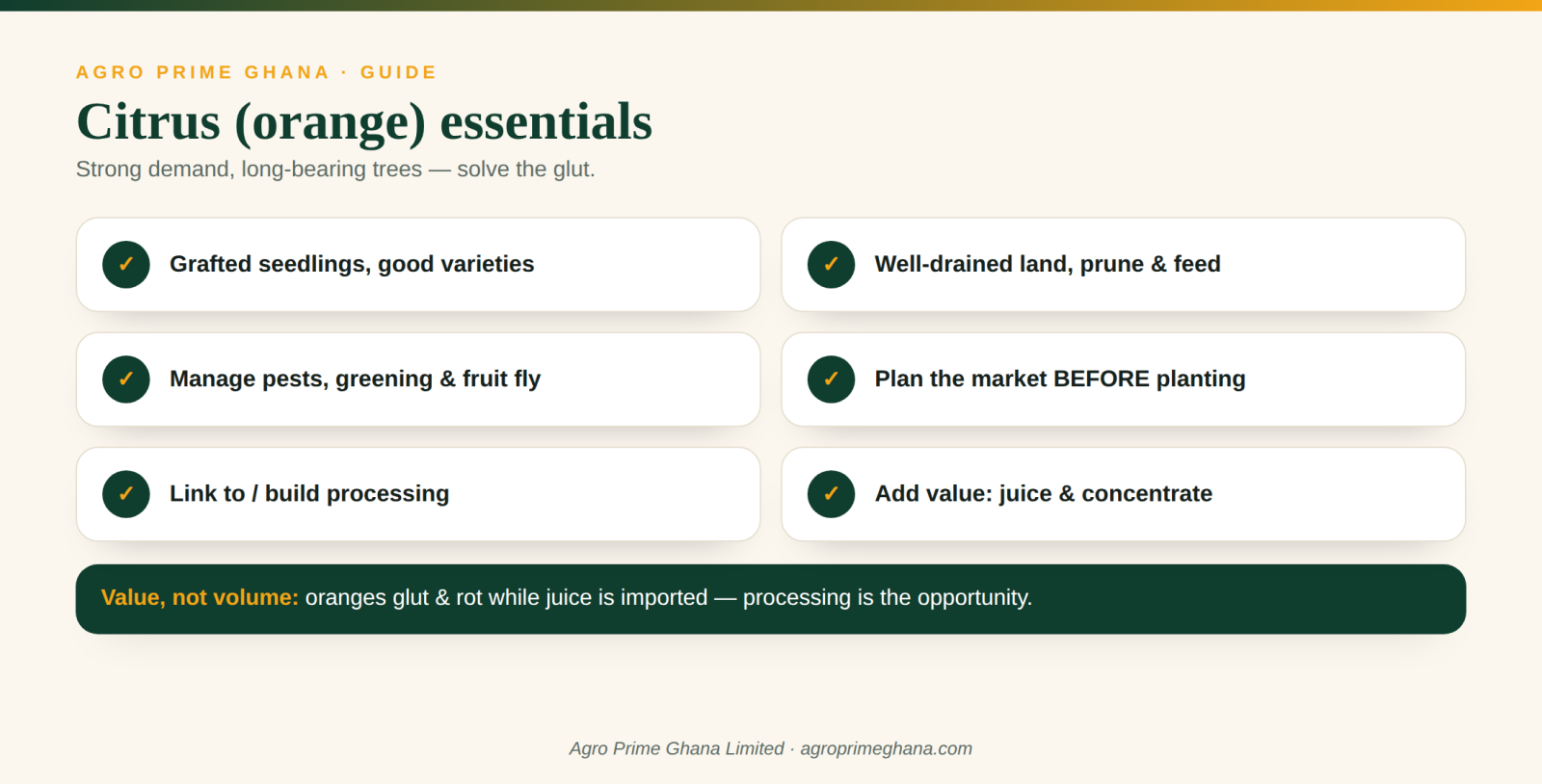
Citrus (mainly sweet orange) is a popular, long-bearing fruit tree in southern Ghana with strong demand. Plant grafted seedlings of good varieties for earlier, reliable bearing, establish on well-drained land, and manage the trees and their pests and diseases over the long term. The defining issue is the seasonal glut: oranges are abundant and cheap in season and much is wasted, while Ghana imports juice. The big opportunity is processing and value addition (juice, concentrate) plus better market planning. Grafted trees plus processing turn a glut into value.
Why citrus is a worthwhile crop
Citrus, led by the sweet orange, is a genuinely rewarding fruit crop for southern Ghana. It is popular and in constant demand: fresh oranges are eaten and juiced everywhere, sold by street vendors, markets and households, and orange juice is a staple drink, so the underlying demand for the fruit and its juice is strong and reliable. Citrus is a long-bearing tree crop: a well-established, grafted orange tree yields heavily for many years, providing durable, recurring income and a family asset. It grows well across the southern forest and transition zones, and Ghana produces oranges in large quantities. The catch — and the opportunity — is that this very abundance creates a seasonal glut that crashes prices and wastes fruit, precisely because processing capacity is limited, even as the country imports packaged juice. So citrus is a crop with strong fundamentals (demand, long bearing, good growing conditions) whose profitability hinges less on growing the fruit — which Ghana does abundantly — and more on solving the market and processing problem. For a farmer who plants good grafted trees and, crucially, thinks about market and value addition, citrus is a worthwhile, long-lived crop with a large unrealised opportunity.
Grafted seedlings and establishing the orchard
A good citrus orchard begins with grafted seedlings, and this choice matters. Grafted citrus trees — a good scion variety grafted onto a suitable rootstock — bear earlier, more reliably and truer to type, and can be more vigorous and disease-resistant, than trees grown from random seed, which are slower to bear and unpredictable. So source healthy grafted seedlings of good sweet-orange (and other citrus) varieties from a reliable nursery. Plant on suitable, fertile, well-drained land (citrus dislikes waterlogging, which causes root problems) at the proper spacing, giving the trees room, and care for the young trees — watering while establishing, weeding, protecting — through the early years before they bear. Because citrus is a long-lived tree crop, starting with good grafted material on suitable land sets up an orchard that will bear well for many years, so this early foundation is well worth getting right. Grafted trees on good, well-drained land are the basis of a productive citrus orchard.
Managing the orchard
A productive citrus orchard needs steady care across its long life:
- Weed and maintain the orchard, keeping it clean, especially while the trees are young.
- Prune the trees, shaping them and removing dead, diseased or crowded wood for health, airflow, and easier spraying and harvesting.
- Feed and water appropriately, as citrus responds to good nutrition and adequate moisture for strong growth and good fruiting; irrigation helps in dry periods.
- Monitor and manage pests and diseases, which are a real part of citrus care (see below), to protect the trees and fruit.
Consistent care — weeding, pruning, feeding, watering and pest management — over the trees' long life keeps a citrus orchard healthy and productive, and neglect shows up as poor, declining yields. Good husbandry is the foundation on which the crop's value, and the processing opportunity, rest.
Pests and diseases to manage
Citrus faces a range of pests and diseases that must be managed to keep the orchard healthy and productive over its long life. These can include insect pests such as aphids, scale insects, mealybugs, fruit flies (which damage the fruit), and others, along with diseases affecting the leaves, fruit and trees. A particularly important concern in citrus worldwide is citrus greening (Huanglongbing) and other serious diseases, often spread by insect vectors, which can seriously damage citrus and are a major threat to the crop globally, so vigilance and good practice matter. Managing citrus health rests on the familiar integrated approach: healthy grafted planting material and tolerant varieties/rootstocks where available, clean well-drained orchards, good pruning for airflow, regular monitoring and scouting, controlling the insect vectors and pests, and correct, safe, well-timed use of appropriate treatments, ideally with extension guidance. Fruit flies in particular can spoil the fruit and matter for quality. Keeping the trees healthy and the fruit clean and sound protects both yield and the marketability of the crop — which is all the more important given that the value must then be captured through good marketing and processing. Attentive, integrated pest and disease management is part of running a productive citrus orchard.
The defining issue: the glut and the processing opportunity
Here is what most shapes citrus economics in Ghana — and its biggest opportunity: the seasonal glut and the processing gap. Because oranges are grown so abundantly, the main season brings a flood of fruit: markets are saturated, prices crash, and large quantities of oranges are wasted — left to rot on trees or roadsides — simply because there are not enough buyers, and, critically, not enough processing capacity to absorb the surplus. Meanwhile, Ghana imports packaged fruit juice. This is a striking paradox: a country awash in oranges that go to waste, importing juice made elsewhere. The opportunity is clear: processing and value addition. Turning the seasonal surplus of oranges into juice, concentrate, and other products — locally, at any scale from small enterprises to larger plants — would absorb the glut, add enormous value, reduce waste, substitute for imported juice, and give farmers a reliable outlet and better prices. For the grower, the practical lessons are: think about the market before you plant, seek or build links to processing and reliable buyers, and where possible participate in or benefit from value addition, so the fruit is turned into storable, valuable product rather than rotting in a glut. Better market planning — spreading harvest where varieties allow, arranging buyers or processors in advance — also helps individual farmers avoid the worst of the glut. The fundamental point is that citrus's problem in Ghana is not growing the fruit but capturing its value, and processing is the key that unlocks it. The farmers and enterprises who solve the market-and-processing problem are the ones who truly profit from citrus.
The economics of citrus
Citrus economics in Ghana are a story of strong production undermined by weak value capture — and therefore of large opportunity. On costs, citrus is a long-term investment: grafted seedlings, suitable land, and years of care before full bearing, then ongoing orchard management and pest and disease control. Income builds as the trees mature and continues for many years. On returns, the underlying demand for oranges and juice is strong and constant, and a productive grafted orchard bears heavily — but the seasonal glut crashes prices and wastes fruit, so the grower who simply produces oranges and dumps them into the glut earns poorly, while the one who plans the market and captures processing/value-addition earns far more. The keys to citrus economics are therefore: establish a good grafted orchard on suitable land, keep it healthy and productive over its long life, and — decisively — solve the value-capture problem by planning the market, linking to or building processing, and turning surplus into juice and other products. Because the fundamentals (demand, long bearing, abundant production) are strong and the missing piece is processing, citrus offers a real opportunity for farmers, cooperatives and entrepreneurs who move up the value chain. Growing oranges is the easy part; profiting from them means capturing their value beyond the glut.
Common mistakes to avoid
- No market or processing plan, dumping fruit into the seasonal glut where prices crash and oranges rot.
- Planting seedling trees instead of grafted trees that bear earlier, reliably and true to type.
- Ignoring value addition, missing the large opportunity in juice and processing.
- Neglecting pests and diseases, including serious threats like citrus greening and fruit fly.
- Waterlogged or poor land, causing root problems in citrus.
- Neglecting pruning and orchard care, reducing long-term yields.
Frequently asked questions
Is citrus (orange) farming profitable in Ghana?
Why do so many oranges go to waste in Ghana?
What is the big opportunity in citrus?
Should I plant grafted citrus trees?
What pests and diseases affect citrus?
How long before citrus trees bear fruit?
How can I avoid losing money in the orange glut?
Where does citrus grow best in Ghana?
The bottom line on citrus farming
Citrus, and the sweet orange above all, is a crop of strong fundamentals and a striking, solvable problem. The demand for oranges and juice is constant, grafted trees bear heavily for many years, and southern Ghana grows the fruit abundantly — yet that very abundance produces a seasonal glut that crashes prices and wastes huge quantities of fruit, while the country imports packaged juice. Growing citrus well means starting with good grafted seedlings on well-drained land, managing the trees and their pests and diseases over their long, productive life. But the decisive lesson of citrus in Ghana is that the challenge is not growing oranges — it is capturing their value. The great opportunity lies in processing and value addition — turning the surplus into juice and other products — and in planning the market before planting. Grow good grafted trees, keep them healthy, and above all reach for the processing opportunity that turns a wasteful glut into lasting value, and citrus becomes not just a popular fruit crop but one of the clearest value-addition opportunities in Ghanaian farming.
Grow a popular crop — and capture its value
Agro Prime Ghana Limited runs a hatchery and agribusiness in Kasoa. Fruit crops like citrus reward growers who plan for markets and value addition. Talk to us about building a resilient, forward-thinking farm: book a visit or message WhatsApp (+233 24 915 1503).