In Ghana the most reliable calcium sources for poultry are crushed oyster shell and ground limestone — both roughly 35–38% calcium — sold in 50kg bags by agro-input shops and feed suppliers in Kasoa, Accra and regional markets; snail (or periwinkle) shell and clean, dried, crushed eggshell are excellent free or near-free alternatives you prepare on the farm. For insoluble grit, birds need small hard stones — crushed granite, hard gravel or coarse washed sand — that the gizzard uses to grind feed. This is a sourcing guide: where to actually get calcium and grit in Ghana, in what forms, at what rough cost, and how to prepare the on-farm options. In a survey of Western Region farmers, nearly nine in ten relied on bought oyster shell, while very few used the cheaper snail-shell and eggshell sources around them — often just because they were unsure how to prepare them. That gap is money left on the table. (For the nutrition science — how much calcium a hen needs and why particle size matters — see our companion guides below.)
Written by the Agro Prime Ghana poultry team and reviewed against current poultry-nutrition references and Ghana-specific research (Feed Strategy and peer-reviewed studies). Last updated September 2026.
Key takeaways
A laying hen needs about 4 g of calcium a day, most of it for the eggshell, so a steady supply is non-negotiable for layers. In Ghana the practical sources are: oyster shell (~35% calcium; bought in 50kg bags, used by ~89% of farmers surveyed); ground limestone (~37% calcium; cheap, sold feed-grade or from Ghanaian deposits); snail and periwinkle shell (high calcium carbonate; often free from chop-bar and market waste); and clean crushed eggshell (~30% calcium; free on any layer or hatchery farm). For grit, use crushed granite, hard gravel or coarse washed sand. Prepare on-farm shells by washing, drying or briefly roasting to kill germs, then crushing — coarse (2–5 mm) for adult layers, finer for young birds. Buy calcium in bulk, offer it free-choice to layers, and keep grit available to scavenging and scrap-fed birds. Only ~4–8% of farmers use the cheapest sources of all, snail shell and eggshell, mostly because they do not know how.
Why sourcing calcium and grit well matters in Ghana
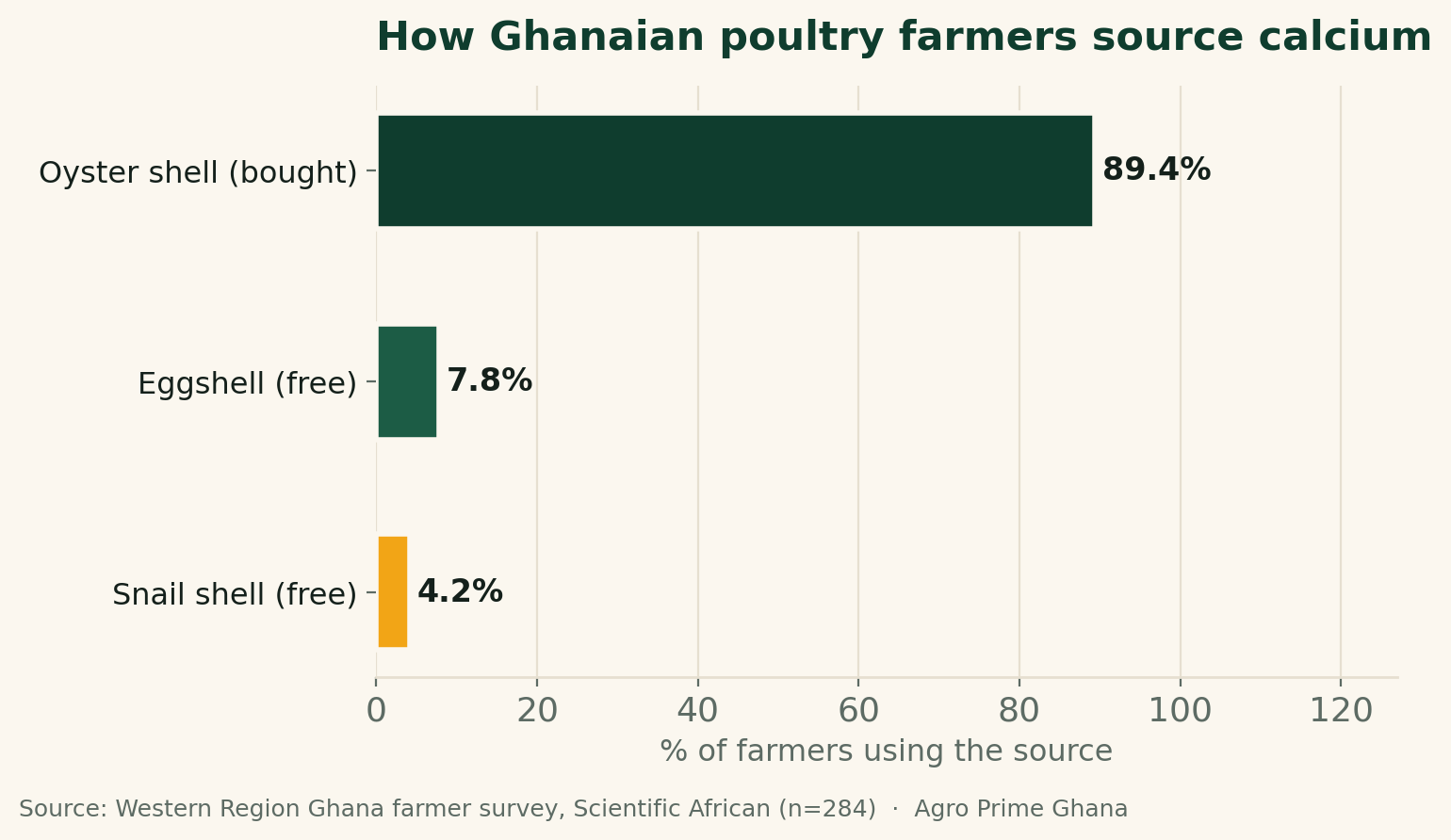
Calcium is the one nutrient a layer cannot afford to run short of even for a day. A hen puts roughly 2 g of calcium into every eggshell and needs around 4 g each day to lay well and keep her bones sound, as specialists writing in Feed Strategy describe. Miss that supply and you get thin, cracked shells, falling production and, over time, weak-boned hens — problems we unpack in our guide to eggshell quality problems. Grit matters for a different but equally basic reason: birds have no teeth and grind feed in the gizzard using swallowed hard particles, so a bird without grit digests fibrous feed and scraps poorly. The good news is that Ghana is short of neither — oyster and periwinkle shells pile up along the coast and at chop bars, limestone is mined locally, eggshell is a waste product on every layer farm, and hard stone is everywhere. The problem is not availability but knowing which source to use, in what form, and how to prepare the free ones. A Western Region survey of 284 farmers in Scientific African found 89.4% relied on bought oyster shell while only 7.8% used eggshell and 4.2% snail shell — even though most agreed those alternatives were cheaper and available, held back mainly by not knowing how to prepare them.
The main calcium sources — and where to get them in Ghana
Four calcium sources are worth knowing in Ghana; they differ in cost and effort rather than dramatically in calcium content, since all are essentially calcium carbonate. Oyster shell is the market standard: sold crushed by agro-input shops and feed dealers in Kasoa, Accra and regional capitals, typically in 50kg bags, at around 35% calcium. Its coarse, slow-dissolving particles suit laying hens, a big part of why nearly 90% of surveyed farmers use it. Ground limestone (feed-grade calcium carbonate) is the other bought staple — often cheapest per kilo — at about 37% calcium; Ghana has its own deposits (Buipe, Nauli), stocked by the same shops. Snail and periwinkle shell are the coastal and forest-zone bonus: shells from chop bars, market stalls and home cooking are rich in calcium carbonate and essentially free, needing only collection, cleaning and crushing. Eggshell hides in plain sight on every layer and hatchery operation — clean, dried, crushed shell runs around 25–30% calcium and costs nothing but the effort.
| Source | Approx. calcium | Where to get it in Ghana | Cost / effort |
|---|---|---|---|
| Oyster shell (crushed) | ~35% Ca | Agro-input & feed shops, poultry suppliers (Kasoa, Accra, regional markets); 50kg bags | Bought; the market standard, moderate cost |
| Ground limestone (feed-grade) | ~37% Ca | Input shops & feed dealers; Ghana deposits (Buipe, Nauli); 50kg bags | Bought; usually cheapest per kg |
| Snail / periwinkle shell | High CaCO₃ | Chop bars, food markets, coastal & forest-zone waste; collect free | Free/cheap; needs cleaning & crushing |
| Crushed eggshell | ~25–30% Ca | Your own layer/hatchery farm; hatcheries, egg sellers, bakeries | Free; needs washing, drying & crushing |
Where to buy oyster shell and limestone
For most commercial and semi-intensive keepers, bought oyster shell and limestone are the backbone of the calcium supply. Any well-stocked agro-input or poultry-supply shop — the same places that sell feed, drinkers and vaccines — carries crushed oyster shell and feed-grade limestone, generally in 50kg bags, and larger dealers and mills sell them in bulk. Two tips save real money. First, buy in bulk: a 50kg bag lasts a small flock a long time and the per-kilo cost drops sharply against small measures. Second, check the form before you pay: for layers you want coarse, gritty particles you can feel between your fingers, not fine powder, because coarse particles dissolve slowly and keep feeding calcium into the shell overnight (see our calcium for laying hens guide). If your store only stocks fine limestone, pair it with a coarse free-choice source such as crushed oyster or snail shell. Calcium is one of the cheapest ingredients in the ration, so sourcing it well is an easy win in reducing feed cost.
Field note: buy calcium coarse, and buy it in bulk
Two small sourcing habits protect your egg quality and your wallet. When we buy oyster shell or limestone for layers, we run a handful through our fingers first: it should feel gritty, with particles up to match-head size, not like flour. Coarse shell dissolves slowly through the night — exactly when the hen is building the shell and not eating — while fine powder is gone too soon. And we buy the full 50kg bag rather than scooping small amounts, because calcium keeps indefinitely if stored dry and the bulk price is far lower per kilo. A separate feeder of coarse oyster shell beside the layer feed is about the cheapest insurance a laying flock can have against thin shells.
Free calcium: preparing snail shell and eggshell
The cheapest calcium in Ghana is what you collect and prepare yourself, and it is genuinely underused. The Western Region survey found most farmers agreed eggshell and snail shell were cost-effective and available, yet only a small minority used them — the standout barrier being simply not knowing how to prepare them. The steps are simple. For eggshell: collect clean shells (your own layers, a hatchery, egg sellers or a bakery), rinse off residue, then dry them thoroughly — or better, roast them briefly in a pan or low oven to drive off moisture and kill any bacteria such as salmonella. Then crush to a coarse, gritty size, not a fine dust. For snail and periwinkle shell: collect from chop bars and markets, wash well, dry or briefly roast, and crush; these shells are hard, so a mortar and pestle or small mill helps. One caution: do not feed raw, uncrushed eggshell that still looks and smells like an egg, as it can teach hens to eat their own eggs — always dry and crush it so it no longer resembles an egg.
Field note: roast the eggshell, don't just sun it
The step most people skip when preparing eggshell is heat, and it is the one we insist on. Raw eggshell can carry salmonella and other germs, and sun-drying alone does not reliably kill them. A few minutes in a hot pan or low oven — until the shells are brittle and lightly toasted — drives off moisture so they crush cleanly and makes them safe to feed back. It also makes them so unlike an egg that the birds never connect the grit in their feeder with the eggs in the nest box.
Stop buying calcium you could collect — and get the birds right first
If you keep layers, you throw away calcium every day as eggshell, and the snail-shell waste at your local chop bar is free for the asking. Preparing them is a half-hour job, not a mystery. Agro Prime Ghana can walk you through a simple wash-dry-crush routine — and supply the strong point-of-lay pullets and quality layer feed that make good shells in the first place. Message us on WhatsApp (+233 24 915 1503) or book a visit to sort out your calcium and feeding, and turn today's waste into tomorrow's strong shells.
Sourcing grit — the other kind of stone
Grit is often confused with calcium, but for sourcing they are two different jobs and often two different materials. Insoluble grit is small, hard, sharp stone that stays in the gizzard and grinds feed; it is not a calcium source and does not dissolve, whereas soluble calcium (oyster shell, limestone) is used up as it dissolves. Birds on finely-ground commercial feed need little grit, but scavenging and backyard birds, and any eating whole grains, fibrous scraps or forage, need insoluble grit to digest that food — a point we develop in our grit and oyster shell guide. Sourcing it is easy and cheap: crushed granite or hard stone (quarry fines and stone-dust, sieved to remove powder), hard washed river gravel, and coarse washed sand for young birds. Whatever you use must be hard (soft stone crumbles uselessly), clean, and sized to the bird — fine grit or coarse sand for chicks and growers, larger gravel-sized grit for adults. Offer it free-choice in a small feeder, or scatter it for scavenging flocks.
A practical sourcing routine for your flock
Putting it together, a sensible routine for a Ghanaian layer flock is simple. Keep a bulk bag of coarse oyster shell or limestone as your calcium base — stored dry, offered both in the feed and in a separate free-choice feeder so hens top up to their own need, especially in the afternoon and evening when shells form. Supplement it with free calcium you prepare on the farm: wash, dry or roast, and crush eggshell and collected snail shell into that feeder. Keep a separate supply of clean, sized grit for birds that scavenge or eat whole grains. Match particle size to age — finer for chicks and growers, coarse for adult layers — and never give growing pullets the high calcium meant for layers, which can damage their kidneys before they lay. Broilers and non-laying birds need far less, met by their feed.
The bottom line on sourcing calcium and grit in Ghana
Ghana has no shortage of calcium or grit for poultry — it has a knowledge gap. Bought oyster shell and ground limestone, both around 35–38% calcium and sold in 50kg bags by agro-input shops, are the dependable base for any layer flock, and buying them coarse and in bulk is a simple, money-saving habit. Almost unused alongside them are the cheapest sources of all: snail and periwinkle shell from chop bars and markets, and crushed eggshell from your own farm — free calcium that only needs washing, drying or roasting, and crushing. For grinding, cheap crushed granite, hard gravel or washed sand supplies the grit scavenging and scrap-fed birds need. Nearly 90% of surveyed farmers lean entirely on bought oyster shell while the free alternatives go to waste, for want of a simple routine. Close that gap and you feed strong shells at the lowest cost your flock will ever manage.
Frequently asked questions
Where can I buy oyster shell and limestone for poultry in Ghana?
What are the cheapest calcium sources for chickens in Ghana?
How do I prepare eggshells as a calcium source?
Can I use snail or periwinkle shell as calcium for layers?
What is the difference between grit and calcium (oyster shell)?
What can I use as grit for chickens in Ghana?
How much calcium does a laying hen need?
Should I give calcium in the feed or free-choice?
Sources & further reading
- Feed Strategy — Understanding the daily calcium cycle in layer hens (daily calcium need, eggshell calcium, coarse vs fine particles).
- Scientific African — Farmers' perceptions and willingness to adopt egg and snail shells as alternative calcium sources for poultry in Ghana's Western Region (source use and preparation barriers).
- Poultry Science — Use of extruded eggshell as a calcium source substituting limestone or oyster shell (calcium content of limestone, oyster shell and eggshell).
- Agro Prime Ghana guides: calcium for laying hens, grit and oyster shell, eggshell quality problems, and reducing poultry feed cost.
About Agro Prime Ghana
Agro Prime Ghana Limited runs a poultry hatchery and mixed agribusiness in Kasoa, supplying day-old chicks and supporting poultry keepers across the country. These guides combine hands-on hatchery and farm experience with current poultry-nutrition references and Ghana-specific research. This article is general educational information, not a substitute for professional nutritional or veterinary advice. We supply healthy day-old chicks (broilers & layers), point-of-lay pullets, quality feed and farm support across Ghana. Setting up a layer flock and want your calcium and feeding right from day one? Book a visit or message us on WhatsApp (+233 24 915 1503) to order pullets, feed or advice.