A broiler record sheet is a simple daily log — kept per batch — of the numbers that decide whether your birds make money: date and bird age, deaths and culls, feed used, water drunk, body weight, house temperature and any medication, plus running totals that let you work out your feed conversion ratio (FCR), mortality percentage and cost per kilo. It is the cheapest, most powerful management tool on any Ghana poultry farm, and the one most keepers skip. Two farmers in Kasoa can buy the same Cobb or Ross chicks, the same feed and the same drugs, and one finishes with plump birds at a healthy profit while the other quietly loses money and never knows why. The difference is almost never luck — it is that one of them wrote things down. Feed is roughly 60–70% of the cost of raising a broiler, so a small unnoticed feed waste or a slow creep in deaths is the difference between profit and loss. This guide shows you what to record every day, gives you a sample template you can copy, and explains how those numbers turn into money.
Written by the Agro Prime Ghana poultry team and reviewed against current industry references (Aviagen Ross 308 performance objectives and standard broiler record-keeping practice). Last updated September 2026.
Key takeaways
Every Ghana broiler farm needs a daily batch record sheet capturing, at minimum: date, bird age (days), daily deaths and culls, feed given, water consumed, periodic body weight, house temperature, and medication or vaccination. From these you calculate the three numbers that drive profit: FCR (kg feed per kg of bird), cumulative mortality %, and average weight against target. A modern Ross 308 broiler should reach roughly 2,300 g by day 35 and 3,000 g by day 42, at a cumulative FCR near 1.5 — benchmarks you can only hit, or even know you missed, if you keep records. Since feed is about 60–70% of production cost, records that catch feed waste, disease and slow growth early are the highest-return, lowest-cost investment on the farm.
What a broiler record sheet actually is
A broiler record sheet is a single-page (or single-spreadsheet) daily log kept for one batch of birds from placement to sale, on which you write down a fixed set of numbers every day and total them as you go. It is not accounting or paperwork for its own sake — it is a management instrument, the dashboard that tells you how the flock is doing while you can still act. Standard broiler record sheets, such as the widely used template from PoultryHub, capture the batch identity (batch number, shed, breed, hatch date, number placed) and then track feed used and mortality across the growing period, finishing with the key calculations — FCR, average weight and mortality percentage — at processing around day 42. The best working sheets go further and record deaths, culls, feed, water, weight and temperature every single day, because a number you only total at the end tells you what happened, while a number you write down daily tells you what is happening in time to fix it.
Why record keeping is where broiler profit is won or lost
The reason records matter so much is the structure of broiler economics: your margins are thin, your costs are dominated by feed, and your birds are only on the farm for about six weeks, so a problem you notice late is one you cannot recover from. Feed alone is roughly 60–70% of the total cost of producing a broiler, which means feed conversion — how many kilos of feed it takes to put on a kilo of bird — is the number that most decides your profit. You cannot know your FCR without recording feed used and birds weighed, and you cannot improve what you do not measure. Records also catch the two silent profit-killers early. A creeping mortality — two dead today, three tomorrow, five the next — is a problem announcing itself, and a keeper watching a daily mortality column spots the trend days before one who only notices when the pen looks thin. And slow growth against a known target tells you feed, health or environment is off while there is still time to correct it. Against costs like these, a notebook and five minutes a day is nothing — record keeping is the highest-return activity on the farm precisely because it protects the biggest costs.
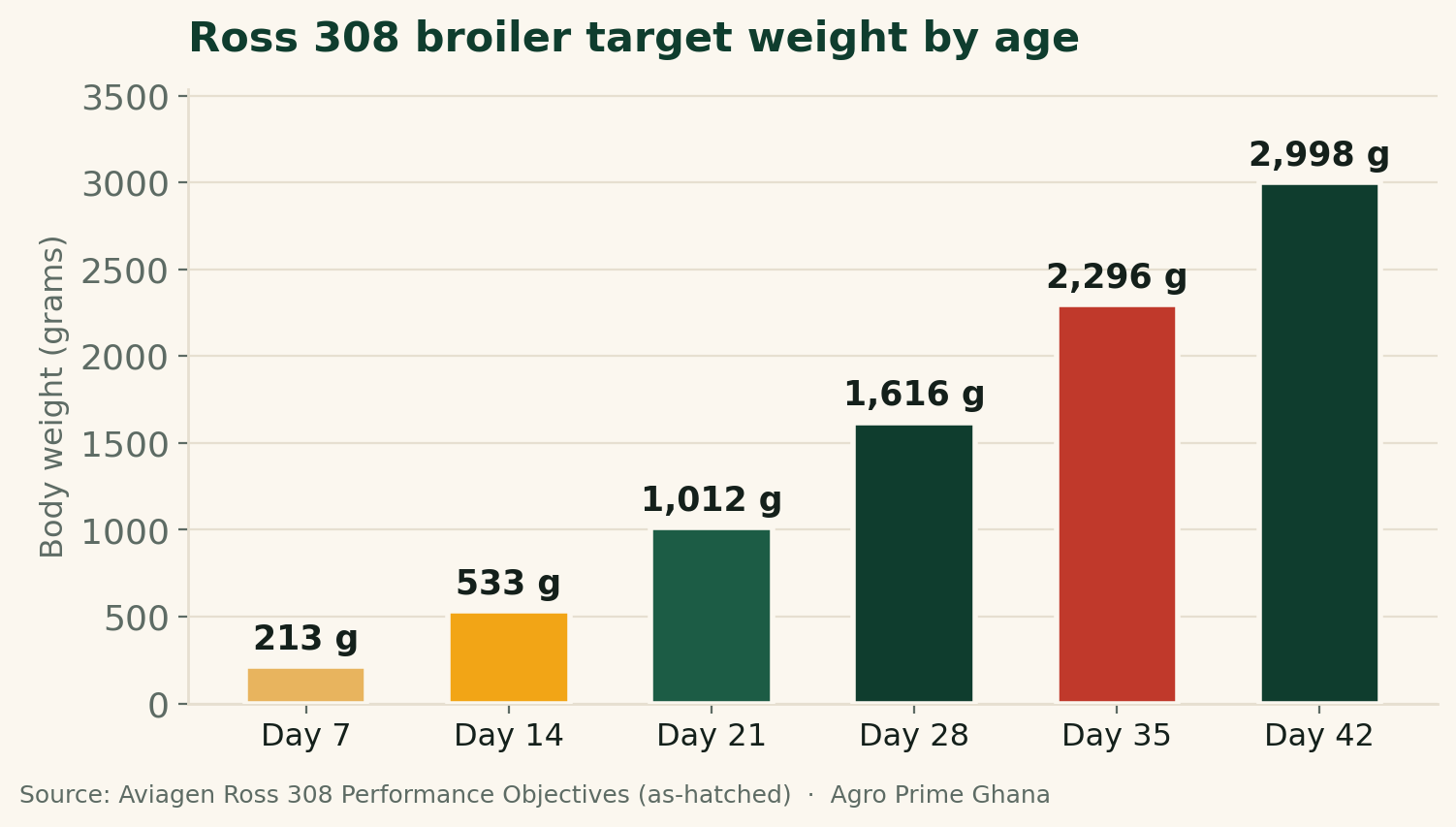
Those targets are what make a record sheet powerful: without them, "the birds look okay" is a guess; with them, weighing a sample on day 21 and finding 800 g instead of about 1,000 g is an early, actionable warning that something is holding the flock back.
What to record every day: the full list
A record sheet is only as useful as the fields on it, so build it to capture everything that moves your result. For each day of the batch, record the following:
- Date and bird age (day number). The backbone that lets you compare your flock to breed targets at any age.
- Deaths and culls (daily and running total). The single most important early-warning column — count and record every dead or culled bird, every day, without exception.
- Feed given. How much feed was put out that day (and which feed — starter, grower or finisher), so you can total feed used and later calculate FCR.
- Water consumed. A sudden drop in water usually precedes a drop in feed and signals a problem; a sudden rise can signal heat stress or gut upset.
- Body weight. Weigh a sample of birds at least weekly (many good farms weigh more often), record the average, and compare it to the target for that age.
- House temperature. Especially in the brooding weeks, so you can link any dip in performance to a hot or cold spell.
- Medication, vaccination and other inputs. What was given, when and why — essential for withdrawal periods, diagnosing problems and repeating what works.
- Remarks. A free column for anything unusual — a storm, a power cut, a feed change, a vaccine day — context you will not remember in six weeks.
Do not overcomplicate it. A sheet you actually fill in every day beats an elaborate one you abandon in week two. Keep it by the house door and fill it during your daily walk.
| Column | How often | Why it earns its place |
|---|---|---|
| Date / Age (day) | Daily | Lets you benchmark against breed targets and time vaccinations and feed changes |
| Deaths + culls (and cumulative) | Daily | Earliest warning of disease or management problems; feeds mortality % |
| Feed given (kg / bags) | Daily | Drives FCR — the number most tied to profit; flags over- or under-feeding |
| Water consumed | Daily | A change often precedes a feed or health change; flags heat stress |
| Average body weight | Weekly (or more) | Shows whether birds are on target while you can still correct it |
| House temperature | Daily (esp. brooding) | Links performance dips to hot/cold spells; supports brooding decisions |
| Medication / vaccination | As given | Withdrawal periods, diagnosis, and repeating what works |
| Remarks | As needed | Captures context — storms, power cuts, feed changes — you will otherwise forget |
A sample broiler record sheet you can copy
Here is a straightforward daily layout that works on paper or in a phone spreadsheet. Rule up one row per day for the whole batch (about 42 rows), with a header block for the batch details and a summary block for the final performance figures.
Header (fill once): Batch number · Breed (e.g. Cobb 500 / Ross 308) · Hatch date · Date placed · Number of chicks placed · Shed/house · Supplier.
Daily rows (one per day):
| Day | Date | Deaths | Culls | Live birds | Feed (kg) | Water (L) | Avg wt (g) | Temp (°C) | Meds / notes |
|---|---|---|---|---|---|---|---|---|---|
| 1 | — | 2 | 0 | 498 | — | — | ~42 | 34 | Placed 500; vit/electrolyte in water |
| 7 | — | 1 | 1 | 493 | — | — | ~210 | 32 | Weigh sample; on-target vs 213 g |
| 14 | — | 0 | 0 | 492 | — | — | ~530 | 29 | Switch to grower feed |
| 21 | — | 1 | 0 | 490 | — | — | ~1000 | — | Weigh sample; target ~1,012 g |
| 35 | — | 0 | 1 | 487 | — | — | ~2300 | — | Target ~2,296 g |
| 42 | — | 0 | 0 | 487 | — | — | ~3000 | — | Weigh all; ready for sale/target ~2,998 g |
Summary (fill at the end): Total birds sold · Total mortality & % · Total feed used (kg) · Average final weight · FCR = total feed ÷ total live weight produced · Total feed cost · Cost per kg of bird · Sale income · Profit/loss per bird and per batch. The weight figures shown are the Ross 308 as-hatched targets from Aviagen — a benchmark to write your own real weights against, not numbers to copy in. This is an honest, generic best-practice layout; adapt the columns to your own farm and feed programme.
Field note: weigh a real sample, and always the same way
The weight column is where record sheets most often go soft, because keepers either skip weighing or eyeball a couple of birds. On our floor the rule is to weigh a proper sample — catch a random group from different parts of the house, weigh them together, and divide — rather than grabbing the nearest (often biggest) birds. Do it at the same time of day each week, ideally before the morning feed, so your numbers are comparable. A sample average drifting below the breed target for that age is the single most useful early signal that feed, health or heat needs attention — but only if the weighing is honest and consistent. A guessed weight is worse than none, because it gives false comfort.
Turning records into money: FCR, mortality and cost per kilo
Records only pay off when you do the arithmetic, and three simple calculations turn your daily columns into decisions. Feed conversion ratio (FCR) is total feed eaten divided by total live weight produced; a Ross 308 flock can reach a cumulative FCR near 1.5 by day 42, meaning about 1.5 kg of feed per kg of bird. If your sheet shows an FCR of 1.8 or 2.0, feed is being wasted, spilled, spoiled or converted poorly by unhealthy birds — and since feed is 60–70% of your cost, closing that gap is the fastest way to turn a loss into a profit. Cumulative mortality percentage is total deaths divided by chicks placed, times 100; watching it climb daily lets you catch disease early, and comparing it batch to batch shows whether your management is improving. Cost per kilo of bird — total costs divided by total kilos produced — tells you honestly whether to sell live at the farm gate, dress and sell to hotels, or hold for the festive market, and at what price you break even. Without records these are guesses; with them they are decisions. To dig into the biggest lever, feed, see our guides to the broiler feeding programme and reducing feed cost.
Keep better records — and start with birds that hit the targets
Your record sheet can only look as good as the chicks and feed behind it. Agro Prime Ghana supplies strong, vaccinated Cobb and Ross broiler day-old chicks from our Kasoa hatchery, bred to reach the weight and FCR benchmarks in this article, plus quality feed and hands-on advice on setting up your records and reading the numbers. Want a simple batch record sheet template and help benchmarking your last flock? Message us on WhatsApp (+233 24 915 1503) or book a visit. See also our guide to poultry farm record keeping.
Field note: the mortality column earns its keep first
If you only ever fill one column faithfully, make it deaths and culls. On our floor a daily death count is the earliest, cheapest disease alarm there is: a flock that loses one or two birds a day and then jumps to six or eight is telling you something is wrong — coccidiosis, a heat problem, a water fault — days before the pen looks visibly thin. A keeper counting every morning acts on that trend while treatment still works; a keeper who does not count only realises when the losses are already heavy. Write down every dead and culled bird, every day, and watch the running total, not just the day's number.
Common record-keeping mistakes to avoid
Most farms that "keep records" still fail to get the benefit, usually for a handful of avoidable reasons. The commonest is keeping records but never using them — filling columns dutifully and never calculating FCR or comparing batches, so the numbers pile up unread. Nearly as common is recording only some things: many keepers log deaths but not feed, or feed but not weight, and you cannot calculate FCR from a half-filled sheet. Others record inconsistently — weighing one week and not the next, or estimating feed instead of measuring it — which destroys the comparability that makes records useful. Some fail to separate batches, mixing flocks so no result is clean. And many never benchmark against breed targets, so they cannot tell a good flock from a mediocre one. The fixes are simple: keep the sheet by the house, fill every column daily, weigh consistently, do the three calculations at the end of each batch, and compare to both the breed target and your own previous batches. Records kept this way compound into something no competitor can copy — a farm that knows its own numbers cold.
The bottom line on broiler records
The broiler record sheet is the cheapest tool on the farm and the one that most reliably separates the keepers who make money from those who merely hope to. It is nothing fancy — a daily log of deaths and culls, feed, water, weight, temperature and medication, kept per batch and totalled into FCR, mortality percentage and cost per kilo. But because broiler margins are thin and feed is 60–70% of the cost, those few minutes a day protect the numbers that decide your profit, catch disease and feed waste while you can still act, and let you benchmark against real targets like a Ross 308 reaching roughly 3,000 g at day 42 on an FCR near 1.5. Start a sheet with your very next batch, fill it honestly every day, do the arithmetic at the end, and compare batch to batch. Within a few cycles you will not just feel like a better farmer — you will be able to prove it, in kilos and in cedis.
Frequently asked questions
What should a broiler record sheet include?
Why is record keeping important on a broiler farm?
How do I calculate feed conversion ratio (FCR)?
What weight should my broilers reach by each week?
How often should I weigh my broilers?
Can I keep broiler records on my phone?
What does a sudden drop in water consumption mean?
How do records help me price and sell my birds?
Sources & further reading
- Aviagen — Ross 308 Broiler Performance Objectives (target body weights and cumulative FCR by day, used as benchmarks).
- PoultryHub — Broiler Record Sheet (standard batch record fields and end-of-batch FCR, weight and mortality calculations).
- Agro Prime Ghana guides: poultry farm record keeping, broiler feeding guide, and reducing poultry feed cost.
About Agro Prime Ghana
Agro Prime Ghana Limited runs a poultry hatchery and mixed agribusiness in Kasoa, supplying day-old chicks and supporting poultry keepers across the country to run their farms as real, measured businesses. These guides combine hands-on farm experience with current industry references. We supply healthy day-old chicks (broilers & layers), point-of-lay pullets, quality feed and practical farm support nationwide. This article is general educational information, not a substitute for professional veterinary or business advice. Ready to start or expand? Book a visit or message us on WhatsApp (+233 24 915 1503) to order chicks, feed or farm-management advice.