Broiler finisher feed is the ration you give birds from about 24–25 days of age until slaughter, and it is deliberately built with slightly lower protein and higher energy than starter or grower feed — because in these final weeks the bird's job is no longer to build frame but to lay down weight as cheaply as possible. This is the phase where a broiler eats the most feed and gains the most weight, so getting the finisher right is where the flock's profit is either made or quietly lost. Many Ghanaian farmers do the opposite of what pays: they run birds on expensive high-protein feed to the end, or switch to a cheap, dusty mash for the finish — both waste money. This guide explains what finisher feed is, how it differs from earlier phases, why energy and pellet quality matter most now, and how withdrawal feed protects the food you sell.
Written by the Agro Prime Ghana poultry team and reviewed against current industry references (Cobb 500 broiler nutrition supplement and Penn State Extension). Last updated September 2026.
Key takeaways
Finisher feed is fed from roughly day 24–25 to slaughter and carries lower crude protein but higher energy than grower feed — Cobb 500 finisher runs about 17–19% protein and 3,180–3,200 kcal/kg energy, versus 21–22% protein in starter. The goal now is cheap, efficient weight gain, and energy (from grains and added fat/oil) is the main driver of that gain. Pellet quality is critical in the finisher: extension trials show FCR improving markedly as the share of intact pellets rises. A withdrawal feed — the finisher without medicated additives — should be fed for the last several days so no drug residues reach the meat, and birds are usually feed-withdrawn (fasted) for 8–12 hours before catching to empty the gut. Because the finisher is the biggest feed phase, small gains here move your whole margin.
What broiler finisher feed is
Finisher feed is the last of the three main broiler rations — starter, grower, then finisher — and it feeds the bird through the heaviest-eating, fastest-gaining stretch of its life, from around three-and-a-half weeks old until it goes to market. By this age the bird has already built most of its skeleton, organs and feathering on the high-protein starter and grower; the finisher's task is different. It is formulated to convert into body mass efficiently and economically, so it deliberately dials protein down a little and energy up. According to the Cobb 500 broiler nutrition supplement, a typical finisher (fed from about day 23–42) carries 18–19% crude protein and around 3,180 kcal/kg of metabolizable energy, with a later finisher/withdrawal ration dropping to 17–18% protein at about 3,200 kcal/kg. Compare that with the starter's 21–22% protein: the bird no longer needs that much protein, and feeding surplus protein it cannot use is simply paying for the most expensive ingredient in the bag to be wasted. This phased approach — matching the ration to the bird's changing needs — is the core idea of phase feeding, and the finisher is its final and largest phase.
How finisher differs from starter and grower
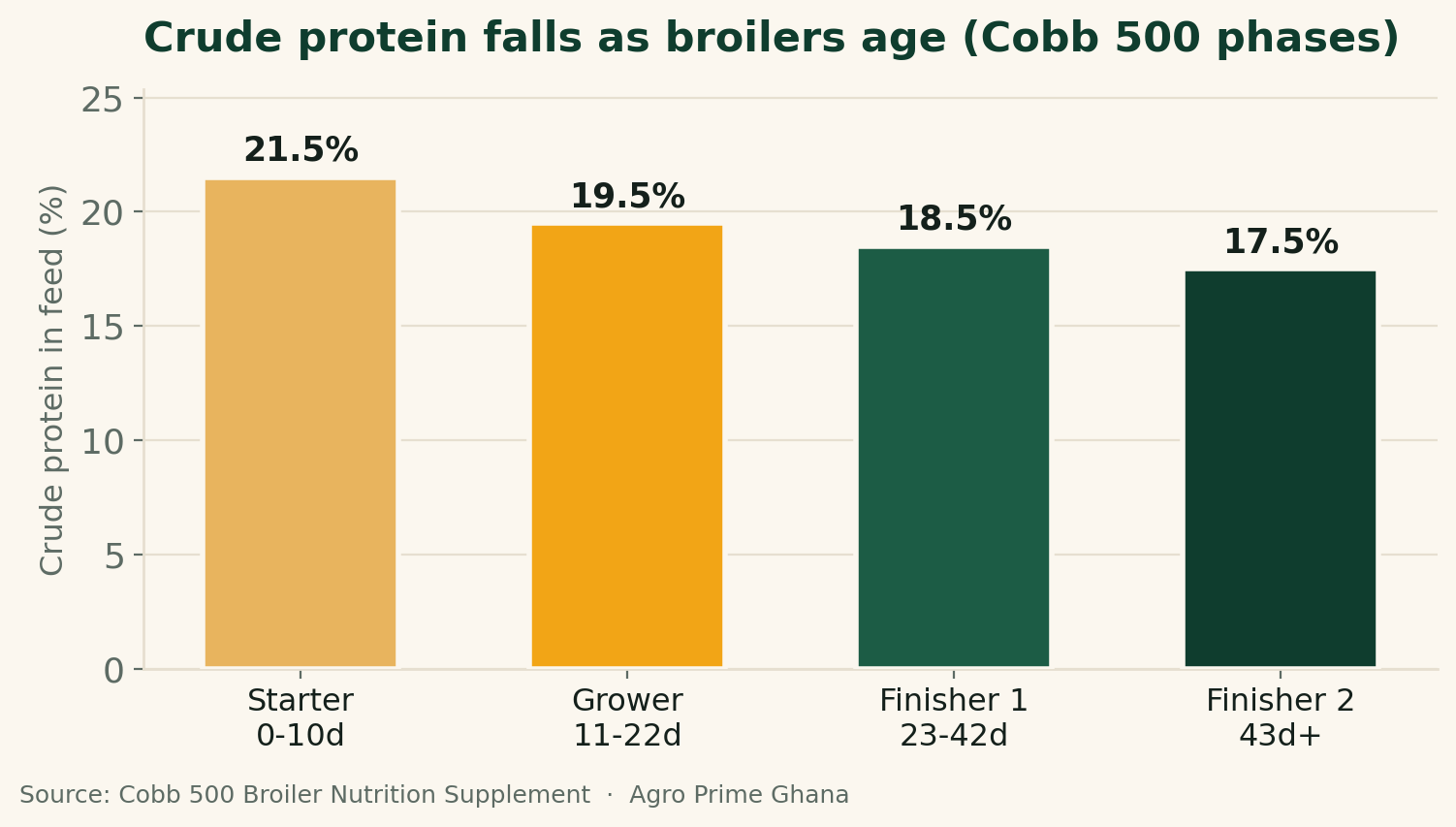
The clearest way to understand finisher feed is to see the whole feeding programme as a deliberate slide: protein falls and energy rises as the bird ages. Protein (and its key amino acids like lysine) builds the frame and muscle a young chick needs, so starter is protein-rich; energy fuels the sheer weight gain of an older bird, so finisher is energy-rich. The Cobb 500 supplement lays the slide out plainly across its phases, shown in the table below.
| Feed phase | Typical age | Crude protein | Energy (ME, kcal/kg) | Lysine |
|---|---|---|---|---|
| Starter | 0–10 days | 21–22% | ~3,035 | 1.32% |
| Grower | 11–22 days | 19–20% | ~3,108 | 1.19% |
| Finisher 1 | 23–42 days | 18–19% | ~3,180 | 1.05% |
| Finisher 2 / Withdrawal | 43 days+ | 17–18% | ~3,203 | 1.00% |
Source: Cobb 500 Broiler Performance & Nutrition Supplement. Exact figures vary by breed and mill; the pattern — protein down, energy up — is what matters.
Why energy — not protein — drives the finish
In the finisher phase, energy is the main lever on how fast and how cheaply a bird reaches market weight. Once the frame is built, added growth is largely about the bird having enough dietary energy to lay down tissue, so finisher rations lean on high-energy cereals like maize and on added fat or oil to raise the energy density. This is why the finisher's protein-to-energy balance is deliberately wide: the bird is getting plenty of fuel and just enough protein to keep muscle growing. Getting this balance wrong is a common and costly Ghanaian mistake. Feed a finisher that is too low in energy — as many cheap, bran-heavy home mixes are — and the bird simply cannot gain efficiently, so growth stalls and FCR climbs even though the birds are eating. Feed one that is too high in protein and you are burning cash: the bird strips the nitrogen it needs and excretes the rest, which also loads the litter with ammonia. The finisher is engineered to reach target weight at the lowest feed cost, which is exactly why it exists as a separate ration and why skipping it — running birds on grower to the end — quietly eats your margin. It ties directly into feed conversion ratio, the number that ultimately decides broiler profit.
Pellet quality: the finisher's hidden multiplier
If there is one place pellet quality earns its keep, it is the finisher — because this is the biggest-volume feed phase, any efficiency gain here is multiplied across the most kilograms of feed. Birds eat good pellets faster and waste less than dusty mash, and they spend less energy feeding, leaving more for growth. The gains are measurable: Penn State Extension reports roughly a 0.4-point FCR improvement for every 10-percentage-point rise in intact pellets, and in one trial lifting the pellet share in the feed pan from 40% to 70% improved FCR by 2.6 points over a 38-day grow-out. Intact pellets, versus ground feed, increased intake by about 116 g and live-weight gain by 22 g per bird. The catch is that a "pellet" that has shattered into fines and dust in the bag or the feeder loses much of this benefit — extension work notes you need at least 40% intact pellets in the pan to see the gain. For Ghanaian farmers the lesson is practical: buy well-made pellets from a reliable source, handle bags gently to avoid crushing them, and be sceptical of "finisher" that pours like flour. Quality pellets are not a luxury in the finish; they are one of the cheapest FCR improvements available.
Field note: don't "save money" by finishing on the wrong feed
The two most expensive false economies we see in the finisher both come from trying to cut the feed bill in the wrong place. The first is holding birds on grower or even starter to the end "because it grows them faster" — it does not grow them more cheaply, and the extra protein is money excreted onto the litter. The second is switching to the cheapest possible dusty finisher mash for the last stretch: the birds waste it, eat slower, and the FCR gain from proper pellets is thrown away. The finisher is where feed volume peaks, so it is precisely the phase where a correctly formulated, well-pelleted ration pays back most. Save money by getting the finisher right, not by feeding the flock badly at its hungriest.
Withdrawal feed: protecting the meat you sell
"Withdrawal" means two different but related things in the finisher, and both matter for selling safe, legal chicken. The first is withdrawal feed — a finisher ration made without the medicated additives (such as coccidiostats) that earlier feeds may contain — fed for the final several days before slaughter so that no drug residue remains in the meat. The Cobb guide notes that where a withdrawal feed is required it uses the same finisher specification, just without the medication; the exact number of days depends on the withdrawal period stated on any additive you have used, so always read and follow the label. The second is feed withdrawal (fasting): birds are taken off feed for roughly 8–12 hours before catching (water is kept available until closer to loading) so the crop and gut empty. An empty gut means cleaner processing, less carcass contamination and less weight loss in transit. Both practices are part of producing wholesome birds, and they matter more, not less, if you supply dressed chicken to schools, hotels or the public. If you are moving into dressing and cold chain, our note on broiler processing and slaughter covers the next steps.
Finish strong with matched chicks and quality finisher feed
The finisher only pays if the birds arriving into it are healthy, uniform and on target — a stressed or disease-set flock cannot make up ground in the last fortnight no matter how good the feed. Agro Prime Ghana supplies robust broiler day-old chicks and quality starter and finisher feed matched to each phase, so your birds move onto an energy-dense, well-pelleted finish at the right age, plus practical margin advice on how much finisher to budget and when to sell. If you want a simple phase-feeding and finishing plan for your next batch, message us on WhatsApp (+233 24 915 1503) or book a visit.
Getting the finisher right in Ghanaian conditions
A few practical rules make the finisher work under our heat and market realities:
- Switch on time. Move birds onto finisher at about 24–25 days (or per your feed brand's programme), and onto a non-medicated withdrawal finisher for the final days before sale.
- Prioritise energy and pellet quality. Use a properly formulated, energy-dense finisher in good pellet form — this is where cheap dusty mash costs you most.
- Feed in the cool hours. In hot weather birds eat less by day; encourage intake early morning and evening so the finisher actually gets eaten and weight goes on.
- Don't over-hold. Because the finisher is the least efficient feed the bird will eat, dragging the flock well past target weight burns finisher for poor conversion — plan your sale age deliberately.
- Respect withdrawal periods. Follow the label on any medicated feed or additive, and fast birds 8–12 hours before catching, keeping water available.
- Keep feeders honest. Raise feeders to back height and fill a third to half full so finisher — your priciest volume of feed — is eaten, not scattered.
The bottom line on broiler finisher feed
Finisher feed is the ration that turns a well-grown bird into a saleable one at the lowest possible feed cost, and because it is the largest feed phase, it is where broiler profit is decided. It carries less protein and more energy than starter or grower — around 17–19% protein and 3,180–3,200 kcal/kg for a Cobb 500 finisher — because the older bird needs fuel for weight gain, not protein for frame. Energy and pellet quality are the levers that matter most now, and a clean, well-pelleted, energy-dense finisher fed on time will beat both an over-rich grower run to the end and a cheap dusty mash. Finish it properly: use a non-medicated withdrawal feed for the last days, fast birds before catching, and sell before efficiency drops away. Do that, and the finisher stops being your biggest cost and becomes your biggest opportunity.
Frequently asked questions
What is broiler finisher feed and when do I start it?
How is finisher feed different from starter and grower?
Why does finisher feed have less protein?
Do pellets really matter in the finisher?
What is withdrawal feed and why is it needed?
Should I stop feeding before slaughter?
Can I just feed grower feed until slaughter to save switching?
How much finisher feed will my broilers eat?
Sources & further reading
- Cobb-Vantress — Cobb 500 Broiler Performance & Nutrition Supplement (feed-phase protein, energy and lysine specifications, withdrawal feed note).
- Penn State Extension — Feeding Pellets for Broiler Performance Improvements (pellet share, FCR, intake and gain data).
- Aviagen — Ross 308 Broiler Performance Objectives (2022) (feed intake and body weight by age).
- Agro Prime Ghana guides: broiler feeding guide, phase feeding, feed conversion ratio, and broiler processing.
About Agro Prime Ghana
Agro Prime Ghana Limited runs a poultry hatchery and mixed agribusiness in Kasoa, supplying healthy day-old broiler and layer chicks, point-of-lay pullets, quality feed and hands-on farm support across Ghana. These guides combine practical hatchery and farm experience with current industry references. This article is general educational information, not a substitute for tailored nutrition or veterinary advice. Want the right finisher feed and a finishing plan for your birds? We supply broiler chicks and quality starter and finisher feed with margin advice — book a visit or message us on WhatsApp (+233 24 915 1503).