If maize is the backbone of poultry feed, soybean is its protein. Every bag of quality poultry feed leans on soya bean meal for the amino acids birds need to grow and lay — which makes soybean one of the most strategically valuable crops a Ghanaian farmer can grow. Demand from the feed industry, food processors and households is strong and steady, soybean improves your soil for the next crop, and it pairs naturally with maize in rotation. For a poultry or maize farmer, growing soybean is a way to secure your own feed protein and open a profitable cash crop. This guide covers how to grow soybean successfully in Ghana.
Key takeaways
Soybean is a high-value protein crop with strong, steady demand from the feed industry. It grows well in Ghana's savannah and transition zones, needs good land preparation, the right variety and (crucially) proper inoculation or nitrogen management, and it enriches the soil for the following crop. Plant on time, control weeds early, harvest and dry properly, and store it well to protect quality and price.
Why soybean is a smart crop
Soybean sits at the heart of the animal-feed value chain, and Ghana's growing poultry and livestock industries need ever more of it — that underlying demand keeps prices firm and buyers reliable. Beyond feed, soybean is used in human foods (soy flour, "dawadawa"-style products, soy milk) and processed products, widening your market. It is also a legume, meaning it fixes nitrogen in the soil and leaves the land richer for the maize or cereal that follows, cutting fertiliser costs in rotation. For a farmer already growing maize, adding soybean is a natural, soil-improving, income-diversifying move — and if you feed your own poultry, it secures a share of your own protein supply. See how it fits into feed in our guide to formulating poultry feed.
Where soybean grows in Ghana
Soybean does best in the northern savannah and the middle-belt transition zones, where the rainfall pattern and warm temperatures suit it, though it can be grown in other areas with the right timing. It prefers well-drained, moderately fertile loamy soils and does poorly in waterlogged ground. Choose a field that drains well, and plan your planting around the reliable part of the rains so the crop has moisture during its critical growth and pod-filling stages and dries down cleanly at harvest.
Choosing a variety and preparing land
Start with a good, improved variety suited to your zone — your local agricultural extension office or seed dealers can advise on adapted, high-yielding varieties and their maturity length, which matters for fitting the crop into your season. Prepare a clean, well-tilled seedbed: soybean seedlings are small and compete poorly with weeds, so good land preparation that buries weed seeds and gives a fine tilth pays off. Use clean, viable, good-quality seed with strong germination — old or poorly stored soybean seed germinates badly, and a thin, patchy stand is hard to recover.
The key step: inoculation and nitrogen
Here is where soybean differs from maize. As a legume, soybean partners with Rhizobium bacteria in its roots to fix nitrogen from the air — but the right bacteria are not always present in the soil. Treating (inoculating) the seed with the correct rhizobium inoculant before planting lets the crop fix its own nitrogen, giving better yields at low cost and enriching the soil. Where inoculant is unavailable, a modest starter dose of nitrogen and good phosphorus help, but inoculation is the cheaper, more sustainable route. This single practice often makes the difference between a mediocre and a strong soybean crop.
Planting and spacing
Plant on time — early in the reliable rains for your area — so the crop flowers and fills pods with enough moisture and matures before the rains end. Sow at the recommended spacing and depth for even, competitive stands: rows help with weeding and harvesting, and the correct plant population avoids both thin stands and overcrowding. Plant into moist soil at a shallow depth so the small seed emerges strongly. Getting planting time and stand right is the foundation of yield.
Weed, pest and crop management
- Weed early. Soybean competes poorly when young, so the first few weeks of weed control are critical — clean fields early and the crop soon closes its canopy and shades out later weeds.
- Watch for pests such as pod-sucking bugs, defoliating caterpillars and, at storage, weevils; scout regularly and act only when needed.
- Manage disease by using clean seed, good spacing for airflow, and rotation with non-legumes like maize.
- Feed the soil sensibly: phosphorus and potassium support pod filling; heavy nitrogen is unnecessary if the crop is well inoculated.
Harvesting, drying and storage
Harvest when the pods are mature and dry and the leaves have fallen, but before pods shatter and drop seed in the field — timing matters, as delayed harvest loses grain. Thresh cleanly, then dry the beans properly to a safe storage moisture, just as you would maize: sun-dry on a clean, raised surface, never bare soil. Store the dry beans clean, off the floor on pallets, protected from rain, rodents and weevils. Well-dried, clean, well-graded soybean fetches a better price and stores through the lean season for a stronger market — poor drying and storage lose both quality and value.
The economics and market
Soybean's appeal is firm demand and multiple markets. Your main costs are land preparation, quality seed, inoculant and labour; as a legume it needs little nitrogen fertiliser, keeping input costs down, and it enriches the soil for a better following maize crop — a saving that carries into next season. On the sales side, feed mills and aggregators, food processors, market traders and households all buy soybean, and if you keep poultry you can retain some to formulate your own feed. Keep simple records of costs and yields per acre so you know your real margin — the same discipline behind good farm record keeping.
Rotating soybean with maize
One of soybean's biggest benefits shows up in the next crop. Because it is a nitrogen-fixing legume, soybean leaves the soil richer, so a maize crop planted after soybean typically needs less nitrogen fertiliser and yields better — a real saving that carries across seasons. Rotating maize and soybean also breaks the cycle of pests and diseases that build up when the same crop grows in the same field year after year, and it spreads a farmer's risk and income across two markets. For a poultry farmer growing feed ingredients, a maize–soybean rotation is close to ideal: it produces both the energy (maize) and the protein (soya) that poultry feed needs, while keeping the land healthy. Plan your fields so that this year's soybean plot becomes next year's stronger maize plot.
Adding value: from grain to soy products
Selling raw grain is the simplest route, but soybean rewards value addition. Processed into soya bean meal it becomes the protein core of animal feed; roasted and milled it becomes soy flour for human food; and it is the basis of soy milk, "dawadawa"-style condiments and other products with strong household demand. Even simple, careful processing — clean drying, grading and bagging — earns a better price than dusty, mixed grain. For a farmer who also keeps poultry, the highest-value option can be to retain part of the harvest and turn it into feed protein for your own birds, capturing the full value chain from field to flock. Whether you sell grain, process it, or feed it, quality drying and storage protect the value you have grown.
Selling into the feed supply chain
Soybean's great advantage as a cash crop is that a large, hungry buyer already exists — the animal-feed industry — but reaching it well takes a little planning. Your buyers fall into a few groups: feed mills and their agents, aggregators and traders who bulk grain for the mills, food processors, and local market sellers, plus your own poultry if you keep birds. The feed and processing buyers pay best for clean, well-dried, well-graded soybean delivered in reasonable quantity, so quality and consistency open the better markets. It helps to line up buyers before harvest rather than scrambling to sell afterwards, and to talk to aggregators or nearby mills early about the volume, moisture and cleanliness they want. Joining or forming a farmer group or cooperative can give small growers the combined volume and bargaining power that individual sellers lack, and can ease access to inputs, inoculant and market information. Timing sales matters too: prices are usually lowest right after harvest when everyone sells, so good storage lets you hold clean grain and sell into the leaner, higher-priced part of the year. Treat marketing as part of the farm plan, not an afterthought, and soybean's firm demand turns into reliable income.
Common mistakes to avoid
- Skipping inoculation. Without the right rhizobium (or nitrogen), yields suffer and the soil benefit shrinks.
- Late planting, which leaves the crop short of moisture at pod-fill or unable to dry down cleanly.
- Weak weed control early, letting weeds smother young soybean.
- Poor-quality or old seed, giving thin, patchy stands.
- Harvesting late, so mature pods shatter and drop grain in the field.
- Bad drying and storage, which loses quality, price and stored grain to mould and weevils.
Frequently asked questions
Is soybean farming profitable in Ghana?
Do I need to inoculate soybean seed?
Where does soybean grow best in Ghana?
What can I do with harvested soybean?
How does soybean help my maize?
Can I grow maize and soybean together in rotation?
What is soya bean meal and can I make it?
The bottom line on soybean farming
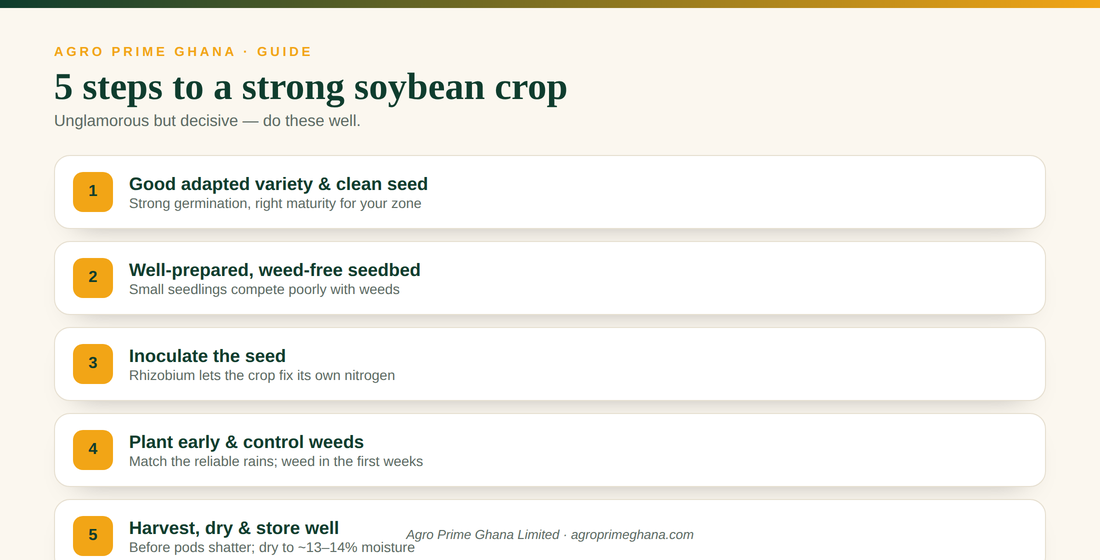
Soybean is a rare crop that pays you three ways: a firm cash market, cheaper inputs (it fixes its own nitrogen), and a richer soil for next season's maize. For any farmer connected to poultry — which in Ghana is almost every farmer — it also secures the protein that feed depends on. The keys to a strong crop are unglamorous but decisive: a good, adapted variety and clean seed; timely planting into a well-prepared, weed-free seedbed; proper inoculation so the crop fixes its own nitrogen; early weed control; and careful, timely harvesting, drying and storage to protect quality and price. Grow it in rotation with maize and you build a two-crop system that feeds people, feeds animals and feeds the soil. Whether you sell the grain, process it, or turn it into feed for your own birds, soybean is one of the most strategic crops a Ghanaian farmer can add.
Grow your own feed protein
Agro Prime Ghana Limited runs a hatchery and agribusiness in Kasoa. Growing soybean and maize secures your feed and diversifies your income. Talk to us about feed, chicks and building a resilient farm: book a visit or message WhatsApp (+233 24 915 1503).