
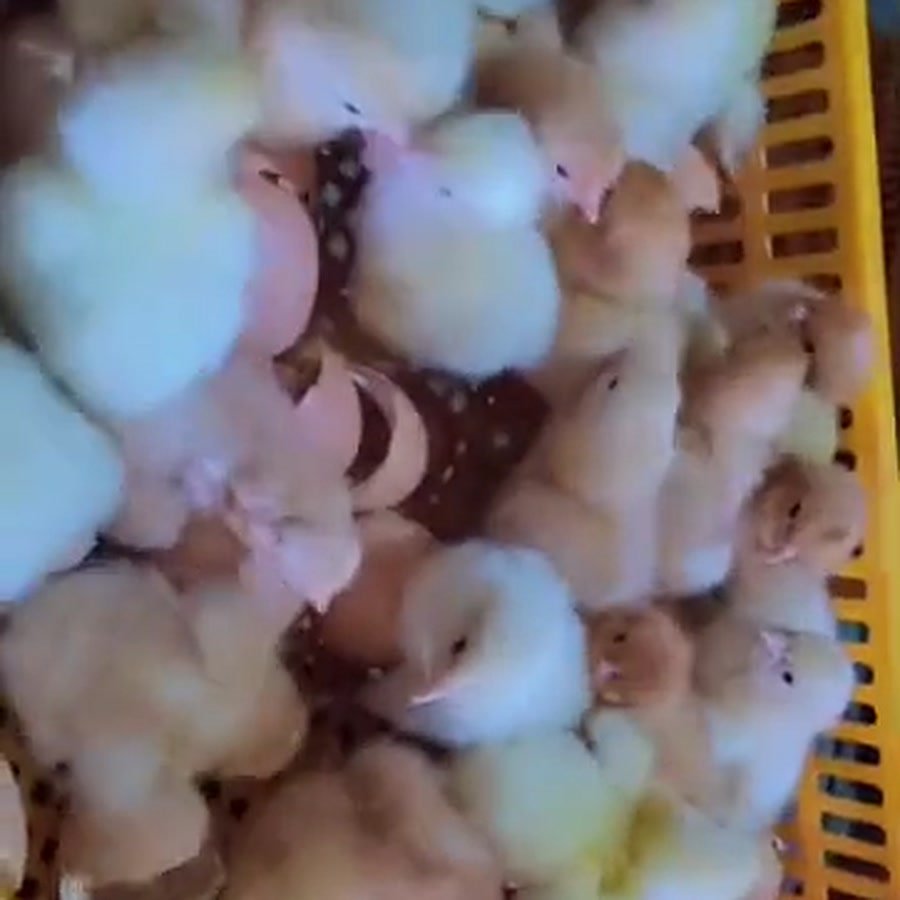
GH₵20. That is what one day-old broiler chick costs at our hatchery in Kasoa, and it is the smallest number you will meet in a batch. The larger figures arrive once feed, litter, vaccines and a sale price join the picture. Anyone thinking about a house deposit should understand those larger figures before a single chick is placed. Our day-old chicks page explains where that starting price comes from.
Ghanaians saving for a house tend to think in blocks. A plot needs a deposit. A building needs cement, roofing sheets and labour paid in stages. A poultry batch looks like one more block at first glance: you commit a known sum, and some weeks later a larger sum comes back. That picture is not wrong. It just hides the parts that decide whether the money reaches the building site on time.
What one batch asks of you
A 1,000-bird broiler batch runs from placement to payout in about eight weeks, and that includes clearing and cleaning the house before the next group arrives. The birds spend roughly six to seven weeks growing. They reach market at around 2.3 to 2.55 kg live. Those numbers set the rhythm of the whole business. Money leaves steadily for six weeks, then a short window at the end brings it back.
A house can run five or six batches a year if timing, labour and buyers all cooperate. That sounds like a steady income. In practice the cash flow is lumpy, with heavy spending at placement and one sales event at the end. If your deposit falls due in the middle of a cycle, you will feel that lumpiness, and a batch cannot be relied on to pay it on time.
Dry-season timing adds its own pressure. Harmattan weeks bring dust and cooler nights, and both make brooding and litter management harder. A batch placed in that period needs more attention than one placed in a mild month, and that attention costs time as well as money. Plan your placement with the weather in mind, not around your bank statement alone.
Where the money goes before any bird is sold
Feed is the biggest cost, and it is not close. Each bird eats about 4.2 kg from day-old to market. A 50 kg bag of broiler starter sells at GAPFA member prices of GH₵400 to GH₵410, while the De Heus list price sits between GH₵451 and GH₵472. Feed makes up more than half of the total batch cost, so a movement in the bag price reaches your budget quickly.
Brooding heat, litter, vaccines and vitamins, labour and utilities add roughly GH₵12 a bird. Put the pieces together and the budget takes shape. The table below shows the core running cost, which lands near GH₵66 a bird before losses. That sits inside the wider GH₵65,000 to GH₵80,000 range we quote for a full 1,000-bird batch.
| Cost line, 1,000-bird batch | Per bird (GH₵) | Batch total (GH₵) |
|---|---|---|
| Day-old broiler chick | 20 | 20,000 |
| Feed, 4.2 kg at GH₵400 to GH₵410 per 50 kg bag | about 34 | 33,600 to 34,440 |
| Brooding, litter, vaccines, labour, utilities | about 12 | about 12,000 |
| Core running cost before losses | about 66 | about 65,600 to 66,440 |
| Full batch range, chick to market | 65 to 80 | 65,000 to 80,000 |
The first four rows are simple arithmetic from the per-bird figures. The last row is the wider range we quote, which absorbs the costs that change from batch to batch.
Those changing costs are where real batches differ. Cooler weeks need more heat. Slow-growing birds eat more before they weigh more. Any losses you absorb are money already spent. A careful farm plans for that gap rather than pretending it does not exist.
Feed deserves its own planning. Bag prices move with import costs, the season and the supplier you buy from, and small changes add up quickly across a flock. For a 1,000-bird batch, 4.2 kg per bird comes to about 84 bags of 50 kg before any wastage. That means every GH₵10 rise in the bag price adds roughly GH₵840 to the batch. Price the batch at today's feed rate, then ask what happens if the rate climbs during the cycle. If the plan still works at a higher bag price, it has room. If it only works at today's price, the house fund should not depend on it.
Reading the profit without wishful thinking
Typical net profit in a normal cycle works out to GH₵12 to GH₵20 per bird sold. That is the range we use when describing what a batch can contribute, and it is a range to test, not a number to bank on. It assumes the birds are well managed, the sale price holds and losses stay low. Change any one of those and the result moves. Our cash-flow breakeven guide works through the same arithmetic in more detail.
Losses are the part newcomers underestimate. A well-managed house usually loses around 3 to 5 per cent of its birds. Poor management or disease can push that to 10 to 20 per cent. At the top of that range the profit from a whole cycle can disappear, because the feed and chicks for the birds that died are already paid for.
Here is an illustrative calculation, not a forecast. Suppose a 1,000-bird batch loses 5 per cent, leaving 950 birds to sell. At GH₵12 to GH₵20 profit per bird sold, that batch would contribute roughly GH₵11,400 to GH₵19,000 on the typical range. Now suppose losses reach 20 per cent. Only 800 birds reach market, and the cost of the 200 that died stays in the account. That gap is why losses matter more than almost any single sale price.

Be wary of any promised fixed return
An offer that promises a fixed monthly percentage is not describing poultry. Feed prices, losses and sale prices all move, and Ghana's Securities and Exchange Commission has warned the public against schemes that promise fixed returns. A farm that tells you its profit is fixed should make you ask harder questions, not fewer. Ask for the written agreement and the batch costs in writing before you transfer anything.
Try your own assumptions before you save
Open the batch calculator on the partner page and enter your own figures for losses, feed prices and sale price. If the result only works when everything goes right, you have learned something useful before a single cedi moves toward a house.
Timing the sale around the festive calendar
Demand is not flat through the year. Quiet months usually see live birds sell at around GH₵75 to GH₵80, while Christmas, Easter and Eid peaks can push the price to GH₵100 or more. The difference is large enough to change a house plan, which is why placement dates matter as much as feed prices. Our guide to the Christmas broiler market explains how the peak works from the buyer side.
Here is an illustrative comparison using the same 950 birds from the earlier example. Sold at GH₵78 in a quiet month, they bring in about GH₵74,100. Sold at GH₵100 into a festive peak, the same birds bring in GH₵95,000. The revenue gap is roughly GH₵20,900 before any other costs in the cycle. A batch that lands in a quiet month still has to cover its costs, so do not build a house payment on the assumption of a peak that may not arrive on schedule.
Working out what your house fund can rely on
A simple way to think about the fund is to ask how much of the house money a batch could safely cover in a bad cycle, not a good one. Start with the birds you place, subtract the losses you planned for, and multiply by the lower end of the per-bird profit range. Then assume that one cycle in the year will disappoint and take it out of the count. What remains is the part of the house plan a batch could reasonably support. Everything else should come from money you already have.
Once a payout lands, one practical pattern is to divide it before it is spent. One part goes straight to the house account. A second part goes to a reserve that covers the next cycle's feed, in case the bag price has moved. The rest stays available for whatever the family or the business needs. Splitting the money on the day it arrives is much easier than deciding later, when the amount no longer feels like a payout and more like spare cash.
Money handling matters in this plan too. Farm payments run through MTN MoMo, Telecel Cash, AirtelTigo, bank transfer or cash, and every payment goes only to the Agro Prime Ghana Limited company account. If someone asks you to send money to a personal number, stop and check the company details first. A mobile wallet is convenient, but that convenience is exactly what scammers count on.
If you live abroad and are saving for a house at home, the distance is the hard part. Diaspora partners can ask for a live video walk-through of the batch, and international transfers are part of the offer for them. Weekly reports help too, because you can see the photo, weight, feed and mortality figures without waiting for a phone call from Kasoa.
Keeping the house fund separate from the flock
Keep the house money and the batch money in separate places, both in your head and in your bank account. A batch works best as a supplement to a house fund, not as its foundation. The fund should still cover a bad month, a delayed sale or a quiet market where prices sit at the lower end of the range.
Timing of the payout matters as well. Capital is returned first, then profit is split as the written agreement sets out. The payout arrives by bank or MoMo days after the final sale. Days after the sale is not the same as the day your builder expects payment. Plan each house instalment for a date a week or two after the expected sale, so a slow transfer does not push you into borrowing.
Before you put house money into a flock
Start with the smallest batch that teaches you something. The partnership begins at 500 birds, and 1,000 is what we recommend for a full cycle. Whichever size you choose, the written profit-share agreement is signed before the chicks go into the house. Read it with someone you trust, and check every figure against the cost table above.
Before the first placement, write down three numbers in a notebook or a phone note: the amount you plan to put in, the lowest per-bird profit you could accept, and the date you need the money for the house. Keep that note where you will see it. When the final report arrives, compare the actual figures against those three numbers. If the result falls short, you will know whether the batch failed on losses, on price or on timing, and you can adjust the next decision with a clear head rather than a hopeful one.
During the cycle, reports arrive every Thursday with a photo, the weight, feed use and mortality for the week. Those figures show whether the batch is following its plan. You will see drift in the weekly numbers rather than discovering it at the final sale, which is the point of reporting weekly.
Keep the house and the flock in separate accounts
A house is a long project, and a poultry batch is a short one. That difference is the reason to keep them apart. Use a batch for what it does reasonably well, which is to return a sum in about eight weeks at a profit that depends on real costs and real prices. Use your house fund for what it must do, which is to be there when the builder is paid.
If the numbers still make sense after you have tested them, the next step is a conversation with the farm. You can reach the partnership team on WhatsApp at +49 151 68495881 in English or German, or write to support@agroprimeghana.com. Farm visits run Monday to Saturday, 7am to 6pm, for anyone who wants to see the house before deciding.
See the batch plan and open the calculator
For a closer look at how the profit-share arrangement is built, read our guide to the hatchery partnership model.


