Raising chickens is only half the poultry value chain — the other half is processing them into the clean, dressed, frozen chicken that shops, restaurants, hotels and households actually buy. Ghana imports vast amounts of frozen chicken, yet local birds are often sold live or roughly dressed, leaving money and market share on the table. A poultry processing business bridges that gap, turning live birds into a hygienic, convenient, branded product — and for a farmer who already keeps poultry, it captures far more of each bird's value. This guide covers how to start a poultry processing (dressing) business in Ghana.
Key takeaways
Processing turns live birds into clean, dressed, frozen chicken — the form the market increasingly wants and imports supply. A processing business earns by adding value to birds (your own or bought in) and selling to shops, restaurants, hotels and households. Success rests on strict hygiene and food safety, an unbroken cold chain, consistent quality and good presentation, and reliable supply. It pairs perfectly with poultry farming, capturing more of each bird's value.
Why poultry processing is a strong business
The market has moved toward convenience and hygiene: consumers, restaurants, hotels, supermarkets and caterers increasingly want clean, dressed, ready-to-cook chicken rather than live birds — which is exactly why Ghana imports so much frozen chicken. Local poultry, by contrast, is often sold live or dressed informally, missing this large, growing market. A processing business fills that gap, and it does two valuable things: it adds value to each bird (a well-dressed, cleanly packaged chicken is worth more than a live one) and it opens markets that will not buy live birds at all. For a poultry farmer, processing captures the margin that currently goes to importers and informal butchers; for an entrepreneur, it serves a clear, rising demand. Done to a high hygiene standard, local dressed chicken can compete strongly with imports on freshness and quality.
Understanding the process
Poultry processing is a defined sequence, and understanding it guides your setup. Broadly, birds are received and rested, then slaughtered humanely, bled, scalded and de-feathered (plucked), eviscerated (cleaned out), washed, chilled, and then either sold fresh-chilled or frozen and packaged — whole or cut into parts. Each step must be done cleanly and correctly: poor bleeding, scalding or evisceration gives a lower-quality, less hygienic product. The scale can range from careful manual processing of modest numbers to semi-automated lines with pluckers and chillers for larger volumes. Whatever the scale, the principle is the same — a clean, orderly flow from live bird to hygienically packaged chicken, with no shortcuts on the steps that determine safety and quality.
Setting up: facility and equipment
A processing facility is built around hygiene and flow:
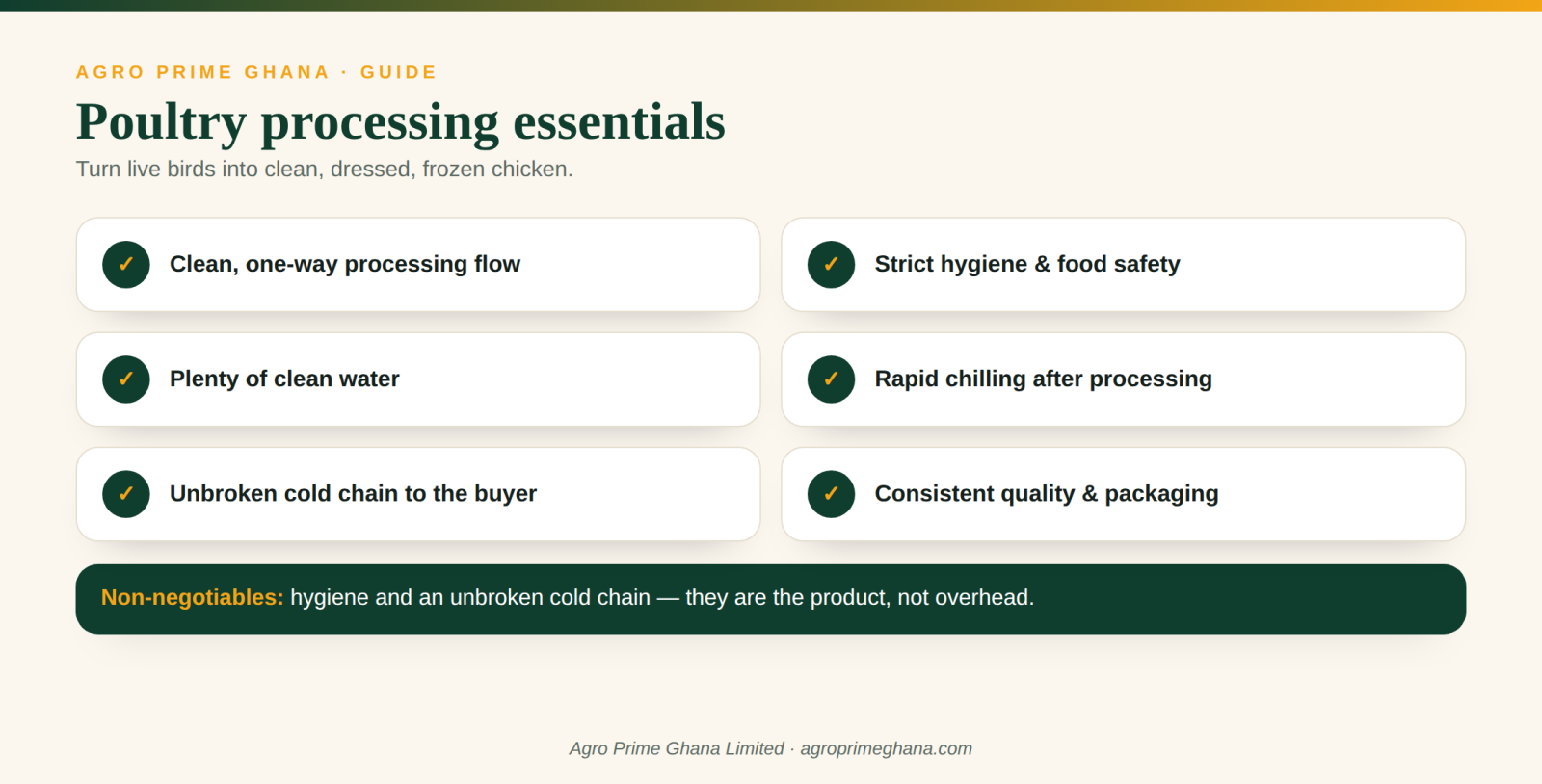
- A clean, well-designed space with a one-way flow from live-bird receiving through slaughter, plucking and evisceration to chilling and packing, so clean and dirty areas do not mix.
- Processing equipment to your scale — from basic (scalding, manual plucking, clean evisceration tables) to semi-automated pluckers and processing lines for volume.
- Reliable clean water in quantity, essential throughout processing.
- Chilling and freezing — a chiller and freezer/cold room to bring the meat down fast and hold the cold chain.
- Backup power, because the cold chain (and often the line) cannot afford outages.
- Packaging that is clean, food-grade and, ideally, branded, plus proper waste handling for feathers and offal.
Hygiene and food safety: the foundation
This is the non-negotiable heart of the business. You are producing food that people eat, so hygiene and food safety come before everything. That means clean facilities, equipment and water; workers with good personal hygiene and clean practices; a layout that keeps clean and dirty areas apart; careful handling to avoid contamination during slaughter and evisceration; and rapid, thorough chilling to keep the meat safe. Good practices along these lines — the discipline behind food-safety systems like HACCP — protect your customers and your reputation, and they are increasingly what buyers, especially hotels, supermarkets and institutions, require. Meet or work toward the relevant standards and any required registration or inspection for processing meat. A single hygiene failure can make people ill and end a food business overnight, so treat cleanliness and safety not as overhead but as the product itself. Clean, safe chicken is the whole proposition.
The cold chain
Processing and cold storage are inseparable. Once a bird is dressed, its safety and shelf life depend on getting it cold fast and keeping it cold all the way to the customer — the cold chain. Chill the meat quickly after processing, freeze what will be sold frozen, and store and transport it consistently cold, never letting it warm and re-cool. A broken cold chain spoils the product and endangers customers, so reliable refrigeration, freezing and backup power (an outage that thaws your stock is a disaster) are essential, and cold transport matters for delivery. This is where processing links naturally to cold storage: many processors run their own freezing and cold storage, and the same power-reliability discipline applies. An unbroken cold chain from your chiller to the customer's freezer is what makes dressed chicken safe, sellable and trusted.
Products, quality and markets
Decide what products you will sell and to whom. Options include whole dressed chicken (fresh-chilled or frozen), cut parts (thighs, wings, breasts, gizzards), and cleaned, graded, branded packs. Consistent quality and good presentation matter enormously — uniform, clean, well-packaged chicken builds a brand that buyers trust and return to, while inconsistent or poorly-presented product struggles. Your markets are broad: restaurants, chop bars and fast-food outlets, hotels and caterers, supermarkets and shops, and households, plus institutions. Reliable supply is as important as quality — buyers who can count on you keep buying — so match your processing volume to steady demand. A processor who delivers clean, consistent, well-presented local chicken reliably can win loyal custom from buyers currently relying on imports. Keep clear records of birds processed, yields, costs and sales, as with any serious enterprise, so you know your true margin per bird.
Why it pairs perfectly with poultry farming
For a poultry farmer, processing is the natural next step up the value chain. Instead of selling live birds at whatever the going rate is, you dress, package and sell them as a higher-value product into markets that pay more and that live-bird sellers cannot reach — capturing margin that otherwise goes to middlemen and importers. It also smooths sales: rather than needing to sell live birds the moment they are ready, you can process and freeze them, holding stock for steady sale. You can process your own birds and, as capacity grows, buy in birds from other farmers to process, turning a farm capability into a business. This integration — hatchery and farm producing birds, processing adding value, cold storage holding product — is how a poultry operation grows from selling live chickens into a resilient, higher-margin agribusiness. Starting with your own birds keeps quality and supply in your control while you learn the processing side.
Starting small and scaling the operation
Poultry processing rewards a careful, staged start. You can begin at a modest scale — processing your own birds and a small, steady volume with basic but hygienic equipment — before investing in semi-automated pluckers, larger cold rooms and a full line. Starting small lets you get the things that matter most exactly right on a manageable scale: the clean one-way flow from live bird to packed product, strict hygiene, an unbroken cold chain, and consistent quality and presentation. It also lets you learn your real yields and costs per bird and build a base of buyers who trust your product before you scale up. As demand grows and your reputation for clean, consistent chicken spreads, you add capacity, take in birds from other farmers, and expand your markets and product range, reinvesting proven earnings. Trying to start large before mastering hygiene, the cold chain and quality is how processing businesses fail; growing deliberately from a clean, well-run small operation is how they succeed. For a poultry farmer, this staged path also keeps processing tied to your own bird supply at first, so quality and volume stay in your control while you learn the trade.
Common mistakes to avoid
- Cutting corners on hygiene and food safety, which endangers customers and can end the business overnight.
- Breaking the cold chain, letting dressed chicken warm and spoil.
- No backup power, risking thawed stock and a stalled line during outages.
- Poor layout, mixing clean and dirty areas and inviting contamination.
- Inconsistent quality or presentation, which fails to build a trusted brand against imports.
- Unreliable supply, losing buyers who need to count on you.
Frequently asked questions
Is poultry processing profitable in Ghana?
What does poultry processing involve?
Why is hygiene so important in poultry processing?
What is the cold chain and why does it matter?
Do I need special equipment to start?
Can I process my own farm's chickens?
Who buys processed chicken?
Do I need approval to process poultry?
The bottom line on poultry processing
Poultry processing is where a poultry business captures the value that currently flows to importers and informal butchers. By turning live birds into clean, dressed, frozen chicken, a processor serves the convenience-and-hygiene market that is growing fast and that imports now dominate — and for a farmer, it is the natural step from selling live birds to selling a higher-value, branded product. The business stands or falls on a few non-negotiables: uncompromising hygiene and food safety, an unbroken cold chain backed by reliable power, consistent quality and presentation, and dependable supply. Get those right, start with your own birds to control quality while you learn, and build toward the standards serious buyers require, and processing becomes the engine that lifts a poultry operation — hatchery, farm, processing and cold storage together — into a resilient, higher-margin agribusiness. In a country importing so much frozen chicken, clean, well-made local dressed chicken is an opportunity worth seizing.
Capture more of every bird's value
Agro Prime Ghana Limited runs a hatchery and agribusiness in Kasoa. Processing is the natural next step from raising poultry to selling a higher-value product. Talk to us about building an integrated poultry business: book a visit or message WhatsApp (+233 24 915 1503).