Pig farming is one of the fastest and most productive ways to turn feed into meat. A single sow can produce two litters a year of ten or more piglets each, pigs grow quickly to market weight, and pork has a steady, growing market in Ghana through the "khebab" trade, chop bars, restaurants and processors. Pigs also thrive on a wide range of feeds, including farm and kitchen by-products, which can keep costs down. For a farmer ready to manage housing and — above all — biosecurity, a piggery is a high-output, profitable venture. This guide covers how to start and run a pig farm in Ghana.
Key takeaways
Pigs are prolific and fast-growing — a sow gives two litters a year of many piglets, reaching market weight in about 6–8 months. Feed is the biggest cost, but pigs use a wide range of feeds and by-products. House them on well-drained concrete with a cool wallow or shade, feed a balanced ration, and treat biosecurity against African Swine Fever as the number-one priority — one outbreak can wipe out a herd.
Why pig farming is profitable in Ghana
Few livestock match a pig's productivity. Sows are highly prolific — commonly two litters a year of ten or more piglets — so a small breeding herd multiplies quickly, and pigs convert feed to meat efficiently, reaching market weight in months. Pork demand in Ghana is real and growing, supplied to the popular pork "khebab" spots, chop bars, restaurants, hotels and processors. Pigs are also flexible feeders that can use farm by-products, brewery and food waste alongside compounded feed, which helps control the biggest cost. For a farmer prepared to manage a clean, secure operation, pigs offer one of the highest meat outputs per animal of any livestock.
Understand the market first
Before investing, be clear about your market, because pork is not eaten everywhere or by everyone in Ghana. Demand is strong in many areas and among many communities, but for religious and cultural reasons it is limited in others. This is not a reason to avoid pig farming — the pork market is large and reliable where it exists — but it is a reason to plan your sales locally: know where your buyers are (pork joints, processors, urban markets, hotels) before you build. A farmer with clear local demand and buyers lined up has a strong, steady outlet; one who builds a piggery without checking the local market first can struggle to sell. Match your scale to the market you can actually reach.
Getting started: breeds and stock
Start with healthy breeding stock from a reputable pig farmer. The common improved meat breeds — Large White, Landrace and Duroc, and their crosses — grow fast and produce large litters, and crossbreds with some local blood can be hardier and better adapted. A typical starter herd is a few sows (females) and access to a good boar (male), or you can raise weaners bought in for fattening if you prefer to start simpler. Choose active pigs with good body condition, sound legs, and no signs of illness, from a farm you trust to be free of disease. Learn correct handling and management from your supplier, and above all buy only from a clean, healthy source — bringing in a sick pig can infect your whole herd.
Housing: clean, dry and cool
A good pigsty keeps pigs clean, dry, cool and secure. The essentials:
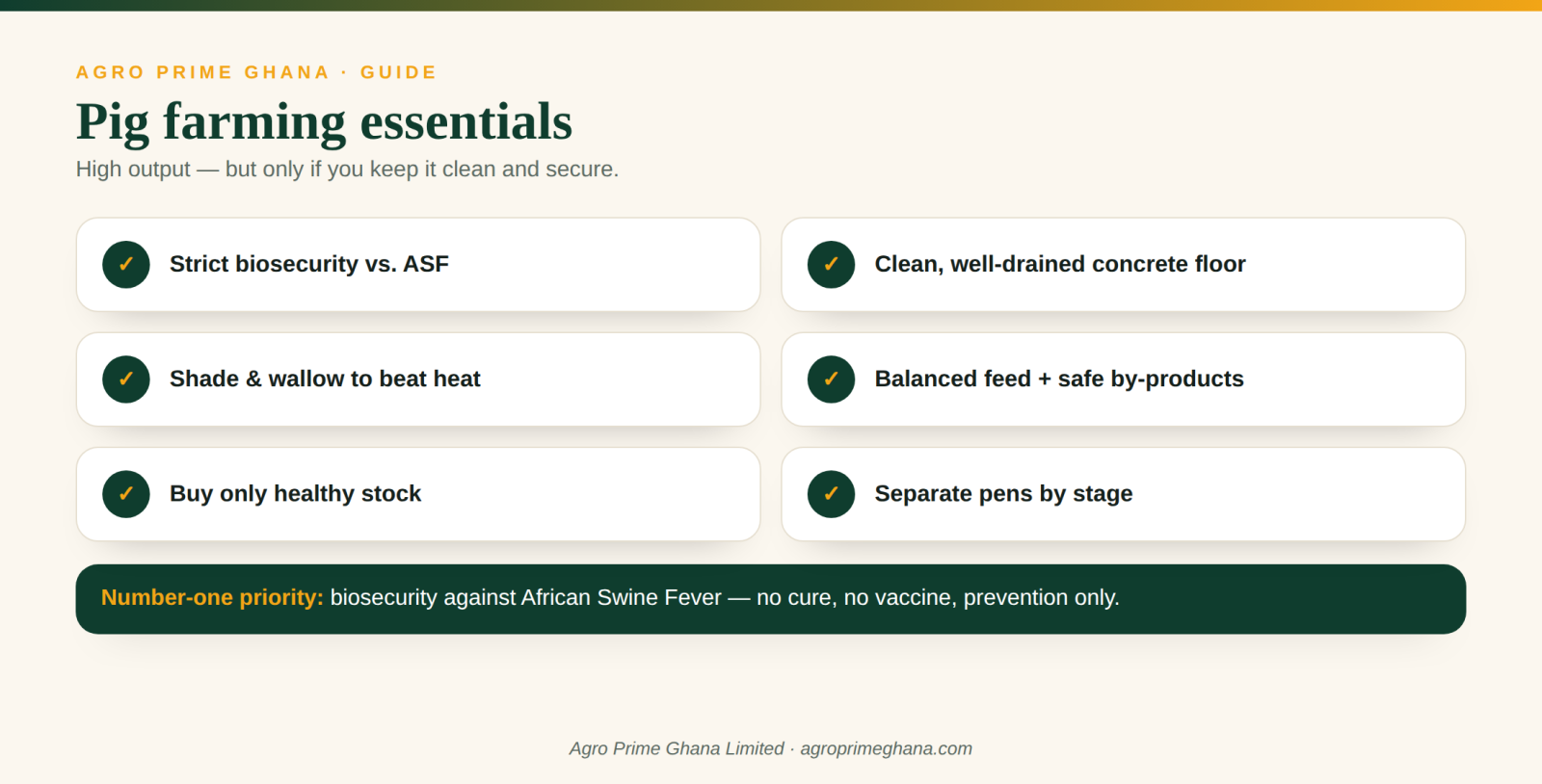
- Solid, well-drained floor: a concrete floor that can be washed and drains well keeps pigs clean and makes hygiene manageable — the foundation of a healthy piggery.
- Shade and cooling: pigs cannot sweat and suffer in heat, so provide shade and a wallow or water spray to let them cool down.
- Pens by group: separate pens for the boar, dry and pregnant sows, farrowing (birthing) sows with piglets, weaners and growers/fatteners.
- Secure and comfortable: strong pens that contain pigs, with dry lying areas and protection from rain and cold draughts, especially for young piglets.
- Easy to clean and disinfect: hygiene is disease prevention, so build for regular washing and disinfection.
Feeding pigs well and affordably
Feed is the largest cost, so managing it well decides your margin. Pigs need a balanced ration of energy, protein, vitamins and minerals, matched to their stage:
| Stage | Feeding focus |
|---|---|
| Piglets / weaners | High-quality, digestible starter feed for a strong start |
| Growers / fatteners | Energy and protein for fast, efficient weight gain |
| Pregnant / nursing sows | Good nutrition to carry and feed large, healthy litters |
| Boar | Steady condition — not too fat, not too thin — for fertility |
Pigs' flexibility is a real advantage: alongside compounded feed you can safely use many farm and food by-products — brewery spent grain, cassava and its peels, ripe fruits, vegetable trimmings and kitchen waste — to lower costs. Introduce any new feed gradually, avoid spoiled or mouldy material, and always provide clean water. Balancing bought feed with safe, cheap by-products is the art of profitable pig feeding — the same cost-control logic behind formulating poultry feed.
Breeding and the productivity engine
A pig's productivity comes from the sow. Gilts (young females) are bred at maturity, carry for about three months, three weeks and three days (roughly 114 days), and farrow a litter of ten or more piglets. With good management a sow gives around two litters a year, so a few sows quickly build a herd. Provide a clean, warm farrowing pen before the sow is due, protect newborn piglets from being crushed and from cold, and make sure they get colostrum (first milk) early. Piglets are weaned at a few weeks and moved to grow-out pens. Managing the breeding cycle well — good sow nutrition, clean farrowing, healthy piglets — is what turns a piggery's biological productivity into profit.
Biosecurity: African Swine Fever and your herd's survival
This is the section every pig farmer must take most seriously. African Swine Fever (ASF) is a deadly viral disease of pigs with no cure and no vaccine, and outbreaks in Ghana have wiped out entire herds. There is no treating your way out of it — the only defence is preventing it from ever reaching your pigs. That means strict biosecurity: control who and what enters your farm; do not bring in pigs from unknown or infected sources; keep visitors, vehicles and equipment from other piggeries away or disinfected; never feed untreated swill or waste that could contain infected pork; keep your pigs from contact with other pigs and with anything coming from an outbreak area; and disinfect footwear, hands and equipment. Fence and control the piggery so stray pigs and animals cannot mix with yours. If disease appears anywhere nearby, tighten everything and report to veterinary authorities. Alongside ASF, routine health care — deworming, parasite control, clean housing and prompt attention to sick animals — keeps the herd productive. In pig farming, biosecurity is not optional paperwork; it is the difference between a thriving herd and losing everything overnight.
The economics
Pigs offer high output but demand real management. Your main costs are housing, breeding stock and — by far the largest — feed, plus health and biosecurity. Against that stand a sow's remarkable yearly output of fast-growing piglets and strong pork demand where the market exists. The keys to good returns are cheap-but-safe feeding (using by-products well), keeping litters large and piglet mortality low, growing pigs efficiently to market weight, and — underpinning it all — never losing the herd to disease. Keep clear records of breeding, feed, growth and sales so you know your true cost and margin per pig, the same discipline behind sound farm record keeping.
Finding buyers and adding value
Your outlets are pork "khebab" and grill spots, chop bars and restaurants, butchers and processors, hotels, and other farmers buying weaners or breeding stock. Selling live pigs or dressed carcasses at market weight is standard; supplying regular buyers on a schedule steadies income. As you grow, value addition — supplying processors, or clean, well-presented cuts to restaurants and hotels — can lift margins. Reliability and healthy, well-finished pigs build repeat business, the same steady-supply approach that works for selling poultry.
Common mistakes to avoid
- Neglecting biosecurity. African Swine Fever can wipe out the whole herd — prevention is the only defence.
- Buying pigs from unknown or unhealthy sources, importing disease into your farm.
- Poor drainage and dirty pens, which breed disease and parasites.
- Underfeeding sows and piglets, giving small litters and weak, slow-growing pigs.
- Ignoring heat, with no shade or wallow, which stresses pigs and hurts growth and fertility.
- Building before checking the local pork market, then struggling to sell.
Frequently asked questions
Is pig farming profitable in Ghana?
How many piglets does a sow produce?
What do pigs eat?
What is African Swine Fever and how do I prevent it?
How long does it take to raise a pig to market weight?
What breeds of pig are best in Ghana?
Do pigs need special housing?
Is there a market for pork in Ghana?
The bottom line on pig farming
Pigs are among the most productive livestock a Ghanaian farmer can keep: prolific sows, fast growth, flexible feeding and a strong pork market where it exists. That productivity is real, but it comes with one non-negotiable condition — biosecurity. African Swine Fever has no cure and no vaccine, and it can erase a herd overnight, so preventing disease from ever reaching your pigs is the first job of a pig farmer, not an afterthought. Get that right, then feed well and affordably using safe by-products, house pigs on clean, well-drained, cool concrete, keep sows productive and piglets healthy, confirm your local pork market before you build, and keep clear records. Do all that, and a piggery turns feed and by-products into one of the highest meat outputs in farming — a serious, profitable enterprise for the farmer disciplined enough to run it clean and secure.
Build a productive, diversified farm
Agro Prime Ghana Limited runs a hatchery and agribusiness in Kasoa. Adding pigs alongside poultry can raise your farm's output and spread risk. Talk to us about planning a resilient, diversified operation: book a visit or message WhatsApp (+233 24 915 1503).


