Palm oil is woven into Ghanaian cooking — the base of soups, stews and street food — and demand for it is constant and large. Processing oil palm fruit into palm oil is a well-established, profitable agribusiness that turns a bulky, perishable harvest into a valuable, sellable product. From small village mills to larger operations, palm oil processing serves a market that never disappears, and it pairs naturally with oil-palm growing in Ghana's forest zones. This guide covers how to start and run a palm oil processing business in Ghana — and how to do it to a quality and safety standard that protects buyers and your reputation.
Key takeaways
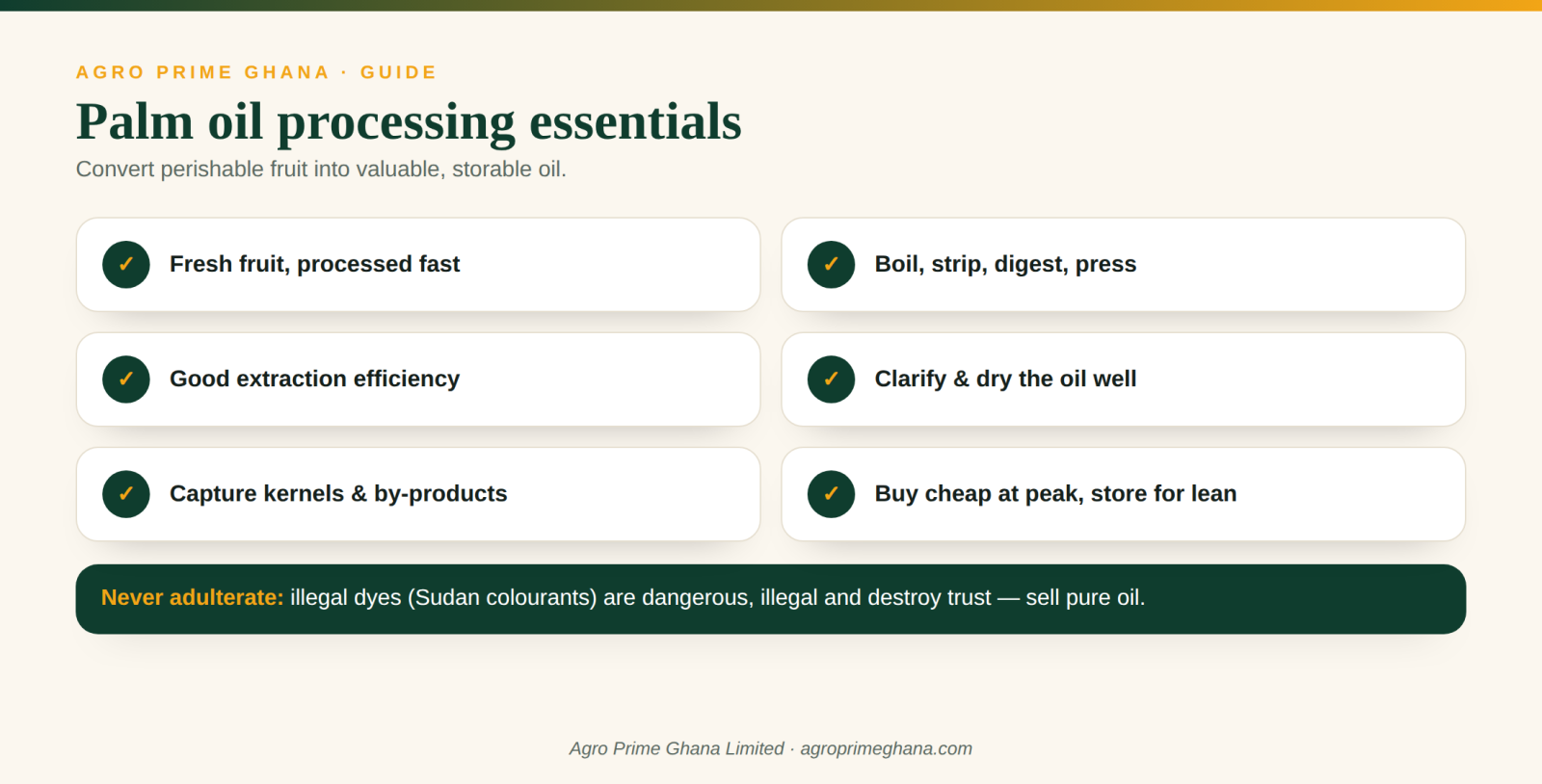
Palm oil has huge, constant demand in Ghana. Processing turns perishable oil-palm fruit bunches into valuable oil — but fruit must be processed quickly after harvest. The process is boil, strip, digest, press, clarify and dry. Success rests on a reliable supply of fresh fruit bunches, good extraction efficiency, and quality and food safety — clean processing, low free-fatty-acid oil, and never adulterating with illegal dyes. Start small and scale with demand.
Why palm oil processing is a strong business
Palm oil is a staple of the Ghanaian kitchen, used daily in homes, chop bars and food businesses, so demand is deep and reliable rather than seasonal or faddish. Oil palm grows well in Ghana's forest and coastal zones, and much of its fruit is processed by small and medium mills, leaving real room for well-run operations. Processing captures the value in the fruit: fresh fruit bunches are bulky and perishable, but the extracted oil stores and sells well, so the processor turns a difficult harvest into a marketable product. The business scales from a small village mill serving local growers to a larger commercial operation, and it links naturally to oil-palm farming. For an entrepreneur or a farmer with access to oil-palm fruit, processing is a proven, durable-demand agribusiness.
Securing fresh fruit bunches
Your business runs on a steady supply of fresh oil-palm fruit, and freshness is critical. Once harvested, oil-palm fruit bunches begin to deteriorate, and stale fruit produces poor-quality oil high in free fatty acids (which affects taste, storage and value) — so fruit must reach your mill and be processed quickly. Secure your supply by growing your own oil palm, contracting nearby growers to supply bunches on a schedule, or buying from farmers and aggregators, always so that fruit is processed within a short window of harvest. Oil-palm fruit also comes in seasons of higher and lower production, so plan for the peak-harvest glut (when fruit is abundant and cheap) and the lean season. Building reliable relationships with growers and matching your intake to your milling capacity keeps the operation running and the oil quality high.
The palm oil process, step by step
Traditional and small-mill palm oil extraction follows a clear sequence:
- Sterilise (boil): boil or steam the fruit bunches to loosen the fruit, stop deterioration and make oil extraction easier.
- Strip: separate the individual fruits from the bunches.
- Digest (pound/mash): pound or mash the boiled fruit to break the flesh and release the oil, by hand or with a digester machine.
- Press: press the mashed fruit to extract the crude oil, using a manual or mechanical press — good pressing is key to yield.
- Clarify (boil and settle): boil the extracted crude oil with water and let it settle so the pure oil separates from water and sludge, then skim off the clean oil.
- Dry and store: heat the clarified oil to remove remaining moisture, then cool and store it clean in suitable containers.
The palm kernels left after pressing are a valuable by-product (for kernel oil and feed), so a good operation captures those too.
Extraction efficiency and equipment
How much oil you get from your fruit — your extraction efficiency — strongly affects profit, and it depends on the fruit's freshness and quality and on your equipment and method. Manual, fully traditional processing extracts less oil and is labour-intensive; a small mechanised mill with a digester and press extracts more oil, faster, with less labour, and is the natural upgrade as volume grows. Boiling and pressing well, and processing fresh fruit, all raise your oil yield from the same quantity of bunches. Match your equipment to your scale and capital: start with what you can afford and fill, and reinvest into a digester, press and better clarification as demand and fruit supply grow. Squeezing more oil from every bunch, cleanly, is one of the most direct ways to improve a palm oil business's margins.
Quality and food safety: the non-negotiables
Palm oil is a food, and quality and safety define a trustworthy processor. Two things matter most. First, oil quality: process fresh fruit promptly, clarify and dry the oil well, and keep it clean, so the oil is low in free fatty acids, good in colour and taste, and stores without going rancid — stale fruit and poor clarification give sour, low-value oil. Second, and critically, never adulterate palm oil with illegal dyes: adding banned colourants such as Sudan dyes to brighten the oil's red colour is dangerous to health, illegal, and has been a serious problem in the market. Genuine, clean, well-processed palm oil — coloured only by the natural fruit — is both safe and, increasingly, what quality-conscious buyers demand. Building a reputation for pure, safe, well-made oil protects your customers and sets your business apart in a market where adulteration has damaged trust. Clean equipment, good hygiene and honest processing are the foundation.
Markets and by-products
Palm oil's market is broad and constant. Buyers include households, market traders, chop bars and restaurants, food processors and manufacturers, and soap makers, plus institutions. Good-quality, clean oil sells reliably, and well-packaged, trusted oil can command better prices and loyal buyers. Beyond the oil itself, a well-run operation earns from by-products: the palm kernels left after pressing yield palm kernel oil (used in soap, cosmetics and food) and kernel cake for animal feed, and the fibre and shells can fuel the boiling process. Capturing these by-products, rather than discarding them, adds meaningful income and reduces waste. As you grow, supplying processors, packaging branded oil, and serving the soap and food-manufacturing trade extend your reach and margins. Keep records of fruit processed, oil and kernels produced and sold, and your costs, so you know your real returns.
The economics and seasonality
Palm oil processing profits by converting bulky, perishable fruit into storable, saleable oil, and by capturing by-products. Your main costs are fresh fruit bunches, labour, fuel for boiling, and equipment (digester, press, clarification), plus containers and any packaging. Against that, oil sells steadily and well, and kernels add income. A key feature to manage is seasonality: oil-palm fruit is abundant and cheap in the peak season and scarce in the lean season, so a smart processor buys and processes heavily at the peak and stores well-made oil to sell into the leaner, higher-priced season — turning seasonality into an advantage. Because oil stores well when properly processed, this buy-low, sell-later strategy can significantly improve returns. Know your extraction efficiency and costs precisely, and keep clear records, as with any serious enterprise, to manage margins across the seasons.
Starting small and scaling
Palm oil processing scales well from a modest start. You can begin with a small operation — traditional or lightly mechanised — serving local oil-palm growers and a nearby market, learning the process, oil quality and fruit supply before investing more. As demand and fruit supply grow, reinvest into a mechanised digester and press (raising oil yield and cutting labour), better clarification and storage, kernel processing, and packaging to move up-market. Starting small lets you prove the trade, build grower relationships and a customer base, and get quality and safety right before committing large capital. The staged path — start small, master extraction and quality, then mechanise, capture by-products and brand — keeps risk manageable and lets the business fund its own growth. For a farmer growing oil palm, adding processing is the natural way to capture the fruit's full value rather than selling bunches cheaply at the glut.
Common mistakes to avoid
- Processing stale fruit, giving sour, high-free-fatty-acid, low-value oil — process fresh, quickly.
- Adulterating oil with illegal dyes like Sudan colourants — dangerous, illegal and reputation-destroying.
- Poor extraction efficiency, leaving oil in the fruit through bad boiling or pressing.
- Weak clarification and drying, giving oil that goes rancid or stores badly.
- Discarding by-products — kernels and fibre are real income and fuel.
- Ignoring seasonality, instead of buying cheap at the peak and storing for the lean season.
Frequently asked questions
Is palm oil processing profitable in Ghana?
How is palm oil made?
Why must palm fruit be processed quickly?
What is the problem with palm oil adulteration?
What can I do with the palm kernels?
How do I manage the seasonal fruit supply?
Can I start a palm oil business small?
Who buys palm oil?
The bottom line on palm oil processing
Palm oil processing serves one of the most constant markets in Ghanaian food, turning bulky, perishable oil-palm fruit into valuable, storable oil plus by-products. It is a proven, scalable agribusiness that suits both entrepreneurs and oil-palm farmers. Success rests on a few essentials: a reliable supply of fresh fruit processed quickly; good extraction efficiency from clean boiling and pressing; capturing the kernels and other by-products; and, above all, quality and food safety — well-clarified, low-acid oil that stores well, and an absolute refusal to adulterate with the illegal dyes that have plagued the market. Manage the seasonal fruit supply by buying cheap at the peak and storing well-made oil for the lean season, start small and reinvest into mechanisation and branding, and palm oil processing becomes a durable, profitable business built on a food Ghana will always need.
Add value to a staple crop
Agro Prime Ghana Limited runs a hatchery and agribusiness in Kasoa. Processing crops into products like palm oil strengthens a diversified agribusiness. Talk to us about building a resilient operation: book a visit or message WhatsApp (+233 24 915 1503).