Palm kernel cake (PKC) is a locally abundant, moderately proteinous by-product of Ghana's palm oil industry that can replace part of the maize and soybean in a poultry ration — but its high fibre and sticky mannan sugars mean it works best in modest amounts and pays off most when you add the right enzyme. At around 16–19% crude protein and 20% crude fibre, PKC sits between an energy and a protein ingredient, and can go into broiler diets at roughly 20–30% and layer diets up to about 25% without hurting performance, provided the rest of the ration is balanced. Fed carelessly at high rates without enzymes, it drags down growth and gives you wet, greasy droppings. This guide explains how to use PKC properly under Ghanaian conditions.
Written by the Agro Prime Ghana feed and poultry team and reviewed against current animal-nutrition references (Feedipedia and peer-reviewed poultry research). Last updated September 2026.
Key takeaways
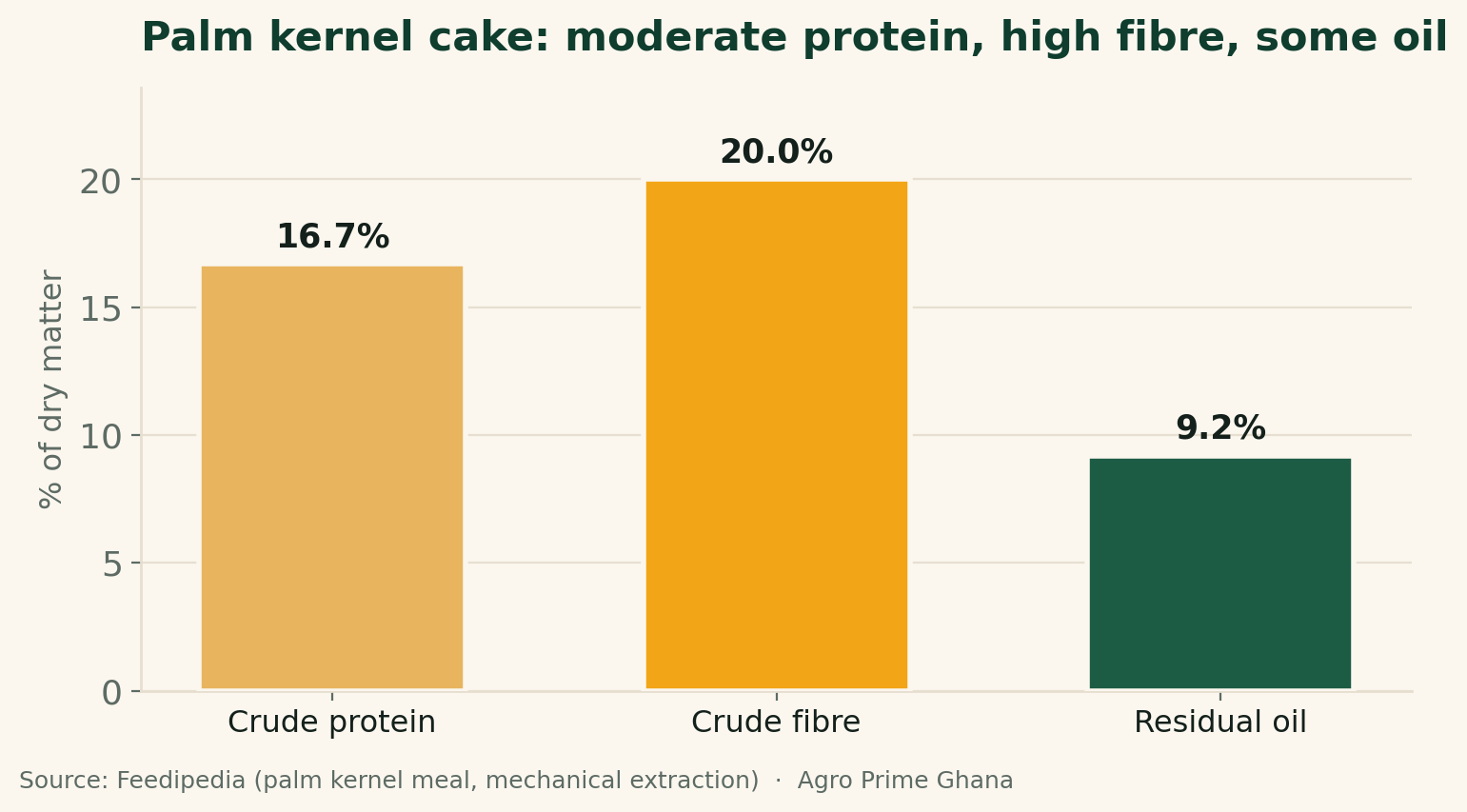
Palm kernel cake (PKC) is what is left after oil is pressed from palm kernels — a gritty, brown meal carrying roughly 16.7% crude protein (mechanically pressed) up to about 18.7% (solvent-extracted), a high ~20% crude fibre, and useful residual oil around 9% in the pressed cake. Its metabolizable energy for broilers is moderate, about 11.1 MJ/kg DM. Its main drawback is that it is one of the richest common feeds in non-starch polysaccharides (NSP), especially galactomannans, which chickens struggle to digest. Keep it to about 20–30% in broilers and up to ~25% in layers; add a mannanase/hemicellulase enzyme to unlock more of its value. It is one of the cheapest, most available local ingredients in Ghana — if you use it with the fibre limit in mind.
What is palm kernel cake?
Palm kernel cake — also called palm kernel meal (PKM) — is the solid residue left after oil has been extracted from the kernel (the hard nut inside the palm fruit). Ghana is a significant palm oil producer, and every tonne of kernels crushed for oil leaves behind this fibrous, brownish cake as a by-product, produced at mills and processing plants across the palm belt. Because it is a by-product rather than a primary crop, it is comparatively cheap and, in palm-growing areas, reliably available — one of the standard "alternative" ingredients Ghanaian feed mixers reach for.There are two grades that matter: mechanically expelled (pressed) PKC, which retains more residual oil (around 9%) and thus a bit more energy, and solvent-extracted PKM, which has most of the oil removed but slightly higher protein. Either way, PKC is best thought of as a mid-range ingredient that brings some protein and some energy, but always alongside a heavy load of fibre.
What is the nutrient value of palm kernel cake?
PKC is a moderate-protein, high-fibre, medium-energy ingredient. According to Feedipedia's data on palm kernel meal, crude protein runs about 16.7% of dry matter in the mechanically extracted cake and up to 18.7% in solvent-extracted meal, with crude fibre around 19.8–20.2% and residual oil about 9.2% in the pressed cake. Metabolizable energy for broilers sits at roughly 11.1 MJ/kg DM — lower than maize because of the fibre. That protein level is genuinely useful: well below soybean meal (around 44–48%) but far above a pure energy source like maize, which is why PKC can shoulder part of both the protein and the energy job. The residual oil in pressed cake is a bonus, adding energy and cutting dustiness. The catch, always, is the fibre and how it is built — which is where the mannans come in.
Why does palm kernel cake need care in Ghana's rations?
The reason PKC cannot simply be poured into feed is chemical, not just about bulk fibre. Feedipedia notes that palm kernel meal is one of the richest common feed ingredients in non-starch polysaccharides (NSP), particularly galactomannans — chains of mannose sugars that are second only to guar gum among ordinary feeds. Chickens lack the enzymes to break these mannans down, so the fibre passes through largely undigested, drags energy digestibility below 50%, absorbs water in the gut and produces wet, sticky, greasy droppings that dampen litter. Wet litter, in turn, drives footpad problems, ammonia and disease. This is the practical brake on PKC: not that it is worthless, but that a bird can only handle so much of that mannan load before performance and litter both suffer. The good news is that this specific problem — undigestible mannans — has a specific solution: an enzyme that breaks them down. That is why PKC and feed enzymes are almost always discussed together, and why our guide to enzymes in poultry feed is worth reading alongside this one.
How much palm kernel cake can you include?
PKC can be included at meaningful levels — far higher than cassava peel — but the ceiling still matters. Drawing on Feedipedia's summary of feeding trials, broilers can take PKC up to about 20–30% of the diet without significantly decreased performance, while 40–50% becomes detrimental; layers can go up to about 25% while maintaining laying performance, with 40–50% possible only when economics strongly justify a production trade-off. In practice, most keepers do best in the lower-to-middle part of those ranges, especially for young or fast-growing birds, reserving the higher end for older or slow-growing local stock that tolerate fibre better.
| Bird class | Sensible PKC inclusion | Notes |
|---|---|---|
| Broiler starter (0–3 wk) | Keep low (≤10%) | Young broilers need dense energy; the fibre load hurts most here |
| Broiler grower / finisher | ~20–30% | Add a mannanase enzyme; watch litter dampness |
| Layers | up to ~25% | Maintains lay when balanced; 40–50% depresses output |
| Growing pullets / local birds | Moderate–higher, with care | Less demanding birds handle fibre better |
How do enzymes unlock more value from PKC?
Adding the right enzyme is the single most effective way to get more out of palm kernel cake. Because the ingredient's main handicap is its indigestible galactomannans and other NSP, supplementing the feed with enzymes that target them — mannanase (beta-mannanase) and hemicellulases — lets the bird release nutrients that would otherwise pass straight through. Feedipedia reports that enzyme supplementation improved digestibility and feed efficiency, and that enzyme-supplemented PKC diets gave better growth and/or reduced feed intake than unsupplemented ones. In plain terms, the enzyme partly "unlocks" the fibre: more of the PKC's energy and protein become available, droppings firm up, and litter stays drier. This matters commercially because it lets you include PKC at the useful end of its range without paying the full performance penalty — turning a cheap but awkward ingredient into a genuinely economical one. Enzymes are not magic and will not make 50% PKC work like maize, but within sensible inclusion levels they consistently improve the return on this ingredient. If you are going to lean on PKC, budget for the enzyme as part of the package, not as an optional extra.
Field note: watch the litter, it tells you if you have gone too far
The clearest sign that PKC is set too high — or that the diet needs an enzyme it is not getting — is the litter. When we push palm kernel cake, the first thing we watch is dropping consistency and litter dampness: greasy, sticky droppings and litter that cakes and stays wet under the birds are the tell-tale that the mannan load is beyond what the flock can handle. Wet litter is never just cosmetic; it is the start of footpad burns, higher ammonia and a friendlier environment for coccidiosis and bacterial gut disease. So we treat litter quality as the real-time feedback on the ration: if it goes greasy and wet after a feed change, we pull the PKC back, check the enzyme, and improve ventilation before problems compound.
What are the limits and downsides of palm kernel cake?
Beyond the fibre and mannans, a few other realities shape how you use PKC. Its energy is moderate, so a PKC-heavy ration needs its energy propped up — the residual oil in pressed cake helps, but you may still need to add fat or oil to hit broiler energy targets. Its amino acid profile is not ideal: PKC protein is not as well balanced as soybean meal for the amino acids chickens most need, particularly lysine, so it complements rather than replaces a quality protein source. There is also variability — PKC quality swings with the crushing method, how much shell and fibre ends up in the cake, and how well it was handled — so two sacks of "PKC" can differ noticeably, and buying from a consistent source pays off. And like any oil-bearing feed, the residual oil can go rancid if the cake is stored badly in heat and humidity, degrading quality and palatability. None of these are dealbreakers; they are simply the reasons PKC is a supporting ingredient formulated around, not a base you can ignore. The discipline is the same as for any local ingredient covered in our overview of poultry feed ingredients in Ghana: know its numbers, balance around them, and buy consistent quality.
Building a least-cost ration around local ingredients? Let us help
Palm kernel cake, cassava peel and other local by-products can cut your feed bill substantially — but they only work inside a ration that still hits its energy, protein and amino-acid targets, and often only with the right enzyme added. Agro Prime Ghana helps farmers formulate practical, least-cost rations around the ingredients they can actually buy locally, and we supply strong, vaccinated day-old chicks and point-of-lay pullets that can make the most of a good diet. If you want to bring PKC into your feed the right way, message us on WhatsApp (+233 24 915 1503) or book a visit for hands-on ration and enzyme advice.
Where can you source palm kernel cake in Ghana?
PKC is a by-product of palm oil extraction, so it is most available where palm is processed: large and medium oil mills, kernel-crushing plants, and the processing clusters of the palm-growing regions — the Eastern, Western, Central and Ashanti areas among them — with traders moving it toward Kasoa, Accra and the main feed markets. Because supply is tied to oil processing, availability and price can move with the palm season and with demand from the wider animal-feed market, where PKC is also used for cattle and pigs. When you buy, judge quality by eye and nose: good PKC is a dry, gritty, uniform brown meal that smells clean and nutty, not rancid, sour or musty; excessive shell fragments, dampness, caking or a rancid smell all signal lower value or poor handling. Buying from a consistent supplier, and in quantities you can store dry and use in good time, is worth more than chasing the lowest price on a variable, oily by-product that spoils if it sits.
Field note: two sacks of "PKC" are rarely the same
The thing that catches keepers out with palm kernel cake is variability. Because it is a by-product, what ends up in the sack depends on the crushing method, how much hard shell and fibre came through, and how the cake was handled afterwards — so one delivery can carry noticeably more shell, more oil or more moisture than the last. We treat each new source as an unknown until we have seen it: a dry, uniform, clean-smelling nutty meal is what we want, while a lot of gritty shell, a rancid or sour smell, or damp caking all mark it down. Locking in one reliable supplier beats chasing the cheapest load, because a ration balanced for good PKC quietly under-delivers when the next batch is half shell.
Is palm kernel cake worth it? The cost-value verdict
Palm kernel cake is one of the most useful local feed ingredients available to Ghanaian poultry keepers — a genuinely economical way to replace part of your maize and soybean, provided you respect its two rules: keep inclusion sensible and add a mannanase enzyme. Its moderate protein and residual oil let it do real work in a ration, and it is cheap and available where palm is processed. Against that, its heavy fibre and indigestible mannans cap how much a bird can use, its energy and amino acids need propping up, and its quality varies, so it must be formulated around rather than dumped in. The keepers who profit from PKC are the ones who treat it as a mid-level ingredient at 20–30% in broilers or up to about 25% in layers, pair it with the right enzyme, watch their litter for the warning signs, and buy consistent quality. Do that, and PKC becomes one of the best tools you have for cutting feed cost without giving up the performance that makes the birds pay.
Frequently asked questions
What is palm kernel cake used for in poultry feed?
How much palm kernel cake can I feed chickens?
What is the protein content of palm kernel cake?
Why do you add enzymes to palm kernel cake diets?
Does palm kernel cake cause wet droppings?
What is the difference between palm kernel cake and palm kernel meal?
Is palm kernel cake good for layers?
How should I store palm kernel cake?
Sources & further reading
- Feedipedia — Palm kernel meal (composition, energy, NSP/galactomannans, enzyme supplementation, inclusion rates for broilers and layers).
- Peer-reviewed research on palm kernel cake with multi-blend enzyme in broilers (effects of enzyme supplementation on growth and carcass traits).
- Agro Prime Ghana guides: enzymes in poultry feed, reducing poultry feed cost, poultry feed ingredients and soybean meal in poultry feed.
About Agro Prime Ghana
Agro Prime Ghana Limited runs a poultry hatchery and mixed agribusiness in Kasoa, supplying day-old chicks and supporting poultry keepers nationwide. We supply healthy day-old chicks (broilers and layers), point-of-lay pullets, quality feed and hands-on farm support, and we help farmers build least-cost rations around local ingredients like palm kernel cake. This article is general educational information, not a substitute for professional nutritional or veterinary advice. Ready to lower your feed cost the right way? Book a visit or message us on WhatsApp (+233 24 915 1503) to order chicks, feed or ration advice.