Mushroom farming is one of the smartest small-space, fast-return ventures a Ghanaian can start — and you do not even need a farm. Oyster mushrooms grow indoors on cheap agricultural waste like sawdust and straw, crop in weeks rather than months, and sell strongly to health-conscious buyers, restaurants and markets. With a shaded room, some bags and mushroom spawn, you can turn waste into a valuable, quick-cash food crop in a backyard or spare room. This guide covers how to start and run oyster mushroom farming in Ghana.
Key takeaways
Oyster mushrooms grow fast on cheap agri-waste (sawdust, straw) in a small, shaded, humid space — ideal even for urban and landless farmers. You need clean mushroom spawn, prepared and pasteurised substrate, bags, and a cool, humid, clean growing room. The great enemy is contamination, so hygiene is everything. Bags fruit in weeks and give several flushes, and mushrooms sell at good prices to health-conscious and restaurant buyers.
Why mushroom farming is a smart venture
Mushrooms break the usual rules of farming in ways that suit many Ghanaians. They need very little space — you can grow them in a spare room, shed or shaded corner rather than acres of land — which makes them perfect for urban and peri-urban farmers. They grow on cheap, abundant agricultural waste (sawdust, straw, corn residues), turning something worthless into food. They are fast: an oyster mushroom crop fruits in weeks, giving a quick return and rapid cash cycles rather than the months livestock and field crops need. And demand is real and growing — fresh mushrooms are prized by health-conscious consumers, restaurants, hotels and markets, and good supply is often short. Low space, cheap inputs, fast turnover and strong demand make mushrooms one of the most accessible high-value ventures around.
Meet the oyster mushroom
The oyster mushroom is by far the most widely grown mushroom in Ghana, and for good reason: it is one of the easiest to cultivate, tolerant of our warm climate, fast-growing, and it thrives on a wide range of cheap substrates. It is the right choice for almost every beginner. Other edible mushrooms exist, but oyster mushrooms give new growers the best chance of success while they learn the process. This guide focuses on them.
What you need to start
Mushroom farming needs specific but modest inputs:
| Item | Purpose |
|---|---|
| Mushroom spawn | The "seed" — grain colonised with mushroom mycelium, from a reliable lab or supplier |
| Substrate | The growing material the mushrooms feed on — sawdust, straw, corn husks/cobs |
| Bags & containers | Heat-tolerant polythene bags to hold the substrate |
| A growing room | A clean, shaded, cool, humid space with some ventilation |
| Basic kit | A drum/pot for pasteurising substrate, a clean work area, a sprayer for humidity |
The most important input is good, fresh spawn from a reliable source — weak or contaminated spawn dooms the crop before it starts. A clean space and a way to pasteurise the substrate are the other essentials.
The growing process, step by step
Oyster mushroom farming follows a clear sequence:
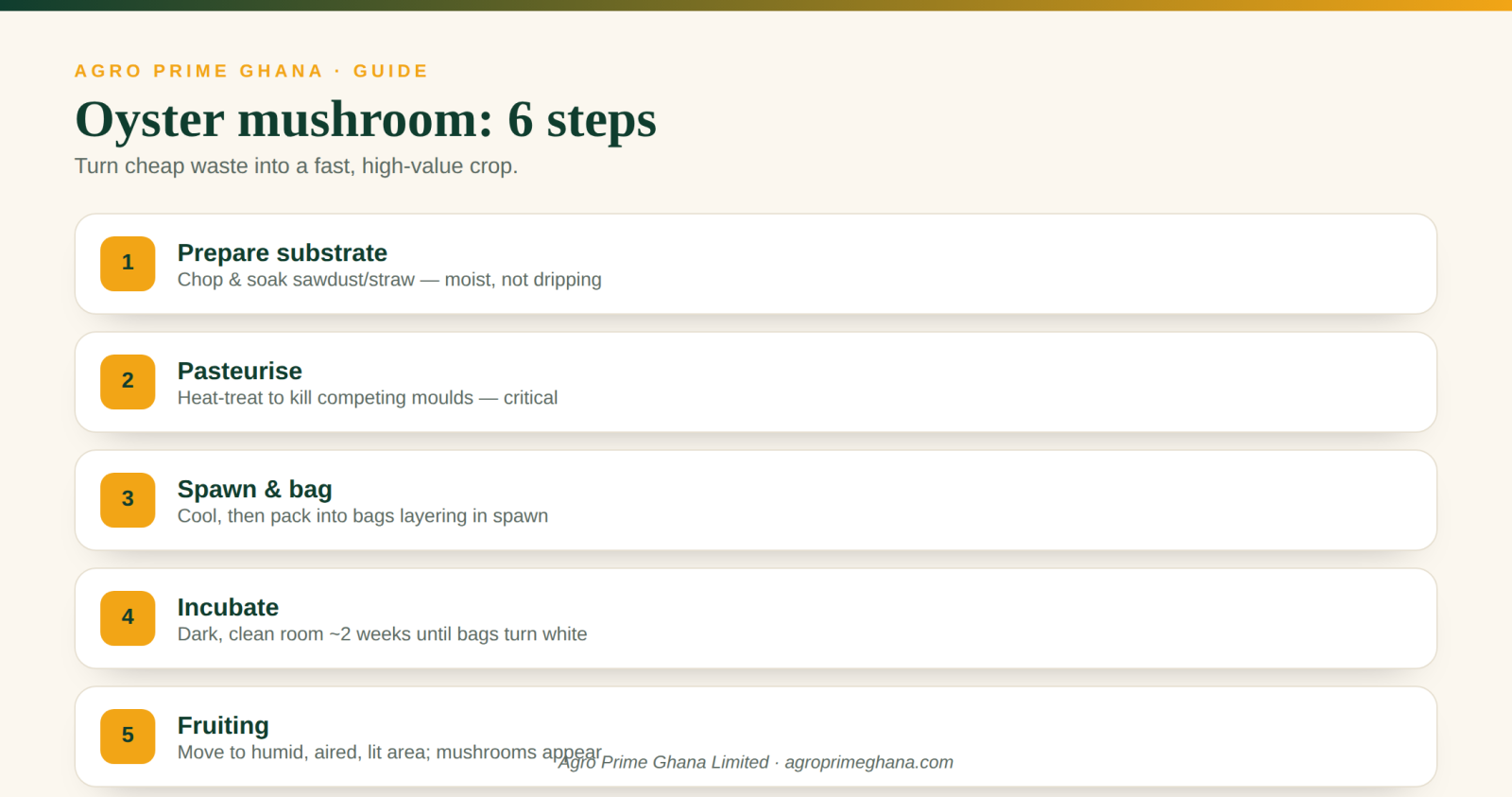
- Prepare the substrate: chop and soak the sawdust or straw so it is moist (damp but not dripping).
- Pasteurise it: heat-treat the wet substrate (for example by hot-water or steam treatment) to kill competing moulds and organisms — this step is critical for success.
- Cool and bag: let the substrate cool, then pack it into bags, layering in the spawn as you fill (spawning).
- Incubate: keep the bags in a dark, clean, warm-ish room for a couple of weeks while the white mushroom mycelium spreads through and colonises the substrate.
- Fruiting: once bags are fully colonised (turned white), move them to the fruiting area, open or slit the bags, and raise humidity and light — tiny mushrooms soon appear and grow rapidly.
- Harvest: pick the mushrooms when the caps are the right size, before they over-mature.
The whole cycle from spawning to first harvest is a matter of weeks, and each bag then gives more mushrooms over subsequent flushes.
Controlling the growing environment
Mushrooms are fussy about their surroundings, and getting the environment right is most of the skill. During incubation they need darkness, cleanliness and a stable, warm-ish temperature to colonise the substrate. During fruiting they need high humidity (regular misting or a humid room), fresh air (some ventilation, since mushrooms breathe and stale air deforms them), moderate indirect light, and protection from heat, which our climate can make the main challenge — a cool, shaded space or the cooler part of the day helps. Keep the room clean and pest-free throughout. Getting humidity, air and temperature right is what turns colonised bags into a heavy, healthy crop; neglecting them gives poor, deformed or failed flushes.
Harvesting and multiple flushes
Harvest oyster mushrooms by picking the whole cluster when the caps have opened to a good size but before they age and drop spores. One of the venture's best features is that a colonised bag does not fruit just once: after the first harvest (flush), the bag rests and then produces a second flush, and often a third, over the following weeks. So each bag yields several harvests before it is spent, and the used substrate afterwards makes good compost or animal-feed supplement. Staggering the setting-up of batches means you can harvest fresh mushrooms continually rather than all at once — important, because fresh mushrooms are perishable and best sold quickly.
The economics and market
Mushrooms combine low costs with fast, repeated returns. Your main inputs are spawn, cheap substrate, bags and the modest cost of a growing space and pasteurising — small and largely renewable per cycle — against a crop that fruits in weeks and gives several flushes per bag. Fresh oyster mushrooms sell at good prices to health-conscious consumers, restaurants, hotels, supermarkets and markets, and demand often exceeds local supply. Because fresh mushrooms are perishable, plan your sales: line up regular buyers, and consider value addition to widen the market and reduce waste (below). Keep simple records of batches, yields and sales so you know your real returns — the same discipline behind good farm record keeping. The fast cycle means capital turns over quickly, which is rare and valuable in farming.
Value addition and reaching more buyers
Fresh mushrooms sell best but perish fast, so value addition both widens your market and cuts losses. Dried oyster mushrooms keep for months, travel well and sell into a broader market; dried and milled mushroom powder is a further step used in soups and seasonings. Cleanly packed fresh mushrooms supplied on a schedule to restaurants, hotels and supermarkets build reliable, higher-value custom. Even simple, hygienic packaging and a WhatsApp presence help you reach health-conscious buyers who actively seek fresh local mushrooms. Building drying or regular-supply arrangements into your plan from the start — rather than rushing to sell every flush fresh — is often what turns a mushroom operation from a hobby into a steady business.
Setting up a simple growing space
You do not need a purpose-built facility to grow mushrooms — just a clean, controllable space, which is part of the appeal. Many Ghanaian growers use a spare room, a shaded shed or a simple structure divided into two functions: a darker, clean area for incubation where spawned bags colonise, and a humid, airier area for fruiting where bags produce mushrooms. Fit the space with shelves or lines to hang or stack the bags so you use the vertical room efficiently and get good airflow around them. The key qualities are cleanliness (to fight contamination), coolness and shade (our heat is the main enemy, so avoid hot tin-roofed rooms in full sun), a way to keep humidity up (regular misting, damp floors, or covering), and some ventilation for fresh air. Keep the space closed to pests and easy to clean between batches. A modest, well-chosen room set up along these lines is enough to run a productive mushroom operation, which is why the venture works for urban and backyard farmers who have space but no land.
Common mistakes to avoid
- Contamination from poor hygiene. The number-one killer of mushroom crops — keep everything clean and pasteurise the substrate properly.
- Weak or old spawn from an unreliable source, which fails to colonise.
- Skipping or under-doing pasteurisation, letting competing moulds take over the bags.
- Wrong environment — too dry, too hot, or no fresh air — giving poor or deformed flushes.
- Letting the room get too hot, the main climate challenge; grow in a cool, shaded space.
- No market plan for a perishable crop, so mushrooms spoil unsold.
Frequently asked questions
Is mushroom farming profitable in Ghana?
Do I need land or a farm to grow mushrooms?
What do mushrooms grow on?
What is mushroom spawn and where do I get it?
How long until I can harvest mushrooms?
Why did my mushroom bags get contaminated?
How many times can one bag produce mushrooms?
How do I sell mushrooms if they spoil quickly?
The bottom line on mushroom farming
Mushroom farming turns cheap waste into a high-value crop in weeks, in a space as small as a spare room — which makes it one of the most accessible ventures in Ghana, open even to those with no land. Oyster mushrooms are the beginner's choice: fast, forgiving of the climate and cheap to grow. Success comes down to a few disciplines above all hygiene and contamination control — good fresh spawn, properly pasteurised substrate, and a clean, cool, humid, well-aired growing space. Get those right and each colonised bag rewards you with several flushes of fresh mushrooms, harvested fast and often. Plan for the crop's perishability by lining up buyers and adding value through drying, keep records, and stagger your batches for continuous harvests. Do that, and mushrooms offer a rare thing in farming: high value, fast turnover and low space — a smart venture for backyard, urban and diversifying farmers alike.
Grow high-value food in small spaces
Agro Prime Ghana Limited runs a hatchery and agribusiness in Kasoa. Mushrooms are a fast, low-space way to diversify farm income. Talk to us about building a resilient, diversified operation: book a visit or message WhatsApp (+233 24 915 1503).