Walk into most small and medium poultry operations in Ghana and the biggest single cost, by a distance, is feed — often two-thirds of everything a farm spends. So when a low-tech, low-cost technique promises better feed conversion, healthier guts and a bit more resistance to the bugs that thrive in our climate, it is worth taking seriously. Fermented feed is exactly that: you take part of the ration, add water and the right microbes, let it sour for a day or two, and feed it out. Done properly it squeezes more performance out of the same ingredients; done carelessly it grows mould, sours the birds' appetite, or wastes feed. This guide explains what fermentation actually does inside the feed and the bird, what the research shows in real numbers, how to ferment feed safely on a Ghanaian farm, and the cautions that separate a useful practice from an expensive mistake.
Written by the Agro Prime Ghana poultry team and reviewed against current poultry-nutrition research (a 2025 review in the journal Animals and peer-reviewed feed-fermentation studies). Last updated September 2026.
Key takeaways
Fermenting feed means letting beneficial microbes — mainly lactic acid bacteria, sometimes yeasts — grow in a wet mix of feed for roughly 24–48 hours, dropping the pH, producing organic acids, pre-digesting nutrients and breaking down anti-nutritional factors. In broiler trials, fermented feed has improved feed conversion by around 7% (a ratio of 1.33 versus 1.43) and lifted day-35 body weight from about 1,858 g to 1,981 g, while raising gut villus height by 16–23% — more surface to absorb nutrients. The low pH and lactic acid also make the gut less friendly to pathogens like Salmonella and E. coli. But the cautions are real: too much acid dents palatability, wet feed can reduce intake in very young chicks, and any hygiene lapse invites mould. Ferment clean, ferment fresh, start small.
What "fermenting" feed actually means
Fermentation is one of the oldest food technologies we have — it turns milk into yoghurt and maize dough into kenkey. The same biology works on animal feed: you mix feed (or part of it) with clean water and let selected microorganisms multiply. As a 2025 review of fermented feed in broilers published in Animals describes it, the dominant workers are lactic acid bacteria (LAB), sometimes alongside yeasts such as Saccharomyces cerevisiae or Bacillus species. As these microbes feed on the starches and sugars, they produce organic acids — chiefly lactic acid — that lower the pH of the mash and generate short-chain fatty acids and other beneficial metabolites.
Three useful things happen at once. The microbes pre-digest part of the feed, breaking complex molecules into simpler ones the bird absorbs more easily, and multiplying into microbial protein themselves. The acidity and microbes together reduce anti-nutritional factors — the natural compounds in raw grains and oilseeds that tie up nutrients. And the feed arrives pre-loaded with beneficial bacteria and acid, acting like a home-grown probiotic-plus-acidifier that helps set up the bird's own gut. The finished product is moist, pleasantly sour-smelling (like yoghurt or ogi, not rotten), and noticeably more acidic than the dry feed you started with.
Why it matters for Ghanaian poultry
Two features of fermentation line up especially well with conditions here. The first is gut health under pressure. Our warm, humid environment favours the very gut pathogens — Salmonella, E. coli, and the clostridia behind necrotic enteritis — that a low-pH, lactic-acid-rich gut suppresses. The Animals review explains that fermented feed increases beneficial lactic acid bacteria while making the gut hostile to pathogens through competitive exclusion and acidity. Where antibiotic growth promoters are increasingly frowned upon and gut upsets quietly drain performance, a practice that stacks the gut in the bird's favour matters.
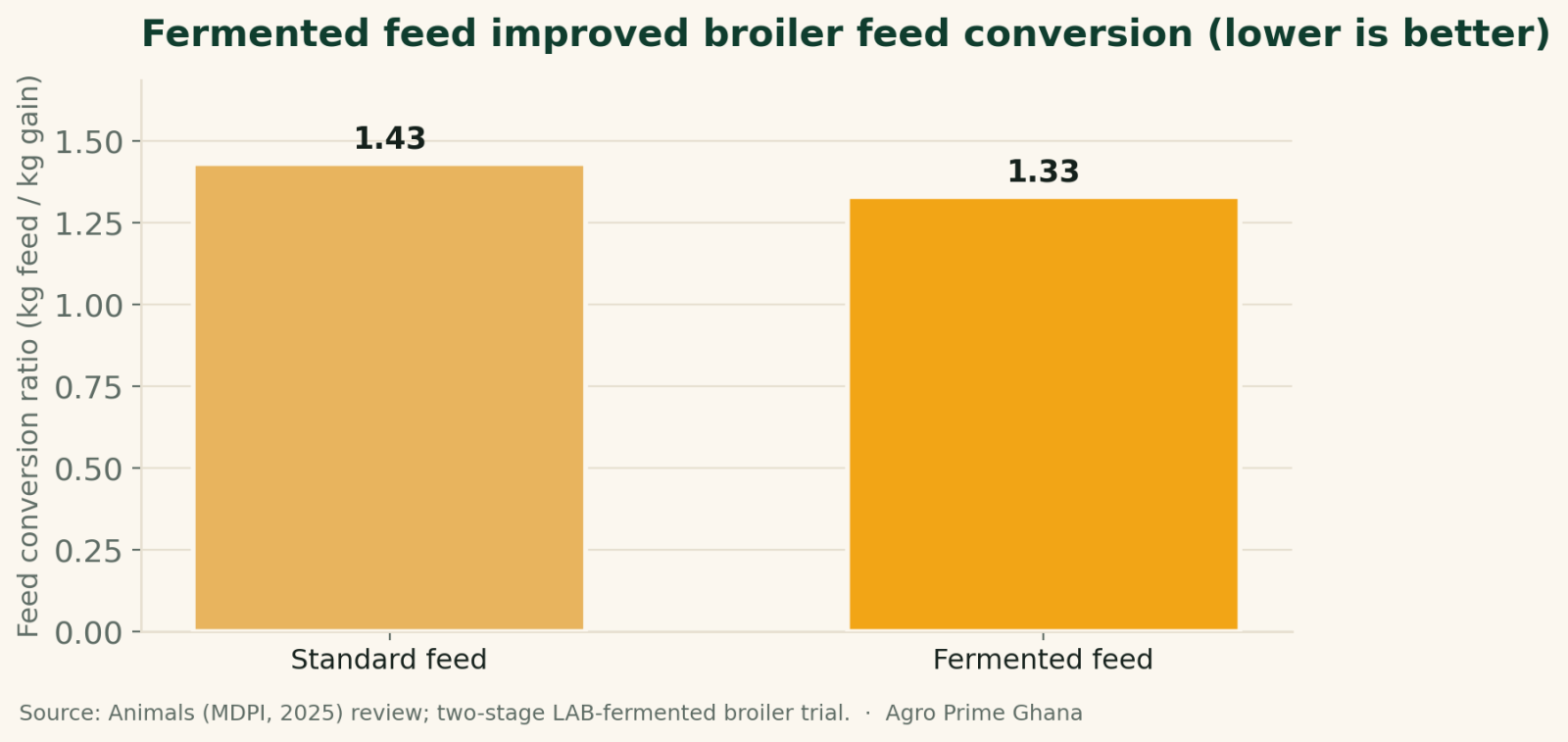
The second is getting more out of modest ingredients. Ghanaian rations lean on maize, wheat bran and locally available protein sources, some carrying anti-nutritional baggage, so fermentation's ability to pre-digest feed and cut those factors means the same bag of ingredients delivers a little more usable nutrition. The research bears this out. In broiler studies summarised by the Animals review, fermented feed improved feed-conversion ratio by around 7% in one two-stage-fermentation trial (1.33 versus 1.43 for the control) and raised day-35 body weight from roughly 1,858 g to 1,981 g; fermented de-oiled rice bran gave feed-conversion ratios of 1.73–1.75 against 1.88 for the control. These are not miracle numbers, but on a farm where feed is two-thirds of costs, a few percent of feed efficiency across every batch is real money.
What the gut gains: absorption and defence
The performance numbers have a physical explanation. A healthy gut lining is carpeted with tiny finger-like projections called villi; the taller and denser they are, the more surface the bird has to absorb nutrients. The Animals review reports that fermented feed increased villus height by about 23% in the mid-jejunum and 16% in the mid-ileum — a meaningful expansion of the bird's absorptive machinery. More surface, better feed conversion. Meanwhile the acid environment and beneficial bacteria crowd out pathogens, so the gut spends less energy fighting infection and more on growth. The table summarises the main documented effects.
| What fermentation does | Documented effect | What it means for your flock |
|---|---|---|
| Lowers feed pH with organic acids | Lactic-acid-rich, low-pH mash | Gut becomes hostile to Salmonella and E. coli; fewer gut upsets |
| Improves feed conversion | ~7% better FCR (e.g. 1.33 vs 1.43) | Same growth on less feed — direct saving on your biggest cost |
| Increases body weight | ~1,981 g vs 1,858 g at day 35 | Broilers finish a little heavier on the same ingredients |
| Grows intestinal villi | Villus height up 16–23% | More gut surface to absorb nutrients from feed |
| Pre-digests feed, cuts anti-nutrients | More available protein and nutrients | Gets more usable nutrition from modest local ingredients |
| Seeds beneficial bacteria | Higher lactic acid bacteria in the gut | Acts like a home-grown probiotic and acidifier |
How to ferment feed on a Ghanaian farm
The method is simple, cheap and uses equipment any farm already has, but the details decide whether you get yoghurt or rot. The basic wet (liquid) fermentation approach works like this:
- Choose what to ferment. Ferment the whole ration or, more safely for beginners, a portion — commonly the grain and energy fraction. Research has used dried fermented feed at 10–25% of the diet and fermented ingredients such as rapeseed meal replacing up to half the soybean meal, so you need not ferment everything to benefit.
- Mix with clean water. Add clean, non-chlorinated water until the feed is well moistened — a soupy-to-porridge consistency. Chlorinated tap water can knock back the very microbes you want, so borehole or settled water is often better.
- Get the right microbes going. You can rely on the wild lactic acid bacteria already present, but fermentation is faster and safer if you "seed" it — a splash of an existing good ferment (backslopping) or a food-grade probiotic culture gives the good bacteria a head start over spoilage organisms.
- Cover and let it work. Cover loosely (it needs to release gas but stay protected from flies, dust and rain) and keep it shaded. Much of the research ferments around 37°C for about 24 hours; on-farm, ambient Ghanaian warmth gives a usable ferment within 24–48 hours. Stir once or twice a day.
- Judge it by smell and look. A good ferment smells pleasantly sour — like yoghurt, ogi or kenkey dough — and may bubble slightly. It should never smell putrid, solvent-like or show fuzzy mould. If it does, discard it.
- Feed fresh. Feed the mash out promptly rather than letting it sit for days, make only what the flock will clean up, and keep feeders clean, because leftover wet feed spoils fast in the heat.
If you already mix your own feed, fermentation slots into that workflow — our guide to making poultry feed in Ghana covers the base ration you would then ferment a portion of.
Field note: treat it like making kenkey, not like leaving feed to spoil
The mental model that keeps people out of trouble is familiar: you are making something like ogi or kenkey dough, not letting feed go off. That means clean containers, clean water, a proper sour smell you would recognise from the kitchen, and a fixed rhythm — mix today, feed tomorrow or the next day, never hold it for a week. We keep the vessel out of the sun, stir daily, and trust our noses: a sharp, clean sourness is good; anything musty, fuzzy or foul goes straight out. The moment fermenting feed becomes "that bucket in the corner we forgot about," it stops being an asset and becomes a mould risk.
The cautions that actually matter
Fermented feed is genuinely useful, but it is not free of trade-offs, and pretending otherwise is how farms lose money. Take these seriously:
- Too much acid hurts intake. The point of fermentation is acidity, but past a point it backfires: the research notes very high organic-acid concentrations — above roughly 286 mmol/L in one study — can reduce palatability so birds eat less. Feed it at a moderate sourness, not maximum sourness.
- Wet feed can set young chicks back. This is the big one for brooding. The Animals review reports that in the early starter phase, wet feed in some trials reduced feed intake by around 40% and weight gain by around 44% versus dry feed — a serious hit at the age when steady intake matters most. Be cautious with fermented wet feed in the first days of life; many farms introduce it later and lean on dry crumbs for the youngest chicks.
- Moisture invites mould and leaching. High-moisture feed spoils quickly in heat, and mould can mean mycotoxins. Nutrients also leach out of overly wet, long-standing feed. Make small batches, feed them fresh, and never feed a batch that has grown mould.
- Consistency is harder than it looks. Wild fermentation varies with temperature, ingredients and hygiene, so results are less predictable than a bagged feed. Seeding with a known culture and a steady routine helps, but expect a few batches learning what "good" looks and smells like on your farm.
- Logistics and labour. Mixing, wetting, fermenting, stirring and feeding wet mash is more work than scooping dry feed, and wet feeders need cleaning. Trivial on a small flock; at scale, plan the labour honestly.
Field note: start on a pen, not the whole farm
Whenever a farm wants to try fermented feed, the advice is the same: pick one pen or batch, ferment a portion of the ration, and compare it honestly against your normal feed over a full growing period — weigh birds, watch droppings, track how much feed disappears. Do not convert the whole operation on the strength of an article. The only way to know whether it pays on your ingredients, in your climate, with your labour, is to run it small first and let the birds tell you.
Where fermented feed fits, and where it does not
Fermentation is best thought of as a way to get more out of a decent ration and shore up gut health — not a rescue for poor ingredients. It will not turn mouldy maize into safe feed (the opposite: wet conditions can make mould worse), and it does not replace getting the fundamentals right: correct protein and energy levels, adequate calcium for layers, clean water. It shines for growing birds and layers past the fragile early-chick stage, where gains in feed conversion, gut health and disease resistance stack up over weeks. For the youngest chicks, favour dry feed. And it works only inside a disciplined hygiene routine — the same discipline that underlies all good poultry keeping, from litter management to feed storage.
The bottom line on fermented feed
Used well, fermented feed can nudge feed conversion up several percentage points, grow more absorptive gut, seed beneficial bacteria and make the gut less welcoming to the pathogens our climate encourages — all from the same ingredients you already buy, using nothing fancier than clean containers, clean water and a day or two of patience. The research supports meaningful gains: around 7% better feed conversion, heavier finishing weights, taller gut villi. But it is a practice, not a product, and it punishes carelessness — over-souring dents appetite, wet feed can set back the youngest chicks, and any hygiene lapse invites mould. Ferment it like kenkey, feed it fresh, be cautious with day-old chicks, and prove it on one pen before you scale. Get that discipline right and fermented feed becomes a genuine edge on your biggest single cost.
Frequently asked questions
What is fermented feed for poultry?
What are the benefits of fermenting poultry feed?
How do I ferment feed at home in Ghana?
How long should feed ferment?
Can fermented feed replace all of my normal feed?
Is fermented feed safe for baby chicks?
How do I know if my fermented feed has gone bad?
Does fermented feed reduce the need for antibiotics?
Sources & further reading
- Animals (MDPI), 2025 — Effect of Fermented Feed on Growth Performance and Gut Health of Broilers: A Review (feed-conversion and body-weight gains, villus height, gut pH and pathogens, palatability and wet-feed cautions).
- Peer-reviewed feed-fermentation research including Recent advances in fermented feeds towards improved broiler chicken performance (Animal Nutrition) on fermentation microbiology and gut effects.
- Agro Prime Ghana guides: how to make poultry feed and poultry litter management.
About Agro Prime Ghana
Agro Prime Ghana Limited runs a poultry hatchery and mixed agribusiness in Kasoa, supplying day-old chicks and supporting poultry keepers nationwide. These guides combine hands-on hatchery and farm experience with current poultry-nutrition research. This article is general educational information, not a substitute for advice from a qualified poultry nutritionist or veterinary officer tailored to your flock, ingredients and conditions. Need chicks, feed advice or farm support? Book a visit or message us on WhatsApp (+233 24 915 1503).