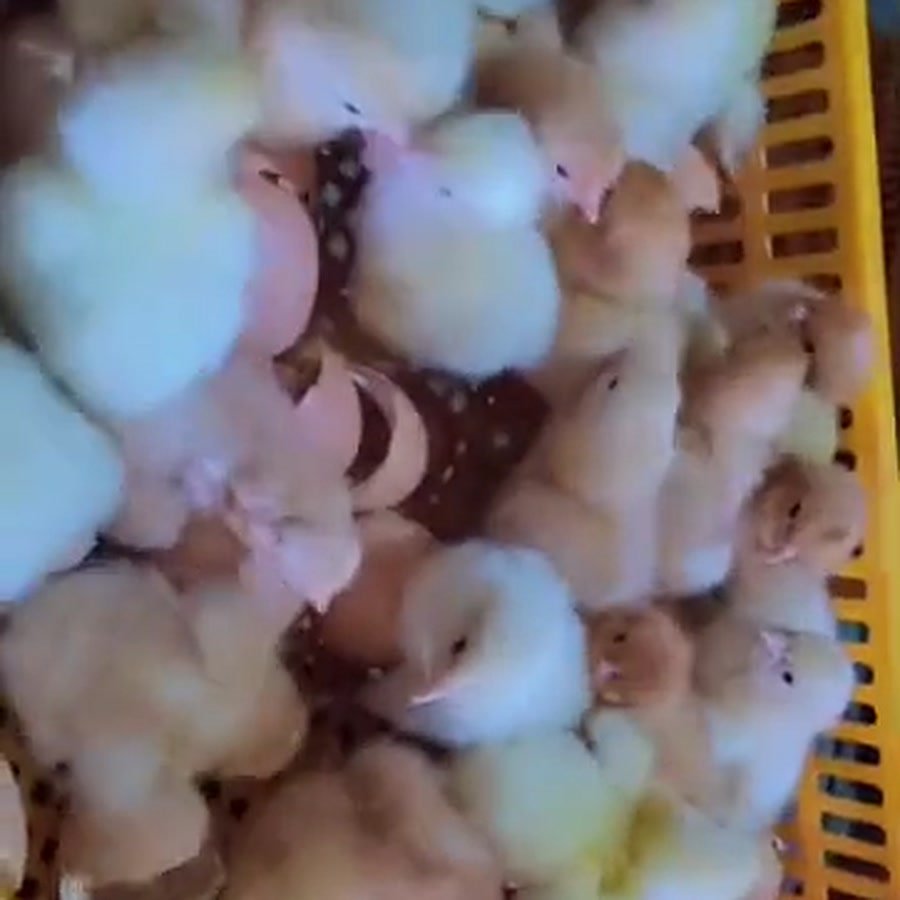
The first question most people ask about a broiler batch is what it will pay. It is a fair question, and it is the wrong place to start. A single batch is one sum with a start date and an end date. A house is a rhythm. Whether it makes money over a year depends less on any one cycle and more on what happens to the cash that comes back after each one.
One batch is a sum, a house is a rhythm
From placement to payout, a broiler batch takes about eight weeks once clean-out is counted. Chicks arrive, the birds grow for six to seven weeks to around 2.3 to 2.55 kg live, they are sold, and the house is cleaned and rested before the next placement. A well-run house can fit five or six batches in a year.
That rhythm is the asset. The house has a fixed capacity, so an extra cedi of profit has to earn its place by doing something useful: a better brooding set-up, cleaner litter management, a vaccination schedule kept to the day, or simply the next batch going in on time. Compounding in poultry is a question of timing and discipline far more than of size.

Two parts of that rhythm are easy to shrink and expensive to shrink. The first is the clean-out and rest. Litter that is not fully removed, or a house reopened too soon, carries problems into the next placement, and the next batch pays for them. The second is vaccination. Agro Prime chicks are vaccinated at day old against Marek's disease, and depending on the batch they often receive Newcastle and Gumboro protection too. Your job is to keep the schedule that batch needs, not to improvise one.
What compounding means on a farm
In finance, compounding means earnings start earning. On a farm it is more down to earth. Profit from one batch pays for the next batch's chicks, feed and brooding, so the cycle carries on without new borrowing. The chick price itself moves over time, and our 2026 guide to day-old chick prices in Ghana sets out the detail. The sooner the money is back in a placement, the sooner the house is full again. Each cycle that closes on time gives you another chance to add to the total.
There is a second kind of compounding that people overlook, and it lives in the notebook. A farmer who has run three batches knows how the birds grew, how the feed came in, when mortality rose and what the sale week looked like. Those records make the fourth batch easier to plan than the first, and planning is where a lot of avoidable losses get caught.
If you hold a share in a partnered batch, you decide whether to roll your share into the next placement. That is a choice you make for each batch, with that batch's agreement in front of you. Nothing about a good result obliges you to reinvest, and nothing about a poor one should push you into it.
The numbers, batch by batch
For a 1,000-bird batch, net profit in a normal cycle runs at roughly GH₵12 to GH₵20 per bird sold. That is GH₵12,000 to GH₵20,000 for the batch. The table shows how that adds up across a year if the same house runs one, three or six batches, and every one of them lands in the normal range.
| Batches in a year | Profit at GH₵12 per bird | Profit at GH₵20 per bird |
|---|---|---|
| 1 batch | GH₵12,000 | GH₵20,000 |
| 3 batches | GH₵36,000 | GH₵60,000 |
| 6 batches | GH₵72,000 | GH₵120,000 |
These are illustrative sums built from the normal range, assuming 1,000 birds per batch. They are not a forecast for your house, and they leave out the bad cycles that any farm can meet.
Notice what the table is quietly assuming. It assumes the house is full every time, that feed stays where you budgeted it, and that the market holds its price across the year. Compounding works on that kind of run. It is also the run that rarely arrives in a straight line, which is why the next two sections matter as much as the table.
There is also a cash timing point hidden in that table. Money goes out at placement and comes back about eight weeks later, so a house running six batches asks your cash to leave and return six times a year. Each cycle needs its full cost available on the day the chicks arrive, not on the day the birds are sold. Count how many times your money has to leave the house in a year, and you will see why a reserve matters more than a bigger batch.
A hypothetical second cycle
This is a hypothetical example, not a real customer. Suppose a first batch nets GH₵15,000 at GH₵15 a bird. Before anything is rolled forward, GH₵5,000 goes into a feed reserve, which covers about 12 bags at GH₵400 each. The remaining GH₵10,000 goes toward the running costs of the next placement, and the rest of that batch is financed on the same terms as before.
Run the same sum the next cycle and the reserve, not optimism, should set the pace. If the second batch comes in lighter, the reserve is what keeps the house fed while you work out why. Farms that try to reinvest every cedi tend to find out the hard way that a rolling budget has no slack in it.
Time is part of the cost
Running one batch is a job. Running five or six in a year is closer to a calendar. Each cycle needs feed deliveries booked, vaccines checked, the house cleaned and rested, and the weekly record kept. Daily checks are usually the first thing to slip when a farm adds batches faster than it adds attention. If the time is not there, a bigger house will not fix the gap.
The part people miss: the calendar
Sale prices do not sit still across the year. In quiet months a live bird typically sells for around GH₵75 to GH₵80. At Christmas, Easter and Eid, prices rise above GH₵100. On 1,000 birds, the gap between GH₵75 and GH₵100 is at least GH₵25,000 in sales, and that gap alone can outweigh the normal profit on the batch.
That is why we think about compounding by the calendar and not only by the cycle. The same 1,000 birds can produce very different results depending on whether they finish in a festive window or in a flat month. Our guide to the Christmas broiler market in Ghana explains how the peaks build up, and it is worth reading before you pick a placement date.
Demand usually builds in the days before a festival, so a batch that is ready in that window catches the rise rather than chasing it. That is one more reason to count back from the festival rather than forward from the chicks.
Hatching runs on a fixed rhythm too.
Agro Prime hatches every Thursday at 7am in Kasoa, so a placement date can be planned backwards from the sale window you want. Working backwards from a festive sale is a better habit than working forwards from whatever chicks happen to be available that week.The harmattan months, roughly December to February, bring dry dust and cooler nights. Ventilation and heat in the house need closer watching in those weeks. A batch that runs through them needs more attention to brooding, and that is one more cost to carry in the monthly budget rather than discover at the end.
Plan the next placement on paper first
Before you commit to a second or third batch, run your own figures through the calculator on our partner page. It is the quickest way to see how one cycle changes when your feed price, sale price or mortality assumption changes. Use the partner calculator for that, and if you want to see a house before you decide, visits run from 7am to 6pm, Monday to Saturday.
Where compounding breaks
Mortality is the first place it breaks. Well-managed flocks land between 3 and 5 per cent. Poor management or disease can push losses to 10 to 20 per cent. At 20 per cent, the profit from a cycle can be wiped out. On 1,000 birds, that is 200 birds gone, and their chicks, feed and brooding were paid for before anyone knew they would not reach market.

Weight is the early warning that many farms read too late. A flock that falls behind its growth curve in the middle weeks has often been off on feed, water or brooding for some time before the final weigh-in shows it. If you read the weekly weights as a trend rather than a single number, you are more likely to fix the cause while the birds are still young enough to catch up.
Feed is the second place.
A 50 kg bag of broiler starter runs at GH₵400 to GH₵410 at GAPFA member prices, and at GH₵451 to GH₵472 at the De Heus list price. A 1,000-bird batch needs 84 bags. Across those bags, the span between the two price ranges comes to more than GH₵6,000. A batch that buys feed in a dear month and sells in a cheap one carries that difference, and money rolled into the next batch inherits the same risk.One bad cycle does not average out
Mortality, feed prices and sale timing do not cancel each other across a year. A single batch at 20 per cent mortality can wipe out the profit from a good batch that came before it. Only reinvest what you could afford to lose on one cycle, and keep a cash reserve for feed before you commit to the next placement.
The discipline that keeps compounding alive is dull. Keep a feed reserve. Do not place birds you cannot finance all the way to market. Read the latest report before deciding the next placement. None of that is exciting, which is rather the point.
Keeping the record that makes the next batch better
Weekly reports are where compounding gets its information. Every Thursday, a partnered batch gets a photo, a weight, the feed used and the mortality figure. Read them as a sequence rather than as separate snapshots. A weight that falls behind in week four tells you something about feed or brooding that a final sale price never will. Keep the same kind of record for your own batches, even if you are not partnering.
Set a simple rule before the batch starts. Decide in advance which mortality level or weight gap would make you pause the next placement, and write it down. A rule made in a calm week is far easier to keep than a decision made in the middle of a bad one.
Every payment for an Agro Prime batch goes to the Agro Prime Ghana Limited company account, and capital and profit payouts follow the written agreement for that batch. If anyone asks you to pay somewhere else to secure a faster place in the next placement, stop and check with the farm before you send a single cedi.
Building slowly, on purpose
None of this means holding back from growth. It means growing in steps you can measure. A house that has run two clean cycles with records behind them is a better base for a third than one that jumped to six batches on the strength of a good sale. Each completed batch is a small piece of evidence, and evidence is what makes the next decision cheaper.
Compounding in a poultry house is less about one good batch and more about the next one going in on time. Keep each cycle small enough to survive a bad month, measure every batch against the same notes, and let the calendar decide when you buy and when you sell. Patience helps, but only when it sits inside what your cash can carry.
Plan a batch on the partner page
If you are still checking whether the numbers hold at all, our guide on whether broiler farming is profitable in Ghana walks through the costs line by line.

