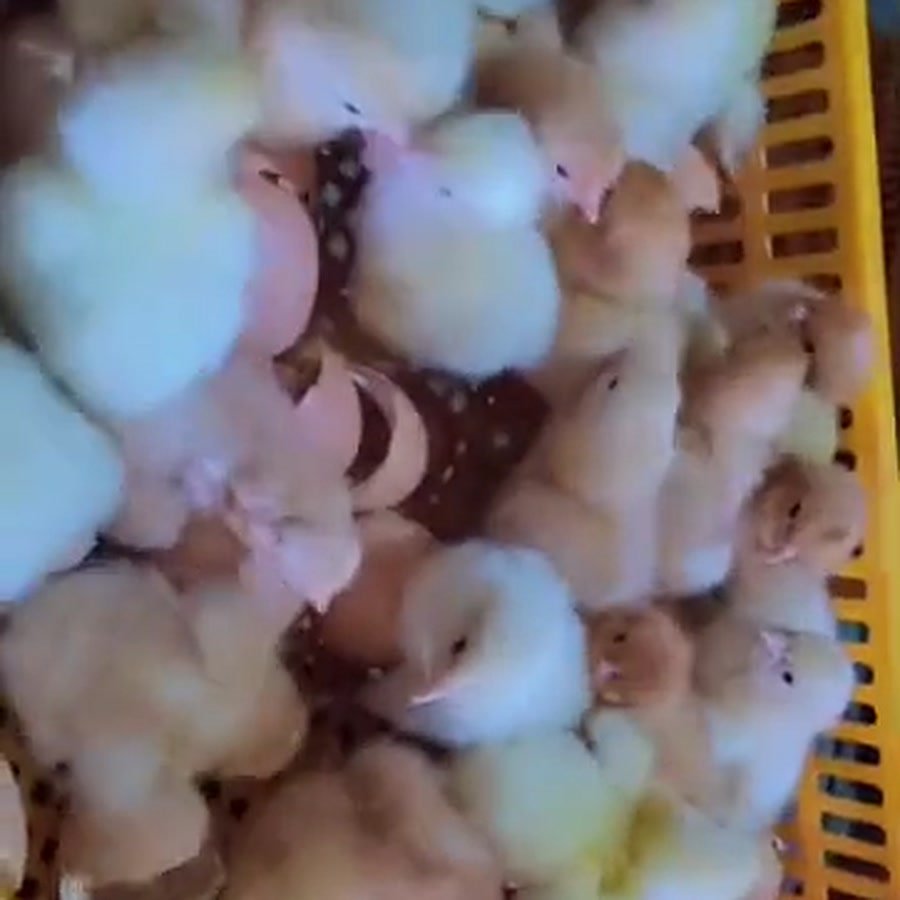
GH₵20. That is what one day-old broiler chick costs at our hatchery in Kasoa, and it is the smallest number on the batch budget. The chick is the easy part to price. What a careful investor should really want to know is whether the person asking for their money can show how every other line is spent.
A trustworthy farm is not the one with the best photographs on its website. It is the one that will let you check its costs, its hatch record, its mortality history and its paperwork before any money moves. This guide sets out what to look for, in an order that makes sense, and what a straight answer usually sounds like.
Start with the cost line by line
A batch of 1,000 birds, from chick to market, sits roughly between GH₵65,000 and GH₵80,000 in capital. A credible operator should be able to say where each part of that goes. Feed is the largest line. A bird eats around 4.2 kg from day one to market, and a 50 kg bag of broiler starter costs GH₵400 to GH₵410 at GAPFA member prices, or GH₵451 to GH₵472 on De Heus's published list. Feed is more than half of the total, so the feed figure is where a quote can hide the most.
The rest, roughly GH₵12 a bird, goes on brooding heat, litter, vaccines and vitamins, labour and utilities. If someone quotes a batch with a feed figure well below those bands and no explanation, that is your first question, not your last. Ask which price they used, whether it is member or list, and whether a rise in the middle of the batch is shared or absorbed. Our day-old chick price is set out in the 2026 chick price guide, so you can check the first line of any quote before looking at anything else.

Ask for the hatch record, not the brochure
Anyone can print a hatch rate on a leaflet. A trustworthy hatchery can show a record of eggs set and chicks hatched, batch after batch. Our average hatch rate is 98%, and we would expect any hatchery you consider to answer the same question with a figure and a record behind it, not a general reassurance.
In plain terms, a 98% average hatch rate means that out of every 100 eggs set, about 98 should hatch, averaged across the hatch. Averages hide weeks, so ask what a weaker week looked like, what caused it and how the farm reported it to its partners at the time.
Timing says something too. Our hatchery produces chicks every Thursday at 7:00 in the morning, which means a Thursday visit shows the operation as it runs rather than a tidied version of it. Farm visits are open Monday to Saturday, from 7am to 6pm. For the wider picture of what a hatchery does in Ghana, the hatchery page describes the setup.

Walk the feed store, then ask who runs the house
The farm store matters because feed is the largest line in the budget, and the store is where that line is physically handled. Look at how the bags are stacked, whether they sit off the floor, and whether the batch labels and dates are readable. Ask how stock is rotated, and whether the feed for your batch would come from the same supplier you can see on the shelf.
Then ask who runs the house day to day. A batch is looked after by people, not by a brochure. You should know who is responsible for the birds on a Saturday, who records the mortality count and who you contact when something looks wrong. A farm that can name those roles, and show you the sheet where they are written down, is one you can hold to account.
Read the table as a checklist
The table below turns the checks in this guide into a single list. The middle column is the kind of answer that should reassure you, and the right-hand column is the kind that should slow you down.
| Check | A straight answer sounds like | Slow down if you hear |
|---|---|---|
| Feed price | The price per 50 kg bag, and whether it is member or list pricing | "Feed is covered" with no figure attached |
| Hatch record | Eggs set and chicks hatched, shown batch by batch | One hatch rate quoted with no record behind it |
| Mortality history | A range from past batches, and the causes of the high ones | "We do not lose birds" |
| Vaccination | Marek's at day old, and a Newcastle and Gumboro plan set by batch | Vague talk of "medicines" with no schedule |
| Written terms | A profit-share agreement, capital first, signed before placement | Verbal terms, or payment to a personal account |
| Weekly reports | Photos, weights, feed and mortality every Thursday | Updates that arrive only when you ask |
| Returns | An explanation of the profit range and what drives it | Any fixed or guaranteed monthly figure |
Mortality and vaccination tell you more than the pitch
A farm's loss record says more about its management than any sales conversation. A well-managed house runs at 3 to 5% mortality. Poor management or disease can take that to 10 to 20%, and at the top of that range the loss can erase the profit for the whole cycle. You are not looking for an operator who promises a low number. You are looking for one who will explain a high number honestly when it happens.
Vaccination is the other clue. Chicks are vaccinated at day old against Marek's disease, and the later cover for Newcastle and Gumboro is set batch by batch. Ask why the schedule looks the way it does and who signs it off. Someone who can answer that without reaching for a brochure usually keeps the schedule in the batch file, not only in their head.
It is also fair to ask how a past batch was reported, including the weeks when the numbers were not good. The format of those reports tells you what the next batch will look like. A farm that shows a clean record but cannot explain its worst week has told you something useful too.
Run a real batch before you commit
Open the calculator on the partner page and set the batch to 1,000 birds. Then move the mortality and the sale price one step at a time, so you can see which assumption carries the most weight. If the farm's figures and yours disagree, that is a conversation worth having in writing, and the batch partnership page is the place to start it.
Read the paperwork as carefully as the birds
A sound farm puts its terms in writing before a single chick is placed. Our model is a profit-share agreement signed before placement. Capital comes back first, and the profit is then split as the agreement says. Reports arrive every Thursday with a photo, a weight sample, the feed used and the mortality count. Payout goes by bank or MoMo, days after the final sale.
Check who you are paying before any money moves. Payments go only to the Agro Prime Ghana Limited company account. A request to send money to a personal number, however friendly the person sounds, is a reason to stop. For diaspora investors, the farm offers a live video walk-through and handles international transfers, so a reasonable operator should be glad to show you the house while a batch is running.
Pay equal attention to what happens when things go quiet. If a report is late, a partner should be able to point to the clause that says when it is due and who sends it. If a payout is delayed, the agreement should say how many days the farm has after the final sale and by which method the money moves. Vague timing is a common source of frustration in shared batches, and it is the easiest thing to fix before you sign.
Walk away from a promised number
If an offer is built around a fixed return, a guaranteed monthly figure or a promise that your money is safe whatever the birds do, do not sign. A profit-share batch depends on real birds, real feed and real sale prices, and no honest operator can promise a fixed outcome. Ghana's SEC warns the public against fixed-return schemes. A farm that tells you plainly that returns vary is giving you the most useful signal you will get.
Check the market story as hard as the farm
Ghana's broiler market is large. Demand sits near 400,000 tonnes of broiler meat a year, local production is around 58,000 tonnes, and imports run above 180,000 tonnes, according to MoFA and USDA figures. That gap is real, but a big market does not make any single farm trustworthy. A pitch that leans only on market size, and says nothing about the farm itself, is answering a different question from the one you are asking.
Test the price story too. Quiet months sit around GH₵75 to GH₵80 per live bird, while Christmas, Easter and Eid can push the price past GH₵100. Break-even in a typical batch falls around GH₵70 to GH₵81 a bird. A good operator will show you the quiet price, the peak price and where break-even sits, rather than quoting the best month and hoping you do not ask.
Ask what would have to happen for a batch to lose money. A good answer names the mortality level, the sale price and the feed cost that would push the result below break-even, and it does not pretend that none of those can happen. A farm that can walk you through its own downside is easier to trust than one that only describes the upside.
Ask how the farm plans its sale dates around the peaks. A batch placed to finish before a festive window is a different decision from one that happens to land in a quiet month, and a good operator will tell you which of the two you are being offered and why.
Test the answers in writing
A trustworthy farm answers questions in writing without fuss. Send yours to support@agroprimeghana.com, or to the partnership WhatsApp on +49 151 68495881 in English or German, and keep the replies. Clear figures, dates and a named person responsible are a good sign. Vague answers, numbers that change between messages and pressure to decide by the end of the day are not.
Whenever you can, put the same questions to two sources. Ask a second hatchery or farm for its chick price and its feed assumption, and compare the answers line by line. Our day-old Cobb 500 and Ross 308 chicks start from GH₵20, so a quote that starts far from that figure is worth questioning before you go any further.
Payment deserves the same care. Whether you use MTN MoMo, Telecel Cash, AirtelTigo, bank transfer or cash at the store, confirm the account name reads Agro Prime Ghana Limited before any money moves, and keep the receipt. Every serious partner should be able to run that check without feeling awkward about it.
The short version before you sign
Choosing a farm to back comes down to a handful of honest checks. Look at the cost line by line, ask for the hatch and mortality record, insist on written terms, pay only into the company account and read the reports as they arrive. None of this needs a technical background. It needs patience, a notebook and the willingness to ask the same question twice.
If a farm passes those checks, the next step is the numbers. Read the batch terms, run your own scenarios in the calculator, and make the decision with the figures in front of you.
Trust usually grows in steps. The partnership starts at 500 birds, with 1,000 recommended, so a first batch can be sized to what you are comfortable with rather than to the biggest figure on the page. Start where the paperwork feels clear, and let the reports tell you whether a second batch makes sense.
Compare the batch terms and calculator
Whether broiler farming is profitable in Ghana, with the costs spelled out


