A day-old chick quality guarantee is a hatchery's promise that the chicks it sells you meet a defined standard of health and vitality — bright, active, dry and evenly-sized birds with clean, healed navels and the vaccinations the hatchery says it gave — and its commitment to make good if a batch clearly falls short. It is not a promise that every chick will survive to market, because that depends heavily on how you brood, feed and protect them; it is a promise about the quality of the bird at the point it leaves the hatchery. In Ghana, where a weak start quietly costs farmers growth, uniformity and birds, understanding what a real quality guarantee covers — and how to judge chick quality yourself — is one of the most valuable skills a poultry keeper can have. This guide explains what quality means at day old, the objective signs professionals use, what a good hatchery stands behind, and the questions to ask before you buy.
Written by the Agro Prime Ghana hatchery team and reviewed against current industry references (Royal Pas Reform chick-quality methods and Merck/MSD Veterinary Manual). Last updated September 2026.
Key takeaways
A quality guarantee covers the condition of the chick at dispatch: healthy, vital chicks meeting a defined standard, with clear information on breed, sex and vaccinations. Professionals score chick quality objectively — the Pasgar score checks reflex, navel, legs (hocks), beak and belly, with a perfect chick scoring 10 and a good batch averaging at least 9.0. A quality chick is alert and active, rights itself within about 3 seconds when placed on its back, has a clean, closed, dry navel, firm legs, a supple belly, bright eyes and dry fluffy down, and is uniform in size with the rest of the batch. Good hatcheries control what drives quality — breeder flock, egg storage, incubation and hygiene — and vaccinate against diseases like Marek's at the hatchery. A guarantee cannot cover your brooding; ask each hatchery exactly what theirs covers before you buy.
What a chick quality guarantee actually covers
A quality guarantee is a statement about the bird at the moment it leaves the hatchery, backed by a commitment to put right a genuine failure of that standard. Concretely, a meaningful guarantee tends to cover a few things: that the chicks are healthy and vital to a defined standard rather than culls or leftovers; that they are the breed and sex you ordered, accurately counted; that the vaccinations the hatchery states were given were actually administered; and that, if a batch clearly does not meet the standard on arrival, the hatchery will make it right — commonly by replacing failed chicks, adjusting the order, or another agreed remedy. What terms apply, and how a claim is handled, vary from hatchery to hatchery, which is exactly why you should ask before you buy rather than assume.
Just as important is what a guarantee cannot honestly cover. No hatchery can promise that every chick reaches market, because survival and performance after dispatch depend overwhelmingly on the buyer: brooder temperature, clean water, feed quality, biosecurity and disease control. A chick can be first-class at day old and still be lost to a cold brooder or a Newcastle outbreak. So a serious guarantee is precise: it stands firmly behind the quality of the chick and the accuracy of the order, and it is honest that outcomes afterwards are shared responsibility. Be wary of any promise that sounds like "guaranteed survival" with no conditions — that is marketing, not a real guarantee.
How professionals measure chick quality objectively
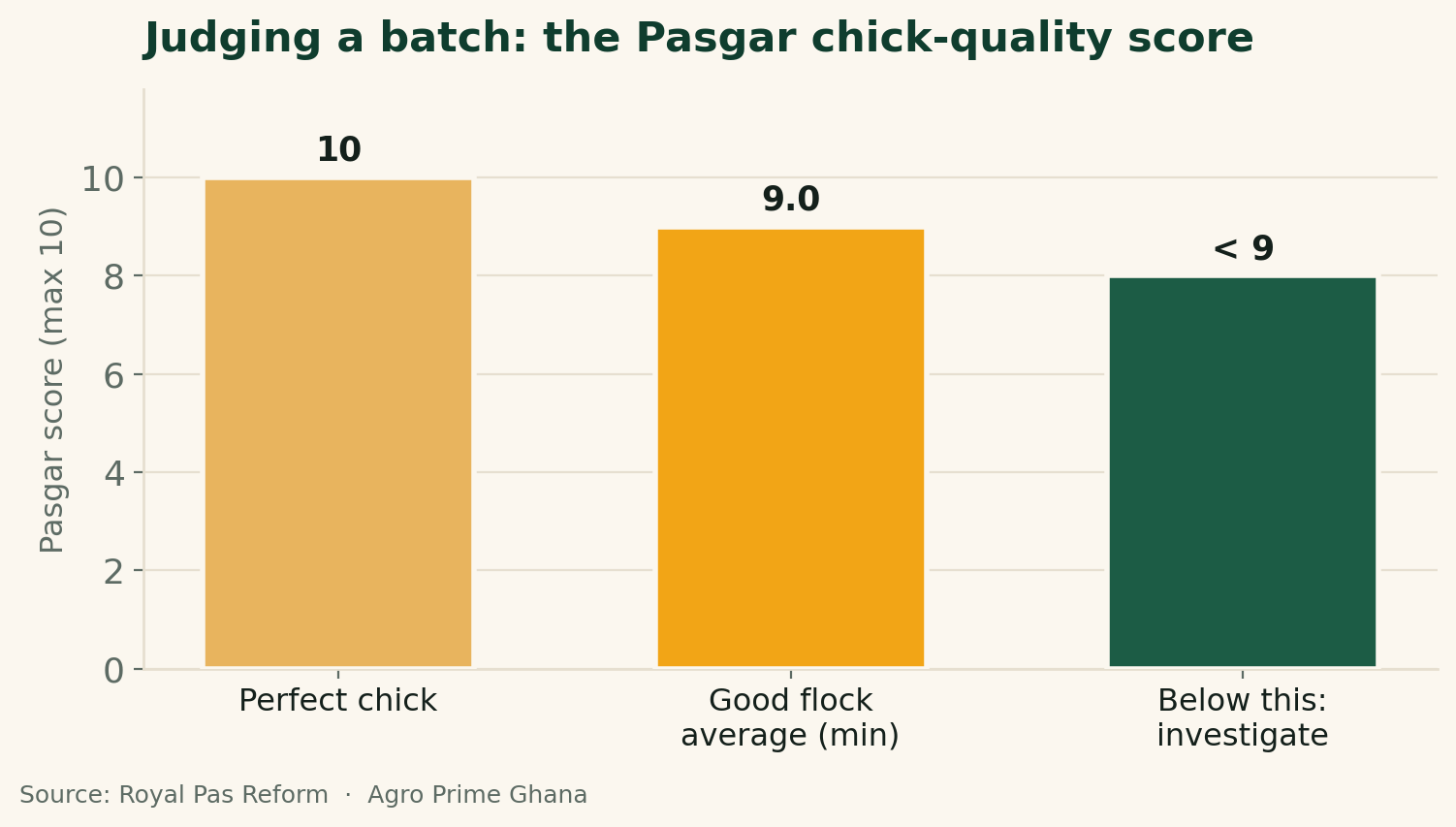
Chick quality is not a matter of opinion — hatcheries measure it with defined scoring systems, and the best known is the Pasgar score from Royal Pas Reform. It assesses each chick on five points, starting from a perfect score of 10 and deducting one point for each defect found. The five checks are: reflex — placed on its back, a good chick turns over and stands within about three seconds; navel — it should be clean, closed and dry, with no black scab or string of tissue; hocks (legs) — no red, irritated patch; beak — no dried blood in the nostrils, red spot or dried albumen; and belly — supple to the touch, not tight and hard (a tight belly means the residual yolk sac is too large and unabsorbed). A perfect chick scores 10, and a good batch should average at least 9.0, preferably higher, according to Pas Reform. These are the same objective checks you can learn to do on a sample of your own delivery.
The signs of a quality day-old chick
You do not need laboratory equipment to judge chick quality — you need to know what to look for, and to check a fair sample of the batch rather than one or two birds. The table below summarises the practical signs, drawn from the Pasgar checks and standard hatchery guidance, so you can assess a delivery yourself.
| What to check | Quality chick | Warning sign |
|---|---|---|
| Activity / reflex | Alert, active, chirping; rights itself in ~3 seconds | Sleepy, weak, slow to stand, lethargic |
| Navel | Clean, closed, dry, healed | Open, wet, black scab, string of tissue ("navel ill") |
| Eyes & down | Bright eyes; dry, fluffy, well-coloured down | Dull or swollen eyes; wet, sticky or matted down |
| Legs & stance | Firm legs, stands and walks steadily; no red hocks | Splayed/crooked legs, red hocks, can't stand |
| Belly | Soft, supple abdomen | Tight, hard, distended belly (poorly absorbed yolk) |
| Uniformity | Even size across the batch | Very mixed sizes; runts among the batch |
Two of these deserve special weight. The navel is a window into incubation quality and a real disease risk: an unhealed, wet or scabbed navel is the classic route for the infection known as omphalitis or navel ill, which kills chicks in the first days. And uniformity matters as much as any single bird — a batch of evenly-sized, evenly-active chicks reflects a well-run hatchery and grows into an even, manageable flock, whereas a batch of very mixed sizes signals problems upstream. For a fuller walkthrough, see our guide to choosing healthy day-old chicks.
What a good hatchery controls to deliver quality
Quality at day old is earned weeks before hatch, by controlling the things the buyer never sees. A serious hatchery manages a healthy, well-fed and correctly-aged breeder flock, because the parent stock's health and nutrition set the chick's starting vigour and the size of its yolk reserve. It handles hatching eggs carefully — collecting, cleaning and storing them properly and not for too long, since stale or badly stored eggs hatch weaker chicks. It runs incubation to tight temperature and humidity targets, because small errors there produce exactly the defects the Pasgar score catches: unhealed navels, unabsorbed yolk, red hocks. And it maintains strict hatchery hygiene — cleaning and fumigating between hatches — so chicks are not contaminated on the way out. None of this is visible in the box, which is why a hatchery's track record and standards matter as much as the chicks in front of you. It is fair to ask a supplier how they manage these things; a confident answer is itself a quality signal.
Field note: judge the batch, not the one chick in your hand
The most useful habit we can teach a buyer is to assess a sample, not a single bird. Any batch, however good, may contain the odd weaker chick; that alone tells you little. What tells you a great deal is running the simple Pasgar-style checks across ten or twenty chicks picked at random — turning a few onto their backs to time how fast they right themselves, feeling bellies for softness, checking navels, watching how evenly they stand and move. A batch where nearly every chick is bright, uniform, soft-bellied and cleanly healed is a quality batch. If a noticeable share are slow, tight-bellied or unhealed, that is the moment to raise it with the hatchery — on arrival, not after they start dying.
Vaccination: part of the quality a hatchery stands behind
A large part of a chick's "quality" is the protection it carries out of the hatchery, because some vaccines can only be given effectively at day old — or before hatch. The clearest example is Marek's disease, a viral cancer of chickens that must be prevented very early: according to the Merck (MSD) Veterinary Manual, Marek's vaccine is delivered either in ovo at 17–19 days of incubation or by subcutaneous injection on day one, at the hatchery, before the chick is exposed to the field virus. Newcastle disease and infectious bronchitis vaccines are also commonly given at the hatchery, often by a coarse spray on day one. Because these are hatchery jobs, done once and impossible to repeat, a chick's vaccination status is genuinely part of what you are buying.
This makes vaccination a fair and important thing to confirm as part of any quality guarantee. Ask each hatchery exactly which vaccines its chicks receive, when and how — and remember that a vaccine only protects if it was handled and administered correctly, which is why cold-chain and technique matter (see our guide to vaccine handling and the cold chain). Vaccination at the hatchery does not remove your own responsibility for later boosters against diseases like Newcastle; it is the foundation your own programme builds on. A hatchery that is clear and specific about its vaccination programme is showing you part of the quality it stands behind.
Ask us exactly what we stand behind — before you buy
At Agro Prime Ghana we grade our day-old broiler and layer chicks for vitality before they leave Kasoa, and we are happy to tell you plainly what standard we work to, which vaccinations each batch has received, and what we do if a delivery genuinely falls short on arrival. We would far rather you ask these questions than assume — a good buyer who checks the batch and knows what to expect is a buyer who succeeds, and repeat customers are how our hatchery grows. Want to know exactly what our chicks come with and what we stand behind? Message us on WhatsApp (+233 24 915 1503) or book a visit to see the birds and ask us anything before you order.
Questions to ask before you buy
Because guarantee terms are not standardised in Ghana, the smartest thing a buyer can do is ask clear questions up front and get the answers in writing, even a simple message. Before committing, ask: What standard do your chicks meet, and how do you grade them? Which vaccinations do these chicks receive, when and how? What exactly does your guarantee cover, and what does it not? What happens if a batch clearly falls short on arrival — replacement, adjustment, or something else — and within what time? Can I inspect the chicks on delivery before I accept them? And can you confirm the breed, sex and count? A reputable hatchery welcomes these questions and answers them confidently. Vagueness, pressure, or promises that sound too good — "guaranteed survival," "never any losses" — are warning signs, because no honest hatchery can guarantee outcomes that depend on your brooding. The goal is not to catch anyone out; it is to buy from a supplier whose standard and terms you both understand. Where to find such suppliers is covered in our guide to where to buy day-old chicks in Ghana.
The bottom line on chick quality guarantees
A chick quality guarantee is a hatchery's honest promise about the bird at the point of sale — a healthy, vital, correctly-bred and vaccinated chick meeting a defined standard — plus a commitment to make good a genuine failure of that standard. It is not, and cannot honestly be, a promise of survival, because what happens after the chick reaches your brooder is largely in your hands. Quality itself is measurable: professionals use the Pasgar score, and you can run the same simple checks — reflex, navel, legs, beak, belly and uniformity — on a sample of any delivery. Behind those checks sits everything a good hatchery controls, from breeder flock to incubation to hygiene to hatchery vaccination. So judge the batch, not one bird; ask each supplier exactly what they stand behind and get it in writing; and buy from a hatchery whose standard and terms are clear. Do that, and a quality guarantee stops being a slogan and becomes what it should be — a shared, honest understanding that your flock is starting from strength.
Frequently asked questions
What does a day-old chick quality guarantee actually cover?
How can I tell if a day-old chick is good quality?
What is the Pasgar score?
Can a hatchery guarantee my chicks will survive?
Should day-old chicks come vaccinated, and against what?
Why does the navel matter so much when judging quality?
What does a hatchery control to produce quality chicks?
What should I ask a hatchery before buying chicks?
Sources & further reading
- Royal Pas Reform — Pasgar score: an easy chick quality assessment method (the five checks, perfect score of 10, target batch average of 9.0+).
- Merck (MSD) Veterinary Manual — Vaccination Programs for Poultry (Marek's, Newcastle and infectious bronchitis vaccination at the hatchery).
- Agro Prime Ghana guides: choosing healthy day-old chicks, where to buy day-old chicks, omphalitis (navel ill), vaccine handling and the cold chain, and Newcastle disease.
About Agro Prime Ghana
Agro Prime Ghana Limited runs a poultry hatchery and mixed agribusiness in Kasoa, grading and supplying day-old chicks and supporting poultry keepers across the country. We supply healthy day-old chicks (broilers and layers), point-of-lay pullets, quality feed and hands-on farm support, and we are happy to tell you plainly what standard our chicks meet and what we stand behind. This article is general educational information, not a substitute for professional veterinary or extension advice. Ready to start or expand? Book a visit or message us on WhatsApp (+233 24 915 1503) to order chicks, feed or advice.