Cabbage is one of the higher-value vegetables a Ghanaian farmer can grow, prized in markets, hotels, restaurants and salad kitchens, and paying well for firm, clean, well-formed heads. But it is also one of the more demanding: cabbage is a cool-season crop by nature, so growing it well in Ghana's heat takes care, and it is a heavy feeder plagued by a persistent pest — the caterpillars, above all the diamondback moth, that riddle the leaves and destroy heads. Grown with the right timing, good feeding and disciplined pest control, cabbage rewards the farmer handsomely. This guide covers how to grow cabbage successfully in Ghana and how to produce the firm, marketable heads that command the best prices.
Key takeaways
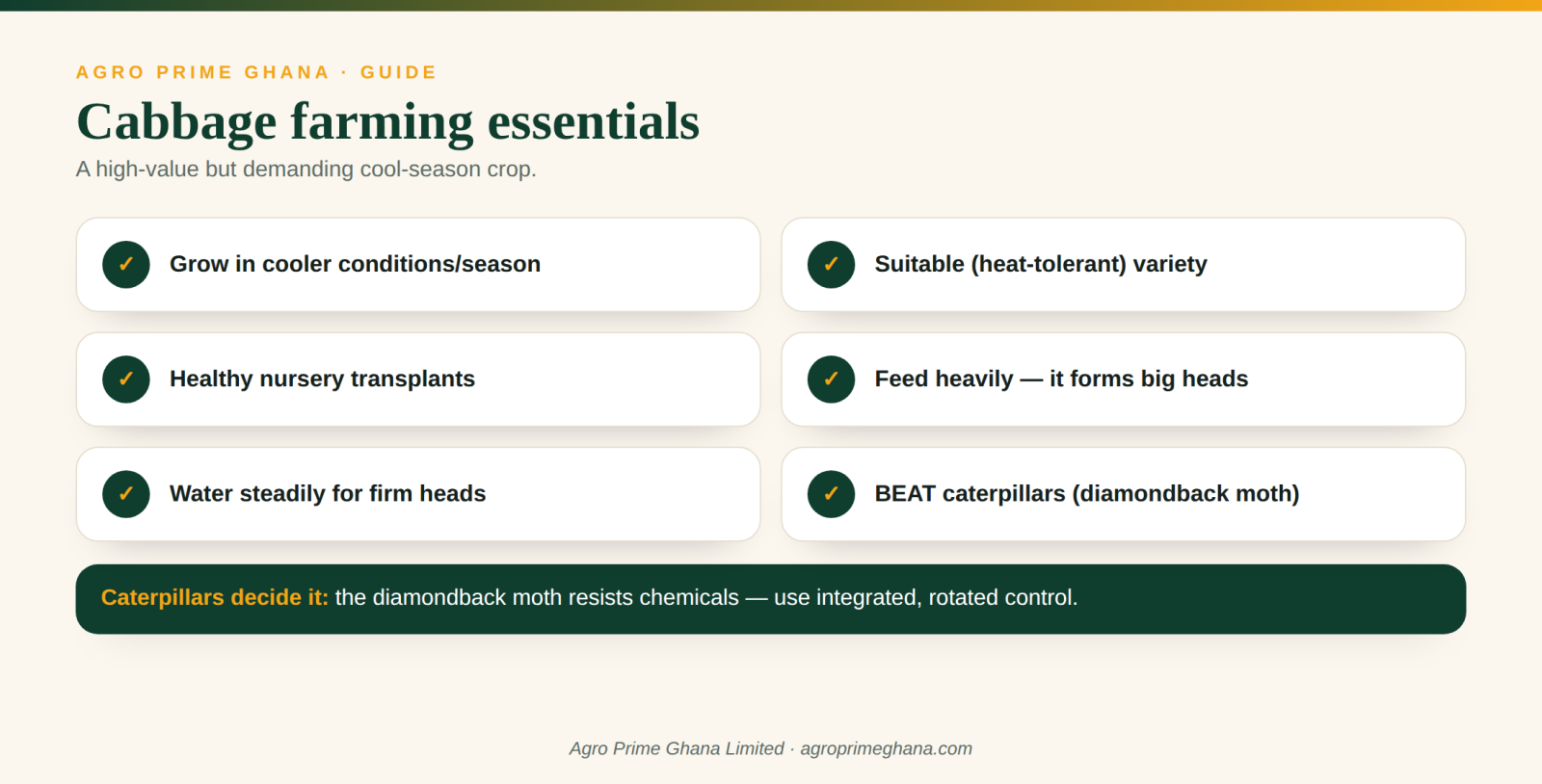
Cabbage is a high-value vegetable but a demanding, cool-season crop. Grow it in the cooler conditions or seasons (cooler areas, or dry-season irrigation), from healthy nursery-raised transplants, and feed it heavily — cabbage needs rich soil and good nutrition to form firm heads. Its biggest challenge is caterpillar pests (especially the diamondback moth) that destroy the leaves and heads; manage them with scouting and integrated, responsible control. Water steadily and harvest firm, clean heads for the best price.
Why cabbage is a high-value crop
Cabbage earns its place through strong value and demand. It sells well to households, market traders, hotels, restaurants, caterers and the growing salad and fast-food trade, and good-quality firm heads command a good price, making cabbage one of the more lucrative vegetables when grown well. Demand is steady and, in urban and institutional markets, quite reliable. Cabbage is also fairly productive per area when it heads well. The catch — and the reason it rewards skill — is that cabbage is genuinely demanding: it is a cool-season crop grown in a hot climate, so timing and location matter; it is a heavy feeder that needs rich soil and good nutrition to form firm heads; and it is a magnet for destructive caterpillar pests that can ruin a crop. This combination of high value and real difficulty is exactly why cabbage pays those who grow it properly: the strong price rewards a good crop of firm, clean heads, while careless growing — poor timing, weak feeding, or unmanaged pests — gives loose, small, pest-eaten heads that sell for little. Cabbage is a crop to grow deliberately and manage attentively, and for the farmer who does, it is among the more profitable vegetables available.
Timing and conditions: a cool-season crop
The first key to cabbage is understanding that it is a cool-season crop being grown in a warm country, so timing and conditions matter more than for many vegetables. Cabbage forms firm heads best in cooler conditions; in excessive heat it struggles to head properly, is more stressed and pest-prone, and gives poorer results. So the practical strategies are to grow cabbage in the cooler areas where climate allows (higher, cooler locations suit it better) and/or in the cooler part of the year and the dry season under irrigation, timing the crop to avoid the worst heat and to mature in more favourable, cooler conditions. Choosing a variety suited to the conditions — including heat-tolerant varieties bred to head in warmer climates — is also important, using good-quality seed. Growing cabbage at the wrong time (into peak heat) or without a suitable variety is a common reason for poor, loose heads. Matching the crop to cooler conditions — by location, season and variety — sets cabbage up to form the firm heads that sell well, and it is a decision to get right before planting, because no amount of later care fully compensates for growing a cool-season crop in the wrong heat.
Nursery, transplanting and feeding
Like tomato and pepper, cabbage is raised in a nursery and transplanted, and it demands rich feeding. Raise the seedlings in a well-managed nursery to get strong, uniform, healthy transplants, protecting them and watering carefully, then transplant healthy seedlings at the right age into a well-prepared field at proper spacing. The field must be fertile and well-prepared, because cabbage is a heavy feeder: forming a large, firm head takes a lot of nutrition, so cabbage needs rich soil and good, balanced feeding to produce well — underfed cabbage gives small, loose, poor heads. Provide good fertility (organic matter and appropriate feeding) to meet the crop's high demands. Cabbage also needs steady, consistent moisture for good, even growth and firm head formation, so water it regularly (irrigation is essential for dry-season crops), while keeping the field well-drained. Weed while the crop establishes. Strong, healthy transplants set into rich, well-prepared soil, fed and watered well, are the foundation of firm, marketable heads — but they must then be protected from the crop's great enemy, the caterpillars, covered next.
The big challenge: caterpillar pests
Here is what most decides success or failure in cabbage: caterpillar and insect pests, above all the diamondback moth. Cabbage (and its relatives) are attacked by a range of leaf-eating caterpillars — the diamondback moth larvae most notoriously, plus other caterpillars and worms, and sucking pests like aphids — that riddle the leaves with holes and bore into and destroy the heads, ruining the crop's quality and marketability. The diamondback moth in particular is a persistent, serious and hard-to-control pest that has developed resistance to many insecticides, making it a real challenge. Left unmanaged, these pests can devastate a cabbage crop. Controlling them is central to cabbage growing and rests on an integrated approach: scout the crop regularly and act early; use tolerant varieties where available; keep the field clean and rotate cabbage with unrelated crops (not following cabbage or other brassicas repeatedly, which builds up pests); encourage natural enemies; and apply appropriate, responsible control measures — rotating between different products to combat resistance, using recommended and biological options where suitable, and always observing safety and pre-harvest intervals since the crop is eaten. Because the diamondback moth resists many chemicals, relying on one product or heavy spraying alone fails; sensible, integrated, well-timed management works far better. The farmers who master caterpillar control produce clean, firm, marketable heads; those who neglect it lose much of the crop to holed, spoiled heads. Managing the caterpillars, especially the diamondback moth, is the key skill in cabbage farming.
Harvest, marketing and the economics
Cabbage is harvested when the heads are firm and well-formed, cutting them at the right stage — before they become over-mature or split — and handling them reasonably carefully, as clean, firm, undamaged heads sell best. Because well-headed cabbage sells for a good price to households, markets, hotels, restaurants and caterers, producing firm, clean, good-sized heads is what captures the crop's value; loose, small or pest-eaten heads fetch far less. On economics, cabbage can be highly profitable but reflects its demands: costs include seed and nursery, land preparation, generous fertiliser (for a heavy feeder), water and irrigation (especially dry-season), and — significantly — the pest control that cabbage cannot do without. Against that, a good crop of firm heads sold into strong demand earns well given cabbage's high value. The main risks are the crop's challenges: growing at the wrong time or in too much heat (poor heading), underfeeding (small loose heads), and above all pest damage (holed, ruined heads) — all of which the disciplines above address. So cabbage profitability depends on getting the whole package right: cool-season timing and a suitable variety, strong transplants, rich feeding and steady water, and disciplined, integrated caterpillar control. Grown this way, cabbage is one of the more rewarding vegetables a Ghanaian farmer can produce; grown carelessly, it disappoints despite its value. Know your costs, grow deliberately, and cabbage repays the effort with strong returns.
Common mistakes to avoid
- Growing into peak heat, so a cool-season crop fails to head firmly — time it for cooler conditions or dry-season irrigation and use a suitable variety.
- Neglecting caterpillar control, letting the diamondback moth and other caterpillars ruin the heads — the number-one cause of failure.
- Relying on one insecticide, against a resistant pest — use integrated, rotated, responsible control.
- Underfeeding a heavy feeder, giving small, loose heads.
- Irregular watering, causing poor, uneven heading.
- Growing cabbage repeatedly on the same land, building up pests instead of rotating.
Frequently asked questions
Is cabbage farming profitable in Ghana?
Why is timing so important for cabbage?
What is the main pest of cabbage?
How do I control the diamondback moth?
Does cabbage need a lot of fertiliser?
Do I need a nursery for cabbage?
Can I grow cabbage in the hot lowlands?
When should I harvest cabbage?
The bottom line on cabbage farming
Cabbage is a high-value, high-reward vegetable — but a demanding one that pays those who grow it deliberately and manage it well. Its value in markets, hotels and restaurants rewards firm, clean, well-formed heads, while careless growing gives loose, small, pest-eaten heads worth little. Success rests on respecting what cabbage needs. It is a cool-season crop, so timing and conditions come first: grow it in cooler areas or the cooler season and dry-season irrigation, with a suitable, often heat-tolerant variety, to let it head firmly. It is a heavy feeder raised from nursery transplants, so it needs rich soil, good feeding and steady water to form good heads. And above all, it is besieged by caterpillar pests — the diamondback moth foremost — that must be managed through disciplined, integrated, resistance-aware control, since they otherwise ruin the crop. Get the timing, variety, feeding, watering and pest control right, and cabbage rewards the Ghanaian farmer as one of the more profitable vegetables there is — a demanding crop, but a genuinely lucrative one for the grower who masters it.
Grow a high-value vegetable the right way
Agro Prime Ghana Limited runs a hatchery and agribusiness in Kasoa. High-value crops like cabbage reward careful, deliberate management. Talk to us about building a resilient, profitable farm: book a visit or message WhatsApp (+233 24 915 1503).