Protein is the most expensive part of any poultry ration, and in Ghana it is also the least secure: soybean and fishmeal prices swing hard, quality is inconsistent, and every rise feeds straight through to the cost of raising a bird. That is why a fast-growing water fern called azolla keeps coming up among farmers looking to cut feed bills. Azolla floats on still water, doubles its mass in days, fixes its own nitrogen through a partnership with a cyanobacterium, and dries into a green meal carrying 20–40% crude protein — grown on a pond in your own yard. It is not a magic replacement for soybean, and it has genuine limits. But used sensibly as a supplement, azolla can trim feed costs, deepen yolk colour and support performance. This guide explains what azolla is, what the research really shows, how to grow and feed it in Ghana, and where it fits — and does not fit — in a ration.
Written by the Agro Prime Ghana poultry team and reviewed against peer-reviewed poultry-nutrition research (Livestock Research for Rural Development and Animal journal feeding trials on Azolla). Last updated September 2026.
Key takeaways
Azolla is a floating water fern whose dried meal contains roughly 20–40% crude protein (about 25.6% in one layer study) plus a useful spread of amino acids, minerals, vitamins A and B12, and a high carotene content of 206–619 mg/kg that deepens yolk colour. In a layer trial, including azolla at 2.5–7.5% of the diet raised hen-day egg production and egg mass, improved feed conversion, lifted egg quality and pushed yolk colour score from 3.9 up to about 10 at 7.5% — while lowering feed cost per hen. In broilers, 5% azolla leaf meal improved starter growth and increased jejunal villus height by nearly 30%. It is best used as a modest supplement (up to about 5–7.5%), not a wholesale soybean replacement, because its bulk and fibre limit how much a bird can eat.
What azolla is, and why it interests poultry farmers
Azolla (commonly Azolla pinnata) is a tiny aquatic fern that floats in a green carpet on still or slow water — ponds, paddies, tanks and ditches. Its agricultural fame comes from a trick few plants can manage: it hosts a nitrogen-fixing cyanobacterium (Anabaena azollae) in its leaves, so it pulls nitrogen straight from the air and builds protein without added fertiliser. That is why rice farmers across Asia have used it for centuries as a green manure, and it is exactly why it interests feeders. A plant that manufactures its own protein, grows explosively on water and needs no arable land is a compelling proposition where protein feed is costly and land is contested.
The numbers back up the interest. According to a review of azolla as poultry feed and a layer feeding trial published in Livestock Research for Rural Development, azolla meal typically carries between 20% and 40% crude protein on a dry-matter basis — the cited study measured 25.56% — along with essential amino acids including lysine, arginine, methionine, leucine and valine. It also supplies iron, calcium, magnesium, phosphorus, manganese and potassium, appreciable vitamin A and vitamin B12, and a notably high carotene content of 206 to 619 mg/kg. That carotene matters commercially: it is a natural pigment that deepens egg-yolk colour, which many Ghanaian buyers prize.
What azolla does not do: the energy and bulk problem
Before getting carried away, be honest about azolla's ceiling, because this is where farmers get disappointed. Azolla is high in water and fibre and relatively low in energy — the same layer research reports a metabolisable energy of only about 1,614 kcal/kg of dry matter, well below maize. A bird has limited gut capacity, so a bulky, watery, fibrous ingredient fills it up before it delivers enough calories. This is why azolla is a supplement, not a base ingredient: push the inclusion too high and total intake, energy and growth suffer, even though the protein looks attractive on paper. The art is to capture azolla's protein, pigment and micronutrient benefits at a modest inclusion without letting its bulk drag down energy — the same balancing act that governs all least-cost formulation, which our guide to poultry feed ingredients works through.
What the research shows at sensible inclusion rates
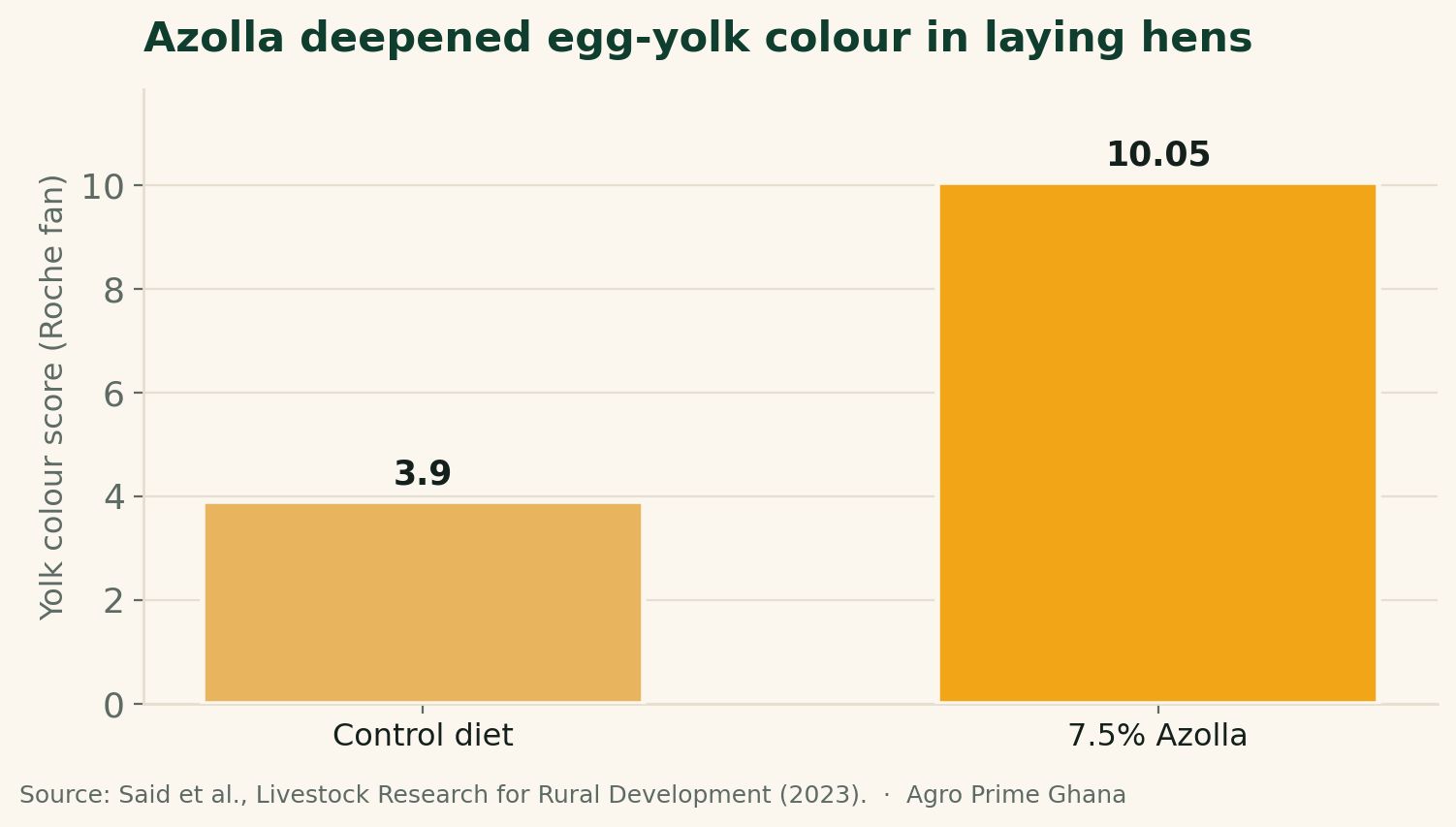
The good news is that at modest levels, the evidence is genuinely encouraging. In the layer trial reported by Livestock Research for Rural Development, hens were fed azolla at 0%, 2.5%, 5% and 7.5% of the diet. Across those levels, hen-day egg production and egg mass were significantly higher than the control, feed conversion improved as azolla rose, and daily feed intake was unaffected — the hens kept eating normally and simply performed better. Egg quality improved too: albumen height, Haugh unit and shell thickness all increased at higher inclusions, and egg weight peaked (around 55–57 g) at 5%. Most visibly, yolk colour score climbed from 3.9 in the control to about 10.05 at 7.5% azolla — a dramatic deepening driven by that high carotene content. And crucially, feed cost per hen fell as azolla replaced more expensive ingredients.
Broilers show a similar pattern. A feeding trial published in the journal Animal found that azolla leaf meal at 5% of the diet improved body weight and feed intake in the starter and grower phases, gave a better feed-conversion ratio in the starter phase, and increased jejunal villus height by 29.8% versus the control. The table lines up the documented effects at practical inclusion rates.
| Measure | What azolla did (at 2.5–7.5%) | Practical read for your flock |
|---|---|---|
| Crude protein of azolla meal | ~25.6% (range 20–40% DM) | A real protein contributor from a home-grown ingredient |
| Egg production & egg mass | Significantly higher than control | More eggs from the same flock, at modest inclusion |
| Feed conversion | Improved as azolla increased | More output per kilo of feed |
| Yolk colour score | 3.9 (control) → ~10 at 7.5% | Deeper, more marketable yolks that many buyers prefer |
| Egg quality (Haugh, shell) | Albumen height, Haugh unit, shell thickness up | Better internal and shell quality |
| Feed cost per hen | Reduced with rising azolla | Lower feed bill — the headline attraction |
| Broiler gut (5% ALM) | Jejunal villus height +29.8% | More absorptive gut surface in growing birds |
How to grow azolla in Ghana
Azolla's appeal is that it is cheap and fast to produce with almost no inputs, which suits smallholder and medium farms perfectly. The basic method is well within reach of any poultry keeper with a bit of space and water:
- Make a shallow bed. A pit, tank or plastic-lined pond roughly 10–20 cm deep works well. Azolla is a surface plant, so surface area matters more than depth. A partly shaded spot suits it — harsh sun and very high temperatures scald it, while deep shade slows growth.
- Add water and a little soil. Put fertile soil or pond mud on the bottom and fill with clean water. A little well-rotted manure or a pinch of phosphorus supports rapid growth, since phosphorus is azolla's main need (it fixes its own nitrogen).
- Seed with fresh azolla. Spread a starter culture of live azolla across the surface. In warm Ghanaian conditions it multiplies fast — roughly doubling within days — so a small start quickly becomes a full green mat.
- Harvest regularly. Once the surface is covered, scoop off a portion every few days with a net, letting the rest keep growing. Regular harvesting keeps the bed productive; letting it overcrowd slows it and can cause die-off.
- Rinse, then feed fresh or dried. Rinse harvested azolla to remove mud. Feed it fresh (chopped into feed or offered directly, especially to layers and scavenging birds) or sun-dry it into a meal that stores better and blends into a ration at a set percentage.
Fresh feeding is simplest for backyard and small layer flocks; drying into a meal is better when you want precise, consistent inclusion in a formulated ration. Either way, cleanliness matters — azolla grown in dirty or contaminated water carries whatever is in that water into your birds.
Field note: keep the pond clean and the harvest steady
Two habits separate a productive azolla bed from a slimy, disappointing one. The first is clean water and a steady, light feeding of the bed — azolla wants phosphorus and a little shade, not a stagnant, algae-choked pit. The second is harvesting little and often rather than letting the mat get thick and rot underneath; a bed you skim every few days keeps throwing out fresh growth, while a neglected one crashes. Treat the bed as a small crop that needs a few minutes on a routine, and it will quietly produce green feed week after week for very little money.
Feeding azolla the right way
The research points to a clear rule: keep azolla a supplement of about 2.5% up to roughly 5–7.5% of the diet, using it to add protein, pigment and micronutrients rather than to carry the ration. Within that band, layers gained in egg output, egg quality and yolk colour while feed cost fell, and broilers gained in early growth and gut development. Push much beyond it and azolla's low energy and high bulk limit intake and dilute the diet, so growth and production suffer — the very outcome you were avoiding. Introduce it gradually, watch feed intake and body condition as with any ration change, and lean toward the lower end for young, fast-growing broilers with high energy demand, and the middle-to-upper end for layers where the yolk-colour and egg-quality benefits are most valued.
It also pairs with other home-grown strategies: a farm mixing its own feed can slot dried azolla meal in alongside its maize and protein sources at a fixed percentage — see our guide to making poultry feed — as one tool for shaving cost off the ration without cutting quality.
Field note: value it for cost and colour, not as a soybean replacement
The mistake we most often see is farmers expecting azolla to swap out soybean or fishmeal pound-for-pound. It cannot — its energy is too low and it is too bulky to shoulder that load. Where it earns its place is at the margin: a few percent that brings home-grown protein, a real lift in yolk colour buyers notice and pay for, and a small but real cut in feed cost per bird. Grown on water you already have, on land you are not using, it is close to free feed value — and for a layer farm selling on yolk colour, the deeper yolks alone can justify the pond.
The honest limitations
To use azolla well you must respect what it cannot do. Its low energy density and bulk cap the inclusion rate, so it will never be a ration's backbone. Fresh azolla is about 90% water, so large fresh quantities deliver less dry nutrition than their volume suggests, and drying costs labour and sun. Quality and protein content vary with how it is grown — water, nutrients, temperature and harvest timing all shift the numbers — so the meal is less standardised than a bagged ingredient. Growing it needs a reliable clean water source and steady management, and as with any green feed grown in open water, contamination is a real risk if the water is dirty. None of these are reasons to avoid azolla; they are reasons to use it deliberately, at a sensible rate, grown cleanly, as part of a balanced ration rather than a shortcut around one.
The bottom line on azolla
Azolla is one of the more genuinely useful low-cost feed ideas open to Ghanaian farmers — a fast-growing water fern that manufactures its own protein, needs no arable land, and dries into a green meal of 20–40% crude protein rich in carotene, amino acids and micronutrients. Fed as a modest supplement of a few percent up to about 5–7.5% of the diet, the research shows it can raise egg production and quality, improve feed conversion, deepen yolk colour markedly, support early broiler growth, and — the point that matters most on a tight budget — lower feed cost per bird. Its limits are equally clear: too bulky and too low in energy to replace soybean or carry a ration, and its quality depends on how cleanly it is grown. Treat it as a smart supplement rather than a miracle, grow it on a well-managed pond, keep it in the right range, and azolla becomes a quiet, renewable way to feed your flock better for less.
Frequently asked questions
What is azolla and can chickens eat it?
How much protein does azolla have?
What percentage of azolla can I include in poultry feed?
Does azolla improve egg yolk colour?
Can azolla replace soybean meal in poultry feed?
How do I grow azolla for my chickens?
Should I feed azolla fresh or dried?
Are there any risks with feeding azolla?
Sources & further reading
- Livestock Research for Rural Development, 2023 — Effect of inclusion of graded levels of Azolla meal in layers diets on productive performance and egg quality (crude protein, carotene, inclusion rates, egg production, yolk colour and feed-cost findings).
- Animal (journal), 2021 — Azolla leaf meal at 5% of the diet improves growth performance and intestinal morphology in broiler chicken (broiler growth and jejunal villus-height effects).
- Agro Prime Ghana guides: poultry feed ingredients and how to make poultry feed.
About Agro Prime Ghana
Agro Prime Ghana Limited runs a poultry hatchery and mixed agribusiness in Kasoa, supplying day-old chicks and supporting poultry keepers nationwide. These guides combine hands-on hatchery and farm experience with peer-reviewed poultry-nutrition research. This article is general educational information, not a substitute for advice from a qualified poultry nutritionist tailored to your flock, ingredients and conditions. Need chicks, feed advice or farm support? Book a visit or message us on WhatsApp (+233 24 915 1503).