
Think of a poultry house as a room that rents out your money. You put cedis in at placement, the birds grow for six or seven weeks, and the money comes back when they leave for market. An empty house earns nothing. A house that cycles well for most of the year does the work of several. Running a second or third house is mostly a matter of keeping every room on its own steady rhythm.
This guide works through the economics of several houses using the figures we work with at Agro Prime Ghana Limited in Kasoa. Where we show a calculation, it is an illustration built from those figures. It is not a forecast of what your houses will earn, and that difference matters more the more houses you run.
Count the house in batches, not in months
A house does not pay a monthly wage. It pays per batch. A well-run cycle takes chicks from placement through six to seven weeks of growth, to market weight of about 2.3 to 2.55 kg live. The birds are sold, the house is cleaned out and rested, and then the next chicks come in. From placement to payout, the whole loop runs about eight weeks, clean-out included.
That loop is why a house can run five or six batches a year rather than four. Five or six is a ceiling, not a target. Every batch lost to disease, and every week a house sits empty while you wait for money or labour, takes a batch off the count. When you plan a second house, use the count you can realistically hit with your own management, then compare it with the best case. The cash timing behind that loop is set out in our guide to poultry cash flow and break-even in Ghana, and it is worth reading before you multiply anything.
What one batch actually ties up
Start with a single 1,000-bird batch, the size we recommend for a partnership. Three cost lines do most of the work. Day-old broiler chicks are from GH₵20 at Agro Prime, and the hatchery vaccinates at day 0. Feed is the big one, at roughly 4.2 kg per bird from day old to market. Everything else, including brooding heat, litter, vaccines and vitamins, labour and utilities, comes to about GH₵12 a bird. If you want the hatchery side of the chick price, our page on day-old chicks in Ghana covers it.
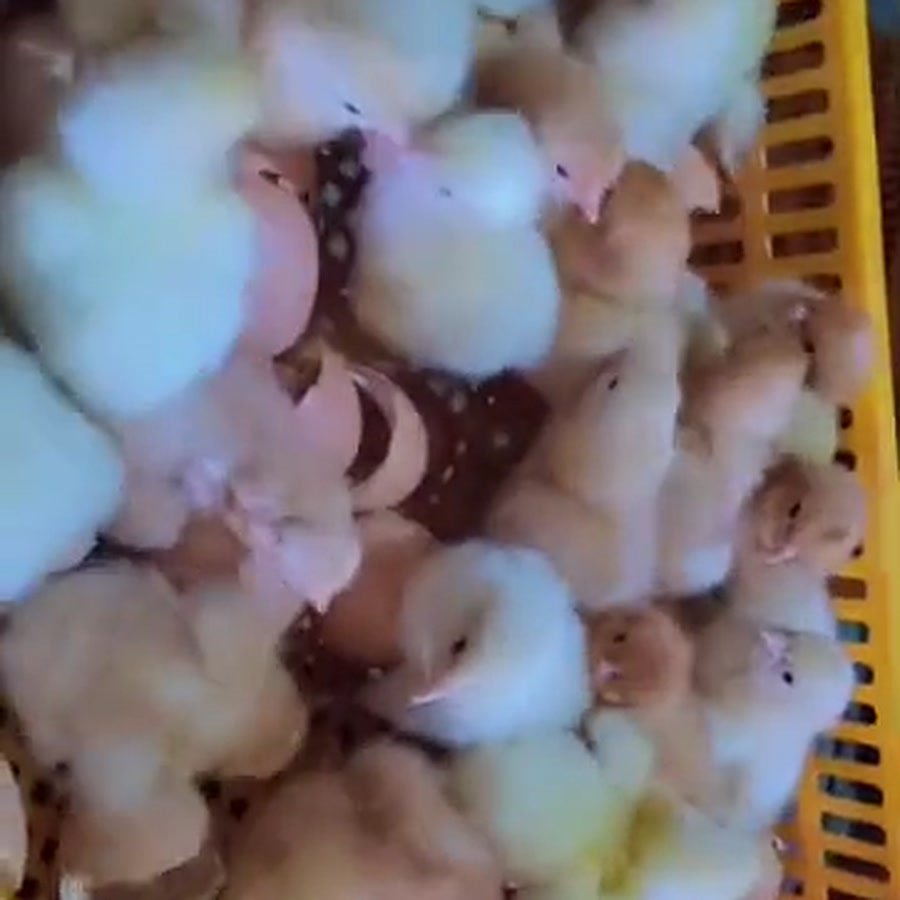
Feed is the line that surprises people most. A 50 kg bag of broiler starter sells for GH₵400 to GH₵410 at GAPFA member prices and GH₵451 to GH₵472 at De Heus list prices. One 1,000-bird batch needs about 4,200 kg of feed across its life, which is 84 bags. That makes feed more than half of the total cost of the batch, and it is the line most worth planning around.
Buying feed in larger lots only pays if you can store it properly. Feed kept damp or in the heat loses quality, and a bag that spoils costs more than the discount it saved. Plan storage space for the batch you are placing and the next one, rather than stocking up for the whole year.
The table turns those figures into a batch budget. The feed row appears twice because the price you pay changes the answer, and the total moves with it.
| Cost line for 1,000 birds | How it is worked out | Amount (GH₵) |
|---|---|---|
| Day-old chicks | 1,000 at GH₵20 | 20,000 |
| Feed at GAPFA member prices | 84 bags at GH₵400 to GH₵410 | 33,600 to 34,440 |
| Feed at De Heus list prices | 84 bags at GH₵451 to GH₵472 | 37,884 to 39,648 |
| Other costs | 1,000 birds at about GH₵12 | 12,000 |
| Total, member-price feed | Chicks, feed and other costs | 65,600 to 66,440 |
| Total, list-price feed | Chicks, feed and other costs | 69,884 to 71,648 |
These are illustrative sums built from the cost lines above, not quotes. Both totals sit inside the GH₵65,000 to GH₵80,000 that a 1,000-bird batch typically needs from chick to market. The gap between the two feed rows, roughly GH₵3,400 to GH₵6,000 on a single batch, is where buying terms earn their keep.
Notice when the money moves. Much of the cost is committed at placement, in the chicks and the first feed purchases, while the income arrives roughly eight weeks later. Every extra house is another place where that gap has to be financed, which is why working capital matters as much as the per-bird margin.
Each house needs that money again at every placement. The capital goes out when the chicks arrive and comes back at payout, so a house running five batches a year cycles the same sum five times. Two houses on the same timetable need twice the cash at the same moment, which is the main reason to stagger them.
Two houses on one calendar
Here is a sketch of two houses, each running five batches of 1,000 birds in a year. That is 10,000 birds placed. At 4 per cent mortality, which sits inside the well-managed band of 3 to 5 per cent, about 9,600 birds reach market. At a normal-cycle profit of GH₵12 to GH₵20 per bird sold, the year comes to roughly GH₵115,200 to GH₵192,000.
Treat that as arithmetic, not a plan. It assumes every batch runs to the normal cycle, that sale prices hold, and that management stays steady across both houses. Check your own figures for anything the per-bird costs do not cover, such as rent for the site or repairs to a shed, before you compare the result with a salary, a loan or a job offer.
Two houses also double the sales side. Each house produces its own sale, so the plan means two sale windows per cycle rather than one. The next section looks at where money tends to leak out of that arrangement.
Attention is the other limit. Each house needs its placements, weights, feed counts and clean-out dates tracked on time, and a missed date in one house can push the next batch into the wrong part of the year.
Where the money leaks
Most of the drag on a multi-house operation comes from four places, and none of them is exotic. The first is feed buying. Depending on which member and list prices you compare, the gap runs from about GH₵41 to GH₵72 a bag. On the 84 bags for one batch, that is roughly GH₵3,400 to GH₵6,000. Across five batches in a single house, the same gap comes to roughly GH₵17,000 to GH₵30,000.
Idle time is the second drag. Every week a house sits empty between batches is a week off its loop. The gap between five and six batches a year is one extra batch of 1,000 birds per house. At the normal-cycle margin of GH₵12 to GH₵20 per bird, that single extra batch is worth roughly GH₵12,000 to GH₵20,000 to that house. Clean-out and restocking are where the time goes, so they belong on the calendar as firmly as placements do.
Sale timing is the third. Quiet months sell around GH₵75 to GH₵80 a live bird, while Christmas, Easter and Eid push prices above GH₵100. Two houses finishing in the same week make one larger sale to move, and you will feel that in the price you get. Spreading finish dates is the simplest defence against it.
Records are the fourth. When several houses run at once, a missed mortality count or a feed delivery logged against the wrong house makes every later decision harder. Clean records let you see which batch cost more and why. Patchy records leave you guessing. A simple weekly summary per house, covering placements, mortality, feed used and the sale date, is enough to compare houses honestly.
Run the second-house numbers yourself
Use the batch calculator on our partner page to test your own assumptions against the figures in this article. Change them until they match what you expect to see. If you would rather check the numbers on the ground, a farm visit can be arranged Monday to Saturday from 7am to 6pm. Start at the batch calculator or read the full partner details.
Mortality is a multiplier, not a line item
Mortality is easy to type into a spreadsheet as a single percentage and hard to feel until it happens. A well-managed house loses 3 to 5 per cent of its birds. A house with poor management or disease can lose 10 to 20 per cent. Take 1,000 chicks at a quiet-month sale price of GH₵75. At 3 per cent mortality, 970 birds reach market. At 20 per cent, only 800 do.
The difference is 170 birds, or GH₵12,750 of sales at GH₵75 each. The chicks and feed for the 200 birds that died were paid for anyway, so the cost side of the table does not shrink to meet the lost sales. At the top of the loss range, the cycle's profit can disappear altogether. Run two houses with the same management habits and the same weakness, and that risk is doubled rather than diluted.
A practical response to rising mortality starts with the record. Note the day the deaths begin, the house, the feed batch and any change in routine. A pattern across two houses points to something shared, such as feed, water or the same people working both sheds. A pattern in one house points to that house. Either way, a house that loses more birds than its neighbours is telling you something, and the earlier you read it, the less of the batch you lose.
Be wary of anyone offering fixed returns
No honest broiler operation can promise a fixed monthly return, and a multi-house plan does not change that. Returns depend on batch costs, mortality and the price you get on the day. The Securities and Exchange Commission in Ghana has warned the public about schemes that promise fixed returns, and a promise of "a set percentage every month" should make you ask where the risk has gone. Our model is a profit share under a written agreement, signed before placement, so your return moves with the real figures.
Running several houses without losing track
The operational side scales less neatly than the money. One house can be run by someone who knows every bird by sight. Two or three houses need routines written down: a placement checklist, a daily record of mortality and feed, and a weight check done the same way every week. Our partnership reports follow that pattern, with a photo, weight, feed and mortality record every Thursday, because a number only means something when it is recorded the same way each time.
Clean-out deserves its own slot in the plan. It is where a second house most often loses its place in the calendar, because cleaning, disinfecting and resting the shed all have to happen between batches, and each step can run late. Mark each house's clean-out dates in the same calendar as its placements. A house that looks ready on paper but is still damp when the chicks arrive has already cost you part of a batch.
A simple rule helps here. Do not open a new house until the existing one has completed a full cycle on time, with its clean-out finished inside the planned window. If the first house has not yet done that, the second will inherit the same problems at double the scale. Treat the first house's records as the test, not your confidence in the plan.
Deciding on the second house
A second house makes sense when the first one runs on time, the feed is bought on terms you can live with, and clean-out fits the calendar without strain. Until then, another house mostly doubles the places where things can go wrong. Run the first house through a few full cycles, keep the same records every week, and let those records tell you whether the eight-week loop holds.
If you are weighing a partner batch alongside your own houses, the partner page sets out the profit-share terms, the weekly reporting and how payouts work. Payments only ever go to the Agro Prime Ghana Limited company account, and payouts reach you by bank or MoMo days after the final sale.
For the wider picture on how contract broiler arrangements are usually structured, see contract broiler farming in Ghana.

